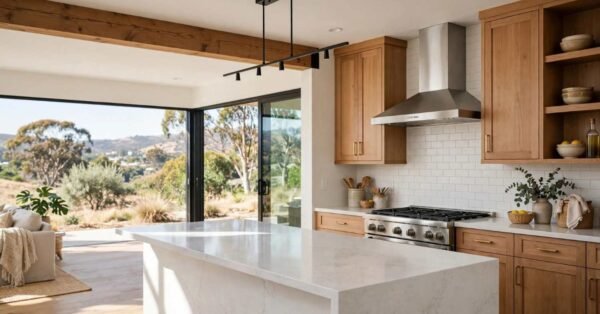
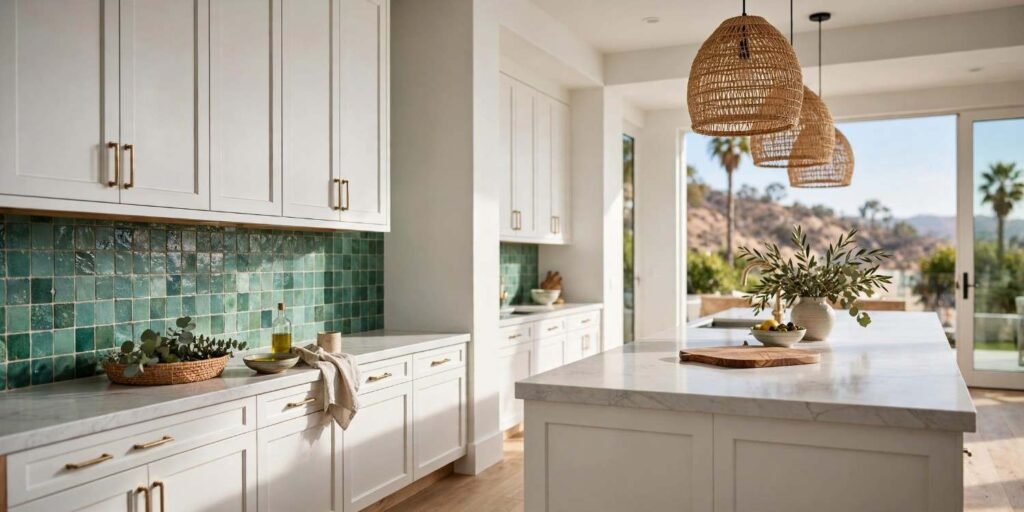
A kitchen backsplash is the protective and decorative wall surface installed between the countertop and upper cabinets, typically made from tile, stone, metal, or slab material. It shields the wall from grease, water, and food splatter while anchoring the kitchen’s overall design. For anyone planning a custom build or remodel in California, the backsplash decision touches both function and first impressions.
Getting this choice wrong means redoing tile work mid-project or living with a kitchen that feels disconnected from the rest of the home.
This guide covers what a backsplash actually does, the styles and materials most common in California kitchens right now, how patterns and color choices come together, what durability and cost really look like, and how to time the decision correctly during a new build.
What Is a Kitchen Backsplash and Why Does It Matter?
A kitchen backsplash protects the wall area behind countertops and stovetops from moisture, heat, and stains while serving as a key visual element in the room. I think of it as the one surface in the kitchen that works this hard and still gets judged purely on looks.
Builders and designers treat the backsplash as a functional boundary, not just trim. It stops water from countertop splashes and cooking grease from soaking into drywall, which matters most directly behind the sink and range.
Function vs. Decoration – What a Backsplash Actually Does
The backsplash absorbs daily wear that paint and drywall were never built to handle. Heat from a range, oil splatter, and repeated wiping all land on this one surface, which is why material choice matters as much as style.
I always tell clients that a backsplash earning its keep structurally will still look good in ten years, long after a purely decorative choice has started to show wear.
Popular Kitchen Backsplash Styles for California Homes

Kitchen backsplash styles in California homes currently lean toward natural textures, warm neutrals, and clean geometric patterns that pair with indoor-outdoor living spaces. Coastal light and open floor plans push most of our clients toward lighter palettes and less visual clutter than a decade ago.
Modern & Minimalist Backsplash Styles
Modern backsplash design favors large-format tile or slab material in a single continuous surface, minimizing grout lines and visual noise. We see this most in open-concept kitchens where the backsplash needs to recede rather than compete with cabinetry or an island.
A monochromatic palette paired with matte finishes reads as calm and contemporary without feeling cold.
Farmhouse & Transitional Backsplash Styles
Farmhouse-style kitchens favor handmade-look ceramic tile in soft whites and creams, often set in a brick-lay pattern. This style photographs beautifully, but its slightly irregular tile edges can complicate grout maintenance compared to rectified porcelain.
Transitional kitchens blend this warmth with cleaner cabinetry lines, splitting the difference between farmhouse charm and modern simplicity.
Coastal & Mediterranean-Inspired Styles
Coastal and Mediterranean styles bring in hand-painted tile, blues and terracottas, and irregular mosaic work that suits California’s climate and architectural history. These looks work especially well in homes with Spanish or Mediterranean Revival exteriors, tying interior finishes to the building’s character outside.
Traditional & Classic Subway Styles
Subway tile remains the most requested backsplash pattern because it is affordable, timeless, and easy to source in nearly any color. Its straightforward rectangular shape also simplifies installation, which keeps labor costs predictable compared to more intricate mosaic work.
Tile Materials: Ceramic, Porcelain, and Glass

Ceramic, porcelain, and glass are the three most common kitchen backsplash tile materials, each offering a different balance of cost, durability, and visual effect. Choosing between them comes down to how much daily abuse the wall near your stove and sink will realistically take.
Ceramic Tile – Pros, Cons, and Best Uses
Ceramic tile is a fired clay tile that is glazed for color and water resistance, making it one of the most affordable backsplash options available. It’s porous at the core, so any chip in the glaze can expose the material underneath to moisture over time.
I recommend ceramic for lower-traffic kitchen zones or secondary prep areas where budget matters more than maximum durability.
Porcelain Tile – Durability and Design Range
Porcelain tile is a denser, less porous fired clay product that resists water absorption and chipping better than standard ceramic. Because of that density, porcelain handles the heat and moisture near a range top with noticeably less wear over a decade of daily use.
It also comes in an enormous range of finishes now, including convincing stone and wood-look patterns.
Glass Tile – Visual Impact and Maintenance
Glass tile reflects light in a way no other backsplash material matches, which is why it shows up so often behind ranges and in accent strips. The tradeoff is that glass scratches more easily than porcelain and shows water spots more visibly, so it needs more frequent wiping to stay looking sharp.
Natural Stone Backsplash Materials
Natural stone backsplashes use quarried materials like marble, granite, travertine, or slate to bring unique veining and texture that manufactured tile can’t replicate. Every slab is different, which is exactly the appeal for homeowners chasing a one-of-a-kind look.
Marble Backsplashes
Marble is a metamorphic stone prized for its dramatic veining, though it etches when it contacts acidic substances like lemon juice or wine. I still recommend it often for clients who accept that a little patina develops character rather than damage.
Granite and Quartzite Backsplashes
Granite and quartzite are harder, more stain-resistant natural stones that hold up better than marble under daily kitchen use. Quartzite in particular has become popular because it mimics marble’s veining while resisting etching far better.
Travertine and Slate Backsplashes
Travertine brings a warm, textured, slightly rustic surface often used in Mediterranean and farmhouse-style kitchens. Slate offers a darker, more matte alternative that hides water spots and fingerprints better than polished stone finishes.
Engineered & Alternative Materials
Engineered and alternative backsplash materials include quartz slabs, stainless steel, and peel-and-stick products, each solving for a different combination of durability, style, and budget. These options have grown fast because they sidestep some of natural stone’s maintenance demands entirely.
Quartz Slab Backsplashes
Quartz slab is an engineered stone made from crushed quartz and resin that resists staining and etching far better than natural marble. It also enables the continuous slab look, since a single piece can run from countertop to upper cabinet with zero grout lines.
Stainless Steel and Metal Backsplashes
Stainless steel backsplashes are a professional-kitchen staple that resist heat, stains, and bacteria better than almost any other material. They scratch over time and show fingerprints readily, so most homeowners pair them with a brushed rather than mirror finish.
Peel-and-Stick and Budget-Friendly Options
Peel-and-stick backsplash tiles are adhesive-backed vinyl or composite panels designed for quick installation without mortar or grout. They work well as a temporary or rental-friendly solution but generally don’t hold up to direct heat exposure near a range the way tile does.
Backsplash Patterns and Layout Techniques
Backsplash pattern selection changes how a kitchen feels far more than material alone, with layout choices like herringbone and brick-lay shifting a space from traditional to dynamic. The same tile installed in two different patterns can produce completely different visual energy.
Subway, Herringbone, and Brick-Lay Patterns
The classic brick-lay pattern offsets each tile row by half a tile width, producing the familiar subway tile look. Herringbone arranges tiles at an angle in a zigzag, adding movement and requiring more precise cutting during installation.
Mosaic and Geometric Layouts
Mosaic layouts use small-format tile, often pre-mounted on mesh sheets, to create intricate patterns impractical with larger tile. Geometric layouts using hexagons, chevrons, or Moroccan-inspired shapes have become a defining feature of more design-forward kitchens.
Color Palettes and Design Coordination
Backsplash color coordination means selecting a tile or slab tone that complements both the countertop and cabinetry rather than competing with either. A backsplash chosen in isolation, without the rest of the kitchen’s palette in hand, is one of the most common remodeling regrets I hear about.
Matching Backsplash to Countertops and Cabinetry
A good rule I rely on is letting the busiest surface in the room, usually the countertop if it has heavy veining, set the palette, and keeping the backsplash quieter by comparison. When both surfaces compete for attention, the kitchen can start to feel visually overwhelming rather than cohesive.
Grout Color Strategy
Grout color shifts a tile’s appearance more than most homeowners expect, with matching grout creating a seamless look and contrasting grout emphasizing the pattern itself. Light grout also shows staining faster near a range, which is worth weighing against the visual effect you want.
Full-Height and Slab Backsplashes (The “Waterfall Wall” Trend)

A full-height backsplash extends from the countertop all the way to the upper cabinets or ceiling, creating one continuous design statement rather than a narrow strip of tile. This approach, sometimes paired with a waterfall-edge countertop in the same material, has become one of the most requested looks in new custom builds.
A Full-height slab eliminates the visual break between counter and wall, which reads as more luxurious but also carries a higher material and installation cost than a standard four-inch or eighteen-inch strip.
Kitchen Backsplash Trends for 2026
Kitchen backsplash trends for 2026 are moving toward textured, matte, and sustainably sourced materials that feel less uniform than the glossy subway tile era that dominated the last decade. Clients are asking for more individuality and tactile interest than a flat, reflective surface provides.
Emerging Textures, Finishes, and Sustainable Materials
Zellige tile, with its intentionally irregular, handmade surface, continues gaining ground because no two tiles reflect light the same way. Recycled glass and reclaimed stone are also showing up more often as homeowners weigh environmental impact alongside appearance.
Cost Factors: What Influences Backsplash Pricing
Kitchen backsplash cost depends primarily on material choice, pattern complexity, and square footage, with simple ceramic subway tile sitting at the low end and full-height natural stone slab at the high end. Two kitchens the exact same size can land thousands of dollars apart purely on these variables.
Material Cost vs. Installation Labor Cost
Material cost is only half the equation, since intricate patterns like herringbone or small-format mosaic require significantly more labor hours than a straightforward brick-lay subway install. A cheaper tile installed in a complex pattern can end up costing more overall than a pricier tile laid simply.
Durability, Maintenance, and Long-Term Performance

Backsplash durability varies widely by material, with porcelain, quartz, and stainless steel generally outperforming ceramic, marble, and peel-and-stick products under daily kitchen conditions. The area directly behind the range and sink sees the most stress, so I always ask clients to think about those specific zones first.
Heat, Moisture, and Stain Resistance by Material
Porcelain and quartz resist heat and staining better than ceramic or natural stone, which makes them the most forgiving choice behind a range. Natural stone like marble needs sealing and more careful cleaning to avoid etching from acidic spills.
Cleaning and Sealing Requirements
Sealed grout and non-porous tile surfaces require only routine wiping, while unsealed natural stone needs periodic resealing to maintain its stain resistance. Skipping that maintenance step is the most common reason a beautiful stone backsplash starts looking dull within a few years.
Installation Considerations for New Builds and Renovations
Backsplash installation in a new build happens after countertops are set and before final appliance installation, allowing tile setters to work around precise, already-measured surfaces. Getting this sequence wrong is one of the more common coordination mistakes on a custom build.
Timing the Backsplash Install in the Build Sequence
Countertop templating has to be finalized first, since the backsplash height and edge details depend on exact countertop dimensions. I schedule backsplash work right after countertop installation and before the range and hood go in, which protects the finished tile from installation damage.
How to Choose the Right Backsplash for Your Kitchen
Choosing the right kitchen backsplash means balancing the room’s style direction, the durability each material zone requires, and the total project budget before finalizing a design. I walk clients through all three factors together rather than letting any one of them drive the decision alone.
Key Questions to Ask Before Finalizing Your Design
Ask how the material performs directly behind the range, whether the grout color will show staining, and whether the pattern complexity fits the labor budget. Those three questions catch most of the regrets homeowners mention after their kitchen is finished.
Conclusion
A kitchen backsplash brings together material durability, pattern, color, and long-term maintenance into one surface that works as hard as it looks good.
Every style and material here connects back to how your full kitchen performs over decades of daily use, not just on move-in day.
We build these details into every custom home we design, and we’d love to help you get your kitchen right from the start, Tiny Home Builders California.
Frequently Asked Questions
What is the most popular kitchen backsplash material right now?
Porcelain tile is currently the most popular kitchen backsplash material because it combines durability, affordability, and a wide range of finish options. It resists moisture and heat better than ceramic while costing less than natural stone or quartz slab.
How much does a kitchen backsplash typically cost?
Kitchen backsplash cost typically ranges from a few dollars per square foot for basic ceramic tile to well over double that for natural stone or slab. Pattern complexity and labor hours affect the final price as much as the material itself.
Can I install a backsplash myself?
Simple peel-and-stick or standard subway tile backsplashes can be installed as a DIY project with basic tools and patience. Natural stone, slab, and intricate mosaic patterns generally require a professional for proper cuts, leveling, and sealing.
What backsplash material is easiest to clean?
Porcelain tile and quartz slab are the easiest backsplash materials to clean because both resist staining and don’t require sealing. Natural stone and unsealed grout need more regular attention to avoid buildup and discoloration.
Should my backsplash match my countertop?
A backsplash doesn’t need to match the countertop exactly, but it should complement its color and veining intensity. Letting one surface lead the palette while the other stays quieter usually produces the most balanced result.
How high should a kitchen backsplash be?
Standard kitchen backsplashes run about four to eighteen inches above the countertop, while full-height designs extend all the way to the upper cabinets or ceiling. The right height depends on your design goals and budget for the project.
What backsplash trends are replacing subway tile?
Textured zellige tile, large-format slab, and sustainable materials like recycled glass are increasingly replacing classic glossy subway tile. Homeowners are prioritizing tactile, less uniform surfaces over the flat, reflective look that dominated the last decade.