Kitchen countertops are the single most-touched surface in a home, and the material you choose determines how your kitchen performs for the next fifteen to thirty years. I’ve watched homeowners fall in love with a slab in a showroom, only to discover six months later it stains from a glass of wine or chips from a dropped pan. Getting this decision right matters more than most people realize going in.
The wrong countertop costs you twice: once at installation, again at replacement. I see it happen more than it should.
This guide covers the major material categories and what separates them, real installed costs across California, how durability actually gets tested rather than marketed, and the practical questions that protect you during the build. We group everything from natural stone to engineered surfaces so you can compare apples to apples before a single slab gets cut.
What Determines Countertop Quality in a Custom Home
Countertop quality comes down to three measurable factors: material density, porosity, and the skill of the fabrication crew that cuts and installs the slab. I’ve seen identical granite slabs perform completely differently in two homes because one installer sealed the seams properly and the other rushed the job.
Density tells you how resistant a material is to chipping and cracking under daily impact. Porosity tells you how much liquid a surface absorbs before it needs sealing again. A dense, low-porosity material forgives a lot of kitchen mistakes.
Material Density & Porosity
Dense materials like quartz and granite resist everyday wear far better than porous options like unsealed limestone. I always ask fabricators for the absorption rate on a slab before it goes in, because that single number predicts staining problems years in advance.
Seam Quality & Fabrication Standards
A tight seam is nearly invisible and structurally sound, while a poor seam collects grime and eventually separates. We check seam placement during the template stage, not after installation, because that’s when mistakes are still fixable.
Granite Countertops: Cost, Durability & Best Uses

Granite is a natural igneous stone that forms from cooled magma, giving it exceptional hardness and a one-of-a-kind crystalline pattern in every slab. It’s been the standard for upscale kitchens for decades, and for good reason. The stone handles heat, resists scratching, and holds up to decades of daily use when it’s properly sealed.
I recommend granite to clients who want a natural look and don’t mind an annual sealing routine. It’s not maintenance-free, but the upkeep is minor compared to the payoff in durability and resale appeal.
Granite Pricing Per Square Foot
Granite typically runs $40 to $100 per square foot installed in California, depending on slab rarity and edge detailing. Exotic patterns from smaller quarries push toward the higher end, while common colors like Black Galaxy or Santa Cecilia stay more affordable.
Sealing & Long-Term Maintenance
Granite needs resealing roughly once a year to maintain its stain resistance, and skipping this step is the single biggest reason granite countertops disappoint homeowners. A quick water-bead test tells you instantly whether a reseal is overdue.
Quartz Countertops: Engineered Durability Explained
Quartz is an engineered stone made from roughly 90 percent crushed natural quartz bound with resin, producing a nonporous surface that never needs sealing. This is the material I steer most clients toward when low maintenance is the priority, because the manufacturing process eliminates the porosity problems natural stone carries.
The consistency is the other advantage. Every slab from the same batch looks nearly identical, which matters a lot when you’re trying to match countertops across a large kitchen island.
Quartz vs. Natural Stone Composition
| Attribute | Quartz (Engineered) | Granite (Natural) |
| Porosity | Nonporous, no sealing required | Porous, needs annual sealing |
| Pattern consistency | Highly uniform | Unique per slab |
| Heat resistance | Good, but can scorch above 300°F | Excellent |
| Average cost/sq ft installed | $50-$120 | $40-$100 |
This table shows how quartz and granite trade off on maintenance versus heat tolerance, which is usually the deciding factor for busy kitchens.
Heat & Stain Resistance Ratings
Quartz resists staining better than almost any countertop material on the market, but it isn’t fully heatproof, and setting a hot pan directly on the surface can cause localized scorching. I always recommend trivets regardless of which engineered surface you choose.
Marble Countertops: Beauty, Cost & Care Requirements

Marble is a metamorphic stone prized for its soft veining and luxury appearance, but it etches and stains more easily than granite or quartz. It’s the material clients request most often for aesthetics and the one I spend the most time explaining realistic expectations around.
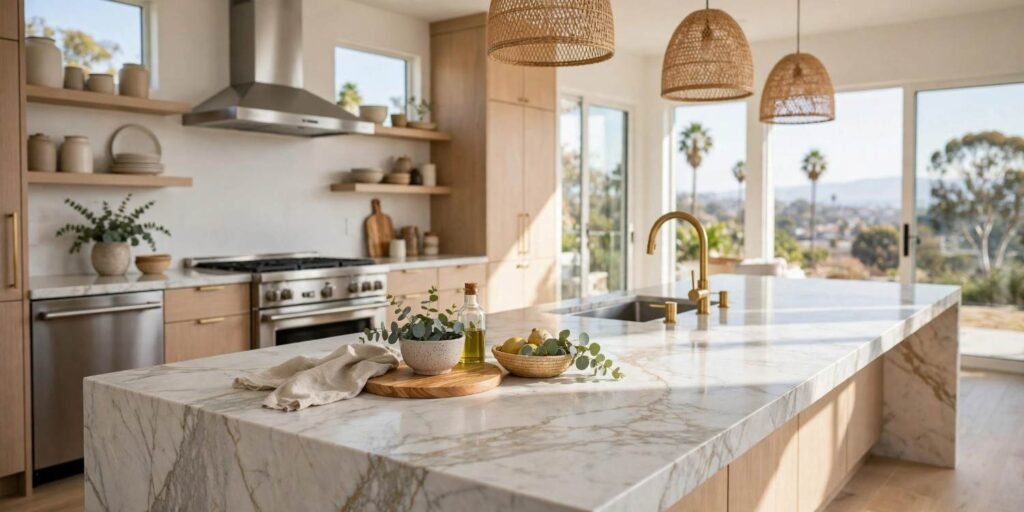
A marble island looks spectacular in photos, and it also shows every lemon juice splash and wine ring within hours if it’s not sealed correctly. This is a lifestyle decision as much as a design one.
Why Marble Etches and How to Prevent It
Marble etches because its calcium carbonate structure reacts with acidic liquids, leaving a dull mark rather than a true stain. Sealing helps slow this reaction, but it doesn’t stop it entirely, so marble works best for homeowners who accept some natural patina over time.
Butcher Block & Wood Countertops
Butcher block is a countertop made from strips of hardwood glued together, offering a warm aesthetic and a renewable surface that can be sanded down when it wears. It’s a popular choice for kitchen islands and secondary prep areas rather than full kitchen coverage, since wood handles water exposure worse than stone or quartz.
I like recommending butcher block for clients who want contrast against a stone perimeter. The two materials paired together create visual depth that a single-material kitchen rarely achieves.
Sealing, Sanding & Lifespan
Butcher block needs oiling every few months near a sink and sanding every several years to remove scratches and stains. With that upkeep, a well-built butcher block surface easily lasts fifteen to twenty years.
Laminate Countertops: Budget-Friendly Performance
Laminate is a synthetic surface made by bonding layers of paper or fabric with resin over a particleboard core, offering the lowest upfront cost of any countertop material. Modern laminate has come a long way from the dated styles of decades past, and today’s printed patterns can convincingly mimic stone from a few feet away.
I use laminate in builds where budget constraints matter more than long-term resale value, like rental properties or secondary kitchens.
Where Laminate Makes Sense in a Build
Laminate performs well in low-impact kitchens, guest suites, and investment properties where the owner prioritizes cost over decades-long durability. It’s not the right call for a primary residence kitchen where resale value matters.
Concrete Countertops: Custom Durability

Concrete countertops are poured and cured on-site or precast off-site, offering unlimited shape, color, and texture customization that no other material matches. They’ve become popular in modern and industrial-style California homes where a homeowner wants a truly one-of-a-kind surface.
The tradeoff is that concrete requires skilled fabrication, and a poorly mixed or cured slab can crack within the first year.
Curing, Sealing & Cracking Risks
Concrete needs a proper curing period before sealing, and skipping this step is the leading cause of hairline cracks in new installations. I only work with fabricators who guarantee a minimum 28-day cure before sealing goes on.
Stainless Steel & Specialty Surfaces
Stainless steel is a nonporous metal surface resistant to heat, bacteria, and staining, making it the standard choice in commercial kitchens and increasingly popular in modern residential builds. It handles everything a working kitchen throws at it, though it does scratch and dent over years of heavy use.
Commercial-Grade Kitchens & Modern Builds
Stainless steel shows up most often in minimalist or industrial-style kitchens where homeowners cook frequently and prioritize hygiene over a soft aesthetic. It pairs well with wood or concrete accents to soften the overall look.
Countertop Cost Comparison by Material
Installed countertop costs in California vary dramatically by material, slab availability, and fabrication complexity, with prices ranging from $20 per square foot for basic laminate to over $200 per square foot for exotic natural stone.
| Material | Cost Per Sq Ft (Installed) | Lifespan |
| Laminate | $20-$50 | 10-15 years |
| Butcher Block | $35-$70 | 15-20 years |
| Granite | $40-$100 | 25-40 years |
| Quartz | $50-$120 | 25-40 years |
| Concrete | $65-$135 | 20-30 years |
| Marble | $75-$200 | 20-40 years with care |
This table lays out how material choice shifts both upfront cost and expected lifespan, which matters more than sticker price alone when budgeting a build.
Installed Cost vs. Material-Only Cost
Material-only pricing excludes fabrication, edge profiles, and installation labor, which together often add 30 to 50 percent to the final bill. I always ask builders for a fully installed quote rather than a per-slab material price to avoid budget surprises.
Durability Ratings: Scratch, Heat & Stain Resistance Compared
Durability testing measures three separate properties: scratch resistance using a hardness scale, heat tolerance by direct contact temperature, and stain resistance through standardized absorption tests. No single material wins every category, which is why matching material to lifestyle matters more than chasing a single “best” option.
How Builders Test for Long-Term Wear
Reputable fabricators test sample slabs with standardized scratch picks, heated pans, and acidic liquid exposure before recommending a material for high-traffic kitchens. I ask every fabricator I work with to walk clients through this testing before they commit to a slab.
How Countertop Choice Affects Home Resale Value
Granite and quartz countertops consistently appraise higher than laminate surfaces, and buyers frequently cite outdated countertops as a reason to discount an otherwise solid home. Appraisers and real estate agents both treat countertop material as a quick visual signal of overall build quality.
Replacing laminate with stone before a sale often returns more than its installed cost, particularly in competitive California markets where buyers compare kitchens directly across listings.
Sustainability & Eco-Friendly Countertop Options

Recycled glass, reclaimed wood, and certain engineered quartz lines made with recycled content offer lower environmental impact than quarried natural stone. These materials perform comparably to their conventional counterparts in most durability tests, though availability varies by region.
I point sustainability-focused clients toward recycled glass composite first, since it combines a low environmental footprint with genuinely strong scratch and stain resistance.
Maintenance Requirements by Material Type
| Material | Sealing Needed | Daily Care |
| Granite | Annually | Mild soap; avoid acidic cleaners |
| Quartz | Never | Mild soap only |
| Marble | Every 6-12 months | Avoid acidic liquids entirely |
| Butcher Block | Oil every 1-3 months | Wipe dry immediately |
| Concrete | Every 1-3 years | Mild soap, reseal if dulling |
This table breaks down ongoing maintenance by material, which should weigh as heavily in your decision as the upfront installed cost.
Questions to Ask Your Builder About Countertop Installation
Asking the right questions before signing a contract protects you from mismatched expectations once the slab is installed. I tell every client to ask about seam placement, sealing schedule, and warranty coverage before approving a material.
A builder who can answer these questions clearly and specifically, rather than vaguely, is usually the builder doing the fabrication work correctly.
Matching Countertop Material to Your Kitchen Design & Lifestyle
The right countertop material depends on how you actually use your kitchen, not just how a slab photographs in a showroom. A family that cooks daily with kids in the house has different priorities than a couple who entertains occasionally and values a dramatic marble island.
I walk clients through their real cooking habits before recommending a material, because the best-looking countertop is worthless if it can’t handle your actual kitchen.
Conclusion
Countertop material shapes your kitchen’s durability, maintenance routine, and resale value for decades, not just its first impression. Granite, quartz, marble, wood, laminate, and concrete each solve different problems depending on your household and budget.
We’ve covered the full spectrum here, and our cluster guides go deeper into fabrication, sealing schedules, and builder vetting for your specific project.
We build custom California homes with countertop choices matched to how you actually live. Reach out to Tiny Home Builders California to start planning your kitchen the right way.
Frequently Asked Questions
What is the most durable countertop material for a kitchen?
Quartz and granite are the two most durable countertop materials for daily kitchen use. Quartz resists stains without sealing, while granite offers superior heat resistance when properly maintained.
How much do kitchen countertops cost in California?
Kitchen countertops in California typically cost $20 to $200 per square foot installed, depending on material. Granite and quartz fall in the $40-$120 range for most standard installations.
Is quartz better than granite for kitchen countertops?
Quartz requires less maintenance since it never needs sealing, while granite offers slightly better heat resistance. Neither is universally “better”; the right choice depends on your maintenance preferences.
Do countertop materials affect home resale value?
Yes, granite and quartz countertops typically appraise higher than laminate and can increase buyer interest. Outdated countertop materials are a common reason buyers discount a listing.
How long do kitchen countertops typically last?
Most quality countertop materials last 20 to 40 years with proper care. Granite and quartz last longest, while laminate typically needs replacement within 10 to 15 years.
Which countertop material requires the least maintenance?
Quartz requires the least maintenance since it never needs sealing and resists stains naturally. Granite, marble, and concrete all require periodic resealing to maintain performance.
Can I mix countertop materials in one kitchen?
Yes, mixing materials like a quartz perimeter with a butcher block island is a common and practical design choice. This approach balances durability, maintenance, and aesthetic variety within one kitchen.