
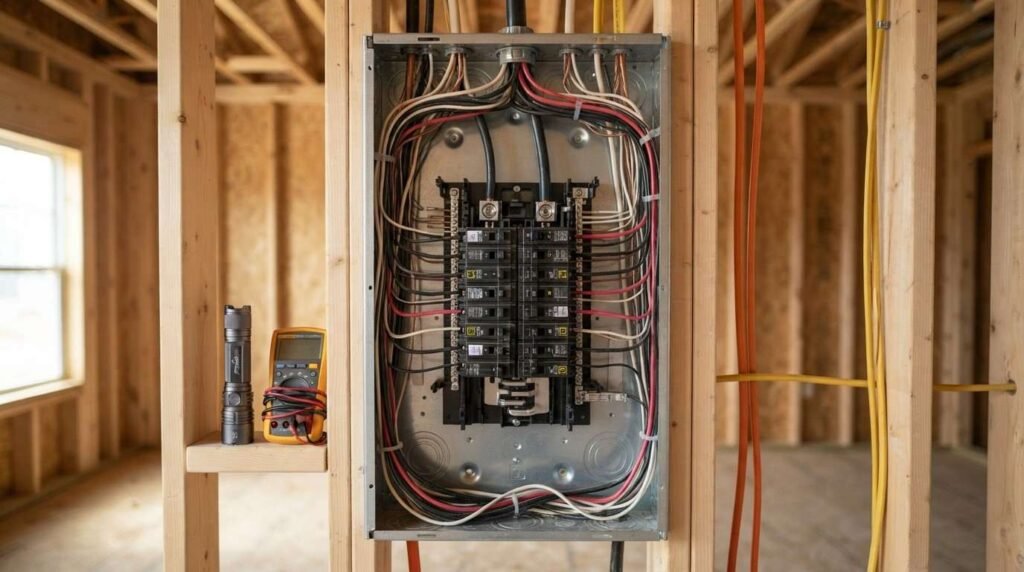
I walk a lot of new builds before final sign-off, and electrical work is where quality either shows up or quietly disappears behind drywall. This 25-item checklist gives you a practical way to verify electrical quality in a new home before you accept it. Wiring problems are expensive once walls are closed, so catching them early protects your investment.
I built this list around the items that separate a well-executed electrical rough-in and finish from one that just passes minimum code. We cover panel and circuit basics, outlet and fixture details, then safety and smart-home readiness, plus the questions worth asking your builder directly.
Why Electrical Quality Matters Before You Sign Off
Electrical systems are one of the few parts of a new home that get buried the moment inspection passes. Once drywall goes up, you cannot see the panel wiring, the circuit routing, or how carefully an electrician labeled anything. I always tell clients this is the point where quality either gets locked in right or gets locked in wrong.
What Poor Electrical Work Costs Homeowners Later
A mislabeled panel or an undersized circuit does not usually cause problems on day one. It shows up two years later as a tripped breaker during a holiday dinner, or a flickering light that turns into a service call. Fixing electrical issues after drywall and paint is finished costs far more than catching them during rough-in.
An electrical system is a network of wiring, panels, and devices that delivers power safely throughout a structure. That definition matters here because “safely” is doing a lot of work; code minimums exist to prevent fire and shock hazards, not to guarantee a system built for how a family actually lives.
How to Use This Checklist During Walkthroughs
I recommend walking through this list at two points: once during the rough-in inspection, before insulation and drywall go up, and again at final walkthrough. Bring a copy, a flashlight, and don’t be shy about asking your builder or electrician to explain anything that looks unfinished. A confident builder welcomes the questions.
The 25 Must-Have Electrical Checklist Items
I grouped these 25 items into three categories so the list stays usable on-site instead of turning into a wall of text. Each group covers a different layer of the electrical system, from the panel outward to the fixtures you’ll touch every day.
Panel, Wiring & Circuit Essentials (Items 1–9)
- Panel sized correctly for the home’s total electrical load, with room for future additions
- All circuits clearly labeled at the panel, matching the actual rooms they serve
- Dedicated circuits for major appliances: range, dryer, HVAC, water heater
- Copper wiring used throughout, not aluminum, for standard branch circuits
- Proper wire gauge matched to circuit amperage, avoiding undersized runs
- Grounding system installed and verified at the panel and throughout the home
- Surge protection installed at the main panel
- Junction boxes accessible, not buried behind finished walls or insulation
- Neat, organized wire runs inside the panel: not a tangled bundle
Outlets, Switches & Fixture Essentials (Items 10–17)
- GFCI outlets installed in kitchens, bathrooms, garages, and outdoor areas
- AFCI protection installed on bedroom and living area circuits
- Outlet spacing that meets or exceeds code minimums along usable wall space
- Outlets placed with actual furniture layout in mind, not just code minimums
- Light switches positioned logically at every room entry point
- Dimmer-compatible wiring in main living spaces where dimmers are planned
- Light fixtures properly secured and wired, with no exposed splices
- Ceiling fan boxes rated for fan weight, not just standard light fixture boxes
Safety, Code & Smart-Home Essentials (Items 18–25)
- Smoke detectors hardwired and interconnected across all required areas
- Carbon monoxide detectors installed per code near sleeping areas
- Exterior outlets weatherproofed with in-use covers
- Electrical panel location accessible and clear of obstructions
- All work permitted and signed off by the local building department
- Wiring pre-run or conduit installed for future smart-home devices
- EV charger circuit roughed in in the garage, even if unused at move-in
- Final inspection documentation provided and kept for your records
Skipping any one of these rarely causes an immediate problem. Skipping several at once is usually a sign the electrical work was rushed to pass inspection rather than built for long-term reliability.
Questions to Ask Your Builder Before Final Inspection

I keep a short set of questions ready for exactly this conversation, and I ask builders to answer them plainly, not with a brochure line. Straight answers here tell you more than the finish package ever will.
Ask who performed the electrical work and whether they’re licensed for the jurisdiction. Ask to see the permit and inspection history for the electrical rough-in and final. Ask directly whether the panel has room for future load, and whether conduit was run for anything beyond current code minimums.
A builder who documents construction standards clearly and answers without hesitation is usually the same builder who built the panel correctly in the first place.
Conclusion
Electrical quality in a new build comes down to specifics, not impressions. Walking through these 25 items at rough-in and final gives you real evidence instead of a builder’s word. We build every home to these standards first, then show our work. Talk to Tiny Home Builders California about how we approach Electrical systems in your new construction project.
Frequently Asked Questions
What is the most commonly skipped item on an electrical checklist?
Conduit or wiring for future smart-home devices gets skipped most often since it’s not required by code. It’s cheap to add during construction and expensive to retrofit later.
Do all bedrooms need AFCI protection in new construction?
Yes, most current residential codes require AFCI protection on bedroom circuits. Confirm your local code version with your builder or inspector directly.
How many dedicated circuits does a typical new home need?
Most homes need dedicated circuits for the range, dryer, HVAC system, water heater, and microwave at minimum. Larger homes with more appliances need additional dedicated circuits.
Should I request an EV charger circuit even without an EV?
I recommend it. Roughing in the circuit during construction costs far less than adding one after walls and driveways are finished.


