
An eco-friendly kitchen remodel is a renovation that reduces environmental impact across four areas: the materials used, the energy the kitchen consumes, the water it uses, and the waste the project generates. I build kitchens in California every year, and the ones that actually perform start with those four decisions, not with a finish sample.
Kitchens use more energy and water than any other room in a house. A remodel that ignores that locks in thirty years of waste and higher bills for the family living there.
This guide covers what makes a remodel genuinely sustainable, how to plan one, the material choices across cabinets, counters, floors, and finishes, the appliance and water systems that drive operating cost, California’s code and rebate landscape, and how to vet a builder who can actually deliver the work.
What Makes a Kitchen Remodel Eco-Friendly
A kitchen remodel qualifies as eco-friendly when it reduces impact across four measurable areas: material sourcing, operational energy use, water consumption, and construction waste diverted from landfill. Everything else is a marketing adjective.
I ask clients to score a project across all four. A kitchen with bamboo cabinets and a gas range that burns through electricity-equivalent therms is not a green kitchen. It is a green-looking kitchen.
The four pillars: materials, energy, water, waste
Materials cover what you put in. That means certified wood, recycled content, low-emission panels, and finishes that do not off-gas into the room.
Energy covers what the kitchen draws every day for the next two decades. Appliances, lighting, and ventilation all sit here.
Water covers faucet flow rates and dishwasher efficiency. Waste covers what leaves the site during demolition and construction.
Embodied carbon vs. operational carbon
Embodied carbon is the greenhouse gas released producing, transporting, and installing a material. Operational carbon is what the kitchen emits in daily use.
Most homeowners only think about operational carbon because it shows up on a utility bill. Embodied carbon is invisible but front-loaded, and it is why reusing an existing cabinet box almost always beats buying a new sustainable one.
The Carbon Leadership Forum estimates that embodied carbon accounts for roughly 11% of global annual emissions from building materials and construction. That number only grows as operational efficiency improves.
Greenwashing vs. verified performance
Greenwashing is an environmental claim made without third-party verification or measurable data behind it. The kitchen industry is full of it.
I treat any claim without a certification number as marketing. FSC, GREENGUARD Gold, ENERGY STAR, WaterSense, and CARB Phase 2 compliance all come with documentation you can request. “Eco-conscious” and “earth-friendly” do not.
How to Plan a Sustainable Kitchen Remodel
Sustainable kitchen planning starts before design, with an audit of what already exists and what can stay. The biggest environmental win in any remodel is the material you never buy.
Here is the sequence I use on every project:
- Audit the existing kitchen for salvageable cabinet boxes, flooring, and appliances
- Set performance targets for energy, water, and waste diversion before drawing anything
- Design the layout to reduce total material volume, not just to look open
- Specify materials by certification, not by product name
- Confirm appliance and fixture rebates before purchase, since eligibility changes
- Sequence trades so finishes cure before cabinets install, preventing rework
Audit before you demolish
An audit documents what in your current kitchen still has useful life. I walk every project with a clipboard before anyone swings a hammer.
Cabinet boxes in solid plywood frequently outlast their doors by decades. Appliances under five years old rarely justify replacement on carbon grounds alone.
Design decisions that cut material use
Smaller runs of cabinetry use less material and less finish. Open shelving on one wall removes two upper cabinets and the panels behind them.
Standardized cabinet widths cut offcut waste at the shop. Custom sizing looks tailored and generates scrap on every box.
Sequencing trades to reduce rework and waste
Rework is pure waste, and it is almost always a scheduling failure. Paint before cabinet install, not after, so touch-ups do not require masking finished millwork.
I hold a pre-construction meeting with every trade on green projects. Thirty minutes there saves days of demolition later.
Sustainable Cabinetry Materials and Construction
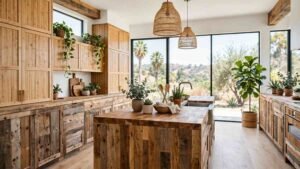
Sustainable cabinetry is cabinetry built from certified or reclaimed wood, bonded with formaldehyde-free adhesives, and constructed to last long enough that replacement never becomes the cheaper option. Cabinets are the largest material volume in most kitchens, so this choice carries the most weight.
Durability is the sustainability metric people skip. A cabinet replaced in twelve years doubles its lifetime footprint.
FSC-certified hardwood and plywood
FSC certification is a chain-of-custody standard confirming wood came from forests managed to defined environmental and social criteria. The Forest Stewardship Council certifies over 150 million hectares worldwide.
Ask for the FSC chain-of-custody number on the invoice, not a logo on a brochure. Only the number is verifiable.
Formaldehyde-free panels (NAUF, NAF, ULEF)
NAUF means no added urea formaldehyde. NAF means no added formaldehyde at all. ULEF means ultra-low emitting formaldehyde.
These labels matter because particleboard and MDF traditionally used urea-formaldehyde binders that off-gas for years. In a sealed modern kitchen, that gas has nowhere to go.
I specify NAF panels on every project now. The cost difference has narrowed to a few percent.
Bamboo, wheatboard, and reclaimed wood
Bamboo is a fast-growing grass that reaches harvest maturity in three to five years, compared to decades for hardwood. It machines well and takes finish cleanly.
Wheatboard is an agricultural-residue panel made from straw that would otherwise be burned or tilled under. It performs similarly to MDF in cabinet boxes.
Reclaimed wood carries near-zero embodied carbon because the tree was felled generations ago. Supply is inconsistent and grading matters.
Refacing and reusing existing cabinet boxes
Cabinet refacing replaces doors, drawer fronts, and visible surfaces while keeping the original boxes in place. It typically costs 40% to 60% less than full replacement and eliminates most of the project’s material footprint.
I push refacing hard when the boxes are plywood and square. I push back on it when they are sagging particleboard from the eighties.
Eco-Friendly Countertop Materials Compared

The table below compares the most common sustainable countertop materials across the attributes that actually drive a decision.
| Material | Recycled content | Embodied carbon | Durability | Maintenance | Relative cost |
| Recycled glass | 70–85% | Low | High | Sealing every 1–2 yrs | Medium-high |
| Paper composite | 100% post-consumer | Low | Medium-high | Oiling annually | Medium |
| Reclaimed butcher block | 100% salvaged | Very low | Medium | Oiling monthly | Low-medium |
| Recycled aluminum | 95%+ | Low-medium | Very high | Minimal | High |
| Domestic quartzite | 0% | Medium-high | Very high | Sealing annually | High |
| Concrete (fly-ash blend) | 20–40% | Medium | High | Sealing annually | Medium |
| Engineered quartz | 0–10% | High | Very high | Minimal | Medium-high |
Recycled glass and paper composite lead on material credentials. Reclaimed butcher block wins on embodied carbon but asks the most from the homeowner in upkeep.
Engineered quartz sits awkwardly here. It is durable and low-maintenance but resin-heavy and energy-intensive to produce, so I only specify it when the alternative would be replaced sooner.
Sustainable Flooring Options for Kitchens
Sustainable kitchen flooring balances rapid renewability or recycled content against the moisture and traffic a kitchen floor actually takes. A material that fails in six years is not sustainable regardless of its source.
Cork, bamboo, and linoleum
Cork is harvested from the bark of living cork oaks on a nine-year cycle without felling the tree. It is warm underfoot and naturally antimicrobial, though it dents under heavy appliance feet.
Bamboo flooring handles kitchen traffic well in strand-woven form. Avoid horizontal-grain bamboo near sinks.
Linoleum is made from linseed oil, cork dust, wood flour, and jute. It is not vinyl, despite being lumped in with it, and it biodegrades at end of life.
Reclaimed and FSC hardwood
Reclaimed hardwood pulled from barns, mills, and demolished structures carries essentially no new harvest impact. Expect nail holes, color variation, and a longer lead time.
FSC-certified new hardwood is the cleaner alternative when reclaimed supply falls short. Engineered construction with an FSC core uses less face-grade timber per square foot.
Recycled-content tile and concrete
Recycled-content tile incorporates post-industrial glass or ceramic waste into the body or glaze. Several manufacturers now offer 70% or higher recycled content with standard performance ratings.
Polished existing concrete slab is the lowest-impact kitchen floor available, because the material is already there. It works in slab-on-grade homes and reads well in modern and industrial kitchens.
Low-VOC Paints, Finishes, and Adhesives
A low-VOC product is one that releases a reduced quantity of volatile organic compounds, measured in grams per liter, as it cures. In a kitchen, these compounds come from paint, cabinet finish, flooring adhesive, caulk, and sealant.
The EPA reports that indoor VOC concentrations run two to five times higher than outdoor levels, and spike during and after renovation.
I look for GREENGUARD Gold certification rather than a VOC number alone. The number only covers the can; the certification covers what the cured product actually emits in a room.
Adhesives are the overlooked category. A low-VOC floor installed with a high-VOC adhesive produces a high-VOC floor.
Water-based finishes on cabinetry have closed most of the durability gap with solvent-based conversion varnish. The difference in the first week of occupancy is dramatic.
Energy-Efficient Kitchen Appliances

Kitchen appliances are the single largest driver of a kitchen’s operational footprint, and refrigeration runs continuously for its entire service life. The U.S. Department of Energy notes that refrigerators account for roughly 7% of a typical home’s electricity use.
ENERGY STAR ratings and what they measure
ENERGY STAR is a federal certification identifying products in the top efficiency tier of their category, verified through third-party testing. The label is a threshold, not a score.
Compare the yellow EnergyGuide label’s annual kWh figure between two certified models. Two ENERGY STAR refrigerators can differ by 200 kWh per year.
Induction cooking and electrification
Induction cooktops transfer energy directly to ferrous cookware through a magnetic field, reaching roughly 85% efficiency compared to about 40% for gas. They also eliminate combustion byproducts in the room.
California has been moving steadily toward kitchen electrification, and a growing number of cities now restrict new gas connections. Specifying induction now avoids a second remodel later.
Check panel capacity early. Induction, an electric oven, and a heat-pump water heater together can exceed what an older service can carry.
Right-sizing refrigeration
Refrigerator energy use scales with interior volume. A 28 cubic foot unit for a two-person household wastes energy every hour of its life.
I size refrigeration to household count and shopping habits, not to the cabinet opening a designer drew. French-door models typically outperform side-by-side layouts on the same volume.
Water Conservation in the Kitchen

Kitchen water use runs through two fixtures: the faucet and the dishwasher. Both are governed by flow rate and cycle efficiency rather than user behavior alone.
WaterSense fixtures and flow rates
WaterSense is an EPA labeling program identifying fixtures that use at least 20% less water than the federal standard while meeting performance criteria. California’s baseline kitchen faucet maximum sits at 1.8 gallons per minute.
Aerators matter more than the faucet body. A quality aerator maintains perceived pressure at reduced flow, which is the whole trick.
Dishwashers vs. hand washing
An ENERGY STAR dishwasher uses roughly 3.5 gallons per cycle, while hand washing a comparable load typically uses more than 20 gallons. The machine wins decisively when run full.
Skip the pre-rinse. Modern soil sensors are designed to work with food residue, and pre-rinsing can double a cycle’s water footprint before the door even closes.
Kitchen Lighting and Ventilation Efficiency
Lighting and ventilation are the two systems homeowners underspecify most, and both affect energy use and daily comfort directly.
LED layering and daylighting
LED lighting uses roughly 75% less energy than incandescent and lasts up to 25 times longer, according to the Department of Energy. In a kitchen, the gain compounds because fixtures run for hours daily.
Layering means separate circuits for ambient, task, and accent light. One overhead fixture forces every task to run at full output.
Daylighting through a well-placed window or tubular skylight can carry a kitchen through most daytime hours without any fixture on at all.
Make-up air and range hood sizing
A range hood exhausts air out of the house, and that air has to be replaced from somewhere. Make-up air is conditioned replacement air supplied deliberately rather than pulled through gaps in the envelope.
California requires make-up air provisions above certain exhaust rates. Oversizing a hood to 1,200 CFM for a visual effect creates a code trigger and an energy penalty.
I size hoods to the cooking surface and the actual cooking style. A 400 CFM hood ducted properly outperforms a 900 CFM hood on a crushed flex duct.
Reducing Construction Waste and Demolition Debris

Construction and demolition debris accounts for a large share of material sent to landfill, and a kitchen remodel generates a surprising volume of it. The EPA reports that construction and demolition materials totaled roughly 600 million tons in a single recent year, more than double municipal solid waste.
Deconstruction vs. demolition
Deconstruction is the systematic dismantling of a structure to recover materials intact for reuse. Demolition is removal for disposal.
Deconstruction takes more labor hours and recovers cabinets, appliances, fixtures, and dimensional lumber. On a kitchen, the added labor often offsets against reduced disposal fees and donation tax deductions.
Salvage, donation, and recycling streams
Habitat for Humanity ReStores accept cabinets, countertops, appliances, and fixtures in working condition across California. The donation generates a receipt and keeps usable material in circulation.
Separate the streams on site. Mixed debris goes to landfill; sorted metal, cardboard, wood, and gypsum each have a recovery path.
CALGreen requires construction waste diversion on many permitted projects. Your contractor should be producing a waste management plan and diversion documentation as standard practice.
Indoor Air Quality in a Remodeled Kitchen
Indoor air quality in a kitchen is the measurable concentration of combustion byproducts, volatile organic compounds, and particulate matter in the air occupants breathe during and after cooking. Kitchens produce more indoor pollutants than any other room.
Gas cooking releases nitrogen dioxide, carbon monoxide, and fine particulate matter directly into living space. A Stanford study found gas stoves leak methane even when switched off.
The fix is mechanical, not cosmetic. Vented-to-exterior ventilation at the cooking surface removes pollutants at the source, while recirculating hoods simply filter grease and return everything else to the room.
Material selection carries the rest of the load. Formaldehyde-free panels and GREENGUARD-certified finishes mean the kitchen is not quietly off-gassing while the hood is off.
California Building Codes and Green Standards
California regulates kitchen remodels more tightly than any other state, and the requirements have real design consequences. Permitted work triggers code compliance regardless of a project’s environmental ambitions.
Title 24 energy requirements
Title 24 is California’s Building Energy Efficiency Standards, governing lighting, insulation, mechanical systems, and appliance efficiency in residential construction. Kitchen remodels commonly trigger its lighting provisions.
High-efficacy lighting is effectively mandatory in kitchens now. Recessed fixtures must be rated for insulation contact and airtight sealing.
CALGreen and CARB Phase 2 compliance
CALGreen is California’s statewide green building code, setting mandatory requirements for water efficiency, material conservation, waste diversion, and indoor air quality. It applies to permitted residential work.
CARB Phase 2 is the California Air Resources Board standard limiting formaldehyde emissions from composite wood products. Any cabinet panel sold legally in California already meets it, but importers occasionally miss this, so documentation matters.
Local electrification ordinances
Dozens of California cities have adopted ordinances restricting or discouraging new natural gas infrastructure in residential construction. Requirements vary significantly by jurisdiction.
Check your city’s current ordinance before specifying a gas range. The rules changed in several jurisdictions within the past two years.
Eco-Friendly Kitchen Remodel Costs and Payback
A sustainable kitchen remodel in California typically runs 5% to 15% above a conventional remodel of equal scope, with most of the premium concentrated in appliances, certified materials, and waste diversion labor. The gap has narrowed considerably over the past five years.
The table below shows where the premium actually lands.
| Category | Conventional share | Green premium | Payback driver |
| Cabinetry | 30–35% | 3–8% | Durability, not utility savings |
| Countertops | 10–15% | 0–20% | None; material choice only |
| Appliances | 15–20% | 5–15% | Utility savings, rebates |
| Flooring | 7–10% | 0–10% | Lifespan |
| Lighting | 3–5% | Often negative | Immediate energy savings |
| Waste handling | 2–4% | 20–40% | Disposal fee offset, tax deduction |
Lighting is the outlier. LED specification usually costs less upfront now and pays back immediately.
Appliance payback depends heavily on your utility rate. In California’s higher tiers, an efficient refrigerator and induction cooktop can recover their premium within five to eight years.
Cabinetry and countertops do not pay back in utility savings, and I tell clients that plainly. Their return is longevity and indoor air quality, which are real but not metered.
Rebates, Incentives, and Tax Credits in California
California offers layered rebates for kitchen electrification and efficiency through federal, state, and utility programs that can be combined on a single project. Stacking them is where the real money sits.
The federal Energy Efficient Home Improvement Credit provides up to $3,200 annually for qualifying improvements under Section 25C. Heat pump equipment and electrical panel upgrades both qualify.
TECH Clean California and the statewide Home Electrification and Appliance Rebates program target induction cooktops, panel upgrades, and wiring. Income-qualified households receive substantially higher amounts.
Utility programs from PG&E, SCE, SDG&E, and municipal utilities run independently and change frequently. Confirm eligibility and reservation requirements before purchasing, because several programs require pre-approval.
Small-Space and Tiny Home Kitchen Sustainability

Small-space kitchens are inherently more sustainable because they consume less material, less conditioned air, and less energy per square foot. The design constraint becomes the environmental advantage.
A tiny home kitchen compresses every decision. There is no room for a 36-inch range or a second refrigerator, which eliminates the two biggest energy loads automatically.
Compact appliances carry efficiency implications that cut both ways. An 18-inch dishwasher uses less water per cycle but may require more cycles for the same household volume.
Multi-function fixtures do real work here. A combination convection and induction unit replaces two appliances and one dedicated circuit.
Vertical storage reduces cabinet run length without reducing capacity. Less linear footage means less material, less finish, and less waste at the shop.
How to Vet a Builder for Sustainable Work
Vetting a builder for sustainable work means verifying documented practice rather than accepting stated commitment. Almost every contractor in California now describes their work as green.
Here is the process I would want a homeowner to run on me:
- Request a waste management plan from a recent comparable project
- Ask for diversion documentation showing actual landfill tonnage versus recycled
- Request FSC chain-of-custody numbers from a past cabinetry order
- Ask which specific GREENGUARD or low-VOC products they default to, by name
- Confirm who handles Title 24 compliance documentation and permit coordination
- Ask for two references on projects completed more than three years ago
Certifications worth asking about
Build It Green Certified Green Building Professional and NAHB Certified Green Professional both require coursework and continuing education. Neither guarantees quality, but both signal investment.
LEED accreditation matters more on commercial work. For residential kitchens, practical certifications and a documented project history tell you more.
Questions that separate claims from practice
Ask what they would do with your existing cabinet boxes. A builder who recommends refacing when boxes are sound is thinking about your project rather than their invoice.
Ask how they handle adhesive and sealant specification. Most contractors have never considered it, and the answer reveals how deep the practice actually runs.
Sustainable Kitchen Design Ideas by Style
Sustainable material choices work within any design style, and the constraint of certified or reclaimed sourcing often improves the result. Style is a finish decision, not an environmental one.
Modern kitchens pair well with polished existing concrete, recycled aluminum counters, and flat-panel bamboo cabinetry. The palette suits the material honesty.
Farmhouse and transitional kitchens absorb reclaimed wood beautifully. Butcher block islands, salvaged beam shelving, and painted FSC maple cabinetry all read as traditional while sourcing cleanly.
Minimalist kitchens benefit most from reduction itself. Fewer cabinets, open shelving on one wall, and integrated appliances cut material volume and achieve the intended look simultaneously.
Coastal and Mediterranean kitchens lean on recycled glass tile and lime-based plaster, both of which carry low embodied carbon and strong regional precedent in California.
Maintaining an Eco-Friendly Kitchen Long Term

Maintaining a sustainable kitchen means protecting the materials that require periodic attention so they reach their full service life rather than being replaced early. Most green materials ask for more routine care and less eventual replacement.
Butcher block and paper composite counters need oiling on a schedule. Skipping it for a year produces staining that no refinish fully removes.
Cork and linoleum floors need prompt water cleanup and periodic resealing. Both handle normal kitchen use indefinitely when maintained and fail quickly when neglected.
Appliance maintenance preserves efficiency. Cleaning refrigerator condenser coils twice a year and replacing range hood filters on schedule keeps both systems running at rated performance.
Ventilation deserves annual attention. A grease-loaded hood filter cuts airflow substantially, which undermines the indoor air quality the whole system exists to protect.
Conclusion
You now understand how materials, energy, water, and waste decisions combine to define an eco-friendly kitchen remodel, and how California code shapes each one.
Sustainable kitchens sit inside a broader shift toward durable, electrified, healthy homes, and the deeper resources in this cluster go further on each component.
We build homes this way as standard practice at Tiny Home Builders California, and we would welcome the chance to walk your project with you.
Frequently Asked Questions
Is an eco-friendly kitchen remodel worth the cost?
An eco-friendly kitchen remodel is worth it for most California homeowners, since the 5% to 15% premium is partly offset by rebates and lower utility bills over time.
What is the most sustainable countertop material?
Reclaimed butcher block carries the lowest embodied carbon of any countertop option. Recycled glass offers the best balance of sustainability, durability, and low maintenance for most kitchens.
Can I make my kitchen eco-friendly without a full remodel?
Yes, cabinet refacing, LED lighting, WaterSense aerators, and an efficient refrigerator deliver most of the benefit. These changes cost far less than gutting the room.
Are bamboo cabinets durable enough for a kitchen?
Bamboo cabinets perform comparably to hardwood in kitchen conditions when properly finished. Strand-woven bamboo actually exceeds oak in hardness ratings.
Does an eco-friendly kitchen increase home value?
Eco-friendly kitchens increase home value through efficient appliances, quality materials, and documented code compliance. California buyers increasingly ask about electrification readiness specifically.
What certifications should I look for in kitchen materials?
Look for FSC on wood, GREENGUARD Gold on finishes, ENERGY STAR on appliances, WaterSense on fixtures, and CARB Phase 2 on composite panels.
How long does a sustainable kitchen remodel take?
A sustainable kitchen remodel takes six to twelve weeks, similar to conventional timelines. Certified material lead times and deconstruction add roughly one to two weeks.