
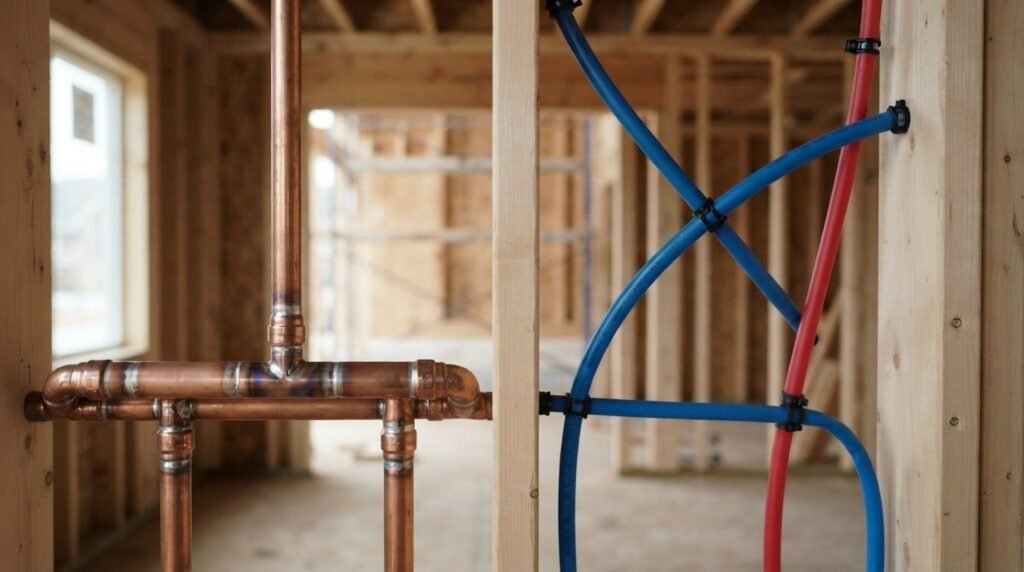
Copper corrodes over decades. PEX flexes through freezes without cracking. That’s the short version of a decision that shapes your home’s plumbing for the next 50 years. I’ve watched homeowners get talked into one material or the other without ever understanding why it matters.
New construction gives you a rare opportunity. You’re not retrofitting around old pipes. You’re choosing the system that runs through your walls before drywall ever goes up, and that choice affects your budget, your timeline, and your home’s resale value.
I’m covering what each material actually is, how they compare on cost and durability, what installation looks like on a real job site, how they perform under stress, and what smart builders choose when it’s their own reputation on the line.
What PEX and Copper Piping Actually Are
Copper piping is a rigid metal tube used to carry potable water through a home’s plumbing system, and it’s been the industry standard since the 1960s. Builders cut and solder copper sections together at joints, creating a permanent, corrosion-resistant network throughout the walls and floors.
PEX is cross-linked polyethylene tubing, a flexible plastic pipe that snakes through framing without needing as many joints. It connects using crimp rings, clamps, or push-fit fittings instead of soldering.
I’ve worked around both systems on active builds, and the difference in how they behave on site is obvious immediately. Copper holds its shape and requires precise measurements. PEX bends around obstacles, which changes how a crew plans the entire rough-in.
How Each Material Is Manufactured and Installed
Copper starts as mined ore, refined and drawn into tubing at controlled diameters. Installers measure, cut, deburr, flux, and sweat-solder every joint by hand, and that process demands real skill.
PEX comes off a spool in continuous lengths. A plumber runs it through studs and joists, cuts it to length, and crimps a fitting on with a hand tool in seconds.
That manufacturing difference is exactly why installation timelines diverge so much between the two materials.
Cost Comparison – Materials, Labor, and Long-Term Value
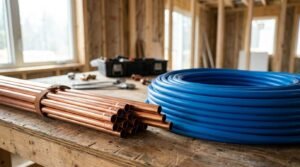
Material cost alone favors PEX by a wide margin. Copper pipe runs significantly higher per foot than PEX tubing, and that gap has only grown as copper commodity prices climb.
Labor cost separates the two even further. Soldering copper joints takes trained hands and more time per connection, while PEX crimping trains new installers fast and moves through a rough-in in a fraction of the hours.
On a typical single-family new build, PEX plumbing systems run roughly 25% to 40% cheaper in total installed cost compared to copper, according to the National Association of Home Builders, which tracks material cost trends across residential construction. That gap covers materials, fittings, and labor combined.
Long-term value tells a more nuanced story. Copper systems hold resale appeal in certain markets where buyers associate copper with premium construction, even when PEX performs equally well.
Why Copper Costs More to Install Today
Copper commodity prices swing with global metal markets, and that volatility gets passed straight to the homeowner. A spike in copper futures can shift a plumbing bid mid-project.
Skilled solder-certified plumbers also cost more to hire, and fewer trades are training in traditional sweating techniques. That labor scarcity pushes copper installation costs higher every year.
Durability and Lifespan in a New Home
Copper pipe lasts 50 to 70 years under normal water conditions, and it resists UV damage, fire, and rodent chewing far better than plastic tubing. It’s a material with a genuinely proven track record across generations of homes.
PEX carries a manufacturer-rated lifespan of 40 to 50 years, and it resists corrosion completely since it’s not a metal. It doesn’t pit, scale, or develop pinhole leaks the way aging copper sometimes does in acidic or soft water conditions.
Water chemistry actually decides a lot of this comparison. Homes on well water with high acidity chew through copper faster than homes on treated municipal supply.
How Each Material Holds Up to Water Quality and Temperature
Acidic water accelerates copper pitting corrosion, a known failure mode that shows up as pinhole leaks years after installation. PEX doesn’t corrode from water chemistry at all, which makes it the safer bet in areas with aggressive water.
UV exposure is PEX’s real weakness. Sunlight breaks down the tubing over time, so it needs to stay inside walls and away from direct light, which isn’t an issue in a properly built home anyway.
Installation Process and Impact on Build Timelines
A copper rough-in on an average single-family home takes a crew several days of measuring, cutting, and soldering every joint by hand. Each connection needs to cool and set before pressure testing.
PEX installation moves dramatically faster. A crew runs continuous lines with far fewer fittings, crimps connections in seconds, and completes a comparable rough-in in roughly half the time.
That speed matters more than it sounds. Faster plumbing rough-ins mean framing, electrical, and drywall crews get into a home sooner, and the whole build schedule compresses.
Why PEX Is Faster for New Construction Crews
PEX requires fewer fittings because it flexes around corners instead of needing an elbow joint at every turn. Fewer joints means fewer potential failure points and less time spent on each connection.
It also tolerates minor installation imperfections better than copper. A slightly imperfect crimp still seals reliably, while a poorly soldered copper joint fails outright.
Performance Factors – Freeze Resistance, Noise, and Water Flow
PEX expands slightly when water freezes inside it, which means it survives a freeze event that would split a copper pipe wide open. That flexibility is a genuine safety advantage in homes built in colder mountain regions of California.
Copper transmits water hammer noise loudly through a home’s walls, a hollow banging sound when valves shut quickly. PEX absorbs that vibration because the material itself flexes, so plumbing noise drops noticeably.
Water flow rate favors copper slightly at equal pipe diameter, since PEX has marginally more interior friction. In practice, that difference rarely affects real-world water pressure in a properly sized system.
How Each Pipe Handles Extreme Temperatures
Copper conducts heat efficiently, which helps with hot water delivery speed but also means it transfers cold from unconditioned spaces faster. PEX insulates naturally, keeping hot water hotter for longer runs.
Extreme heat is where copper still wins outright. It won’t soften or deform near a water heater connection the way PEX can if installed too close to a heat source without proper clearance.
Which Builders Choose and Why It Affects Your Home’s Value

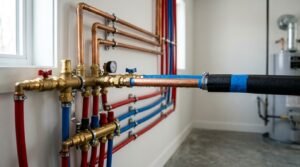
Most production and custom builders across California have shifted to PEX for primary water distribution, reserving copper for water heater connections and specific code-required transitions. That hybrid approach captures PEX’s cost and speed advantages while keeping copper’s heat tolerance where it matters most.
Builder reputation ties directly to which system they choose and how well they install it. A builder cutting corners on either material creates problems that surface years after the warranty ends.
I care about which system goes into a home because it reflects how a builder thinks about long-term performance versus short-term savings. A trustworthy builder explains the tradeoffs instead of defaulting to whichever material costs less to install.
Questions to Ask Your Builder About Plumbing Materials
Ask which manufacturer’s PEX they use, since quality varies significantly between brands and cheaper tubing degrades faster. Ask whether they use copper at the water heater and why, since that detail reveals whether they understand each material’s strengths.
Ask about their warranty on plumbing systems specifically, not just the general home warranty. A builder confident in their plumbing work backs it with real terms.
Conclusion
PEX and copper both deliver reliable plumbing when installed correctly by an experienced crew. The right choice depends on your budget, water chemistry, and how your builder balances cost against long-term performance.
Construction quality always comes down to the details most homeowners never see until something fails. That’s exactly why the builder matters as much as the material.
We build every home with transparency about the materials and methods behind the walls. Talk to Tiny Home Builders California about how we approach plumbing systems in your new construction project.
Frequently Asked Questions
Is PEX or copper better for new construction?
PEX offers lower cost and faster installation for most new construction, while copper offers longer proven durability and better heat tolerance. Most builders now use PEX for main distribution and copper near water heaters.
Does PEX plumbing lower a home’s resale value?
PEX rarely lowers resale value since it’s now standard in most new homes across California. Some buyers in older, copper-heavy markets may ask about it, but proper installation resolves most concerns.
How long does PEX piping last in a home?
PEX piping carries a manufacturer-rated lifespan of 40 to 50 years under normal residential water pressure and temperature conditions. Proper installation away from UV exposure extends that lifespan further.
Can PEX and copper be used together in the same house?
Yes, many builders use PEX for the main water distribution and copper at the water heater or specific code-required connections. This hybrid approach is common and fully code-compliant.
Why do some builders still prefer copper over PEX?
Some builders prefer copper for its decades-long proven track record, higher heat tolerance, and resistance to UV and rodent damage. Others simply have crews trained in traditional soldering techniques.
Does PEX plumbing affect water pressure in a new home?
PEX has slightly more interior friction than copper, but properly sized PEX systems deliver water pressure indistinguishable from copper in real-world use. Pipe diameter matters more than material choice.
Is PEX plumbing safe for drinking water?
Yes, PEX tubing is certified safe for potable water under NSF/ANSI standards used throughout residential construction. Reputable manufacturers test extensively for chemical leaching before certification.


