
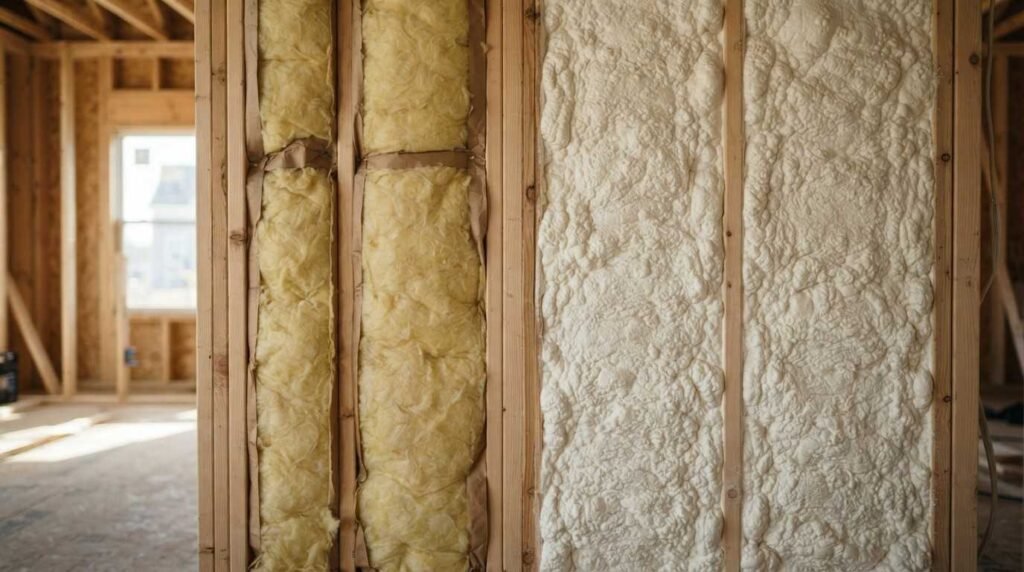
Spray foam insulation delivers a higher R-value per inch and seals air leaks that batt insulation simply can’t touch, but batt insulation costs less upfront and still performs well in the right application. I’ve walked through dozens of framed homes before insulation goes in, and the choice between these two always comes down to climate, budget, and how tight you want the building envelope.
New construction gives you one real shot at getting insulation right before drywall closes everything up. Get it wrong here, and you’re looking at higher energy bills, uneven room temperatures, and moisture problems for decades. This decision affects comfort and performance for the life of the house.
I’ll walk through how each insulation type actually works, where spray foam pulls ahead, where batt still makes sense, and how California’s climate zones factor into the decision. I’ll also cover what to ask your builder about their insulation standards before you sign anything.
What Insulation Actually Does in a New Build
Insulation is a building material that slows heat transfer between conditioned indoor space and the unconditioned exterior. It works alongside air sealing and moisture control, not instead of them.
A lot of homeowners think insulation is just about keeping warm air in during winter. It’s really about controlling three things at once: heat flow, air movement, and moisture. Miss any one of those and the whole system underperforms, no matter how thick the insulation is.
R-Value, Air Sealing, and Moisture Control Explained
R-value measures a material’s resistance to heat flow. Higher R-value per inch means more thermal resistance packed into the same wall cavity, which matters most in framing where space is limited.
Air sealing is a separate function entirely. A wall can hit its target R-value on paper and still leak heat badly if air moves freely through gaps around outlets, top plates, and penetrations. I’ve seen homes with excellent batt installation lose significant efficiency purely from air leakage the insulation never addressed.
Moisture control rounds out the picture. Insulation that traps moisture inside wall cavities leads to mold and rot regardless of its thermal performance. This is where spray foam and batt start to diverge in a meaningful way.
Spray Foam Insulation – How It Works and Where It Excels
Spray foam insulation is a liquid polyurethane material that expands and hardens after application, filling wall cavities completely and creating an air seal in the same step. That combination is the whole appeal.
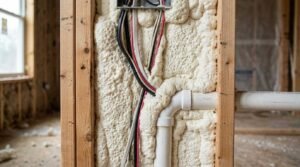
Because it expands to fill irregular gaps, spray foam handles the odd angles and penetrations around wiring and plumbing that batt insulation tends to miss. I like it for homes where the framing isn’t perfectly uniform, which is most homes once electrical and plumbing rough-in is complete.
Open-Cell vs Closed-Cell Spray Foam
Open-cell spray foam is lighter, less expensive, and typically runs R-3.5 to R-3.6 per inch. It’s softer and more flexible, which makes it forgiving around minor building movement, but it doesn’t offer the same moisture resistance as closed-cell.
Closed-cell spray foam runs a denser R-6 to R-7 per inch and adds structural rigidity to the wall assembly. It also functions as a vapor barrier on its own, which matters in coastal California climates with higher humidity.
Batt Insulation – How It Works and Where It Excels
Batt insulation is a pre-cut, fibrous material installed in rolls or panels that fit between wall studs, floor joists, and ceiling rafters. It relies on trapped air pockets within the fiber to resist heat transfer.
Cost is where batt insulation wins outright. Material and labor run well below spray foam, and installation moves faster on a straightforward, uniformly framed structure. For a builder working on a tight schedule with clean framing, batt gets the job done efficiently.
Fiberglass vs Mineral Wool Batts
Fiberglass batts are the standard choice, running roughly R-3.1 to R-3.4 per inch. They’re widely available, straightforward to install, and represent the lowest-cost insulation option in new construction.
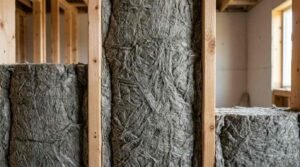
Mineral wool batts cost more but offer better fire resistance and sound dampening. The National Institute of Standards and Technology found mineral wool insulation maintains structural integrity at significantly higher temperatures than fiberglass, which matters in wildfire-prone regions of California.
Spray Foam vs Batt – Side-by-Side Comparison
Cost separates these two products more than any other factor. Batt insulation typically runs $0.50 to $1.50 per square foot installed, while spray foam runs $1.50 to $5.00 per square foot depending on open-cell or closed-cell selection.
Installation time favors batt in straightforward applications since it doesn’t require curing time or specialized equipment on-site. Spray foam takes longer per square foot but eliminates the separate air-sealing step batt installation still requires.
Cost, Installation Time, and Energy Performance
Energy performance is where spray foam usually pulls ahead in real-world results, not just R-value on paper. The U.S. Department of Energy notes that air sealing combined with insulation reduces energy loss far more effectively than insulation R-value alone, which favors spray foam’s built-in air seal.
That said, a batt-insulated home with meticulous air sealing done separately can approach similar real-world performance. The gap closes when a builder takes air sealing seriously as its own line item rather than assuming insulation handles it.
Which Insulation Fits Your Climate Zone and Build Type
California spans several distinct climate zones, and the right insulation choice shifts depending on where you’re building. A home in the high desert has very different thermal demands than one near the coast.

California Climate Zones and Insulation Recommendations
Coastal zones with mild temperatures and higher humidity benefit from closed-cell spray foam’s built-in vapor barrier. Inland and desert zones with wide day-to-night temperature swings lean toward higher R-value assemblies regardless of material, since thermal mass and insulation work together there.
Mountain and higher-elevation zones with real winter cold demand the highest R-values a builder can reasonably fit into the framing. This is often where spray foam’s per-inch performance advantage matters most, since wall cavity space is limited no matter what.
How to Evaluate a Builder’s Insulation Standards

Insulation choice matters less than installation quality. A poorly installed spray foam job underperforms a well-installed batt job every time, and I’ve seen both outcomes on job sites.
Ask your builder which insulation type they recommend for your specific climate zone and why. A builder who gives you a generic answer without referencing your project’s location hasn’t thought it through carefully.
Questions to Ask Before Signing a Build Contract
Ask whether air sealing is a separate line item in your contract or assumed to be part of insulation installation. Ask what R-value the walls, ceiling, and floor assemblies will actually achieve, not just what the insulation product is rated for.
Ask to see a recent project where they used the insulation type you’re considering. A builder confident in their craftsmanship has no problem showing you real examples of finished work.
Conclusion
Spray foam and batt insulation both perform well when matched to the right climate and installed correctly. The material matters less than the builder’s attention to air sealing, moisture control, and climate-appropriate assembly design.
Getting this right shapes comfort and energy costs for the life of your home. It’s worth pushing your builder for specifics rather than accepting a default answer.
We build every home with insulation specified to its actual climate zone and verified during installation. Talk to Tiny Home Builders California about the right insulation strategy for your new construction project.
Frequently Asked Questions
Is spray foam insulation worth the extra cost in new construction?
Spray foam costs more upfront but reduces long-term energy bills through better air sealing. Homes in humid or extreme-temperature climate zones see the fastest return on that investment.
Can spray foam and batt insulation be combined in the same home?
Yes, builders often use closed-cell spray foam in rim joists and hard-to-seal areas while using batt insulation in standard wall cavities. This hybrid approach balances cost against performance in specific trouble spots.
Does batt insulation perform as well as spray foam if installed correctly?
Batt insulation performs well when installed tightly with no gaps and paired with separate, thorough air sealing. The performance gap between the two narrows significantly when installation quality is high.
What R-value do new homes in California need?
R-value requirements vary by climate zone under California’s Title 24 energy code. Coastal zones typically require lower R-values than mountain or desert zones due to milder temperature swings.
Does spray foam insulation cause moisture problems?
Closed-cell spray foam actually reduces moisture problems by acting as its own vapor barrier. Open-cell spray foam allows more vapor movement, so it needs a separate vapor barrier in certain climates.
How long does spray foam insulation last compared to batt?
Both materials last the lifetime of the home when installed correctly and not disturbed. Spray foam tends to maintain its performance more consistently since it can’t sag or settle the way batt insulation sometimes does over decades.
Should I ask my builder to show R-value calculations before construction starts?
Yes, a builder should provide the calculated R-value for each assembly type in your home before construction begins. This confirms the insulation plan actually meets code requirements for your specific climate zone.


