
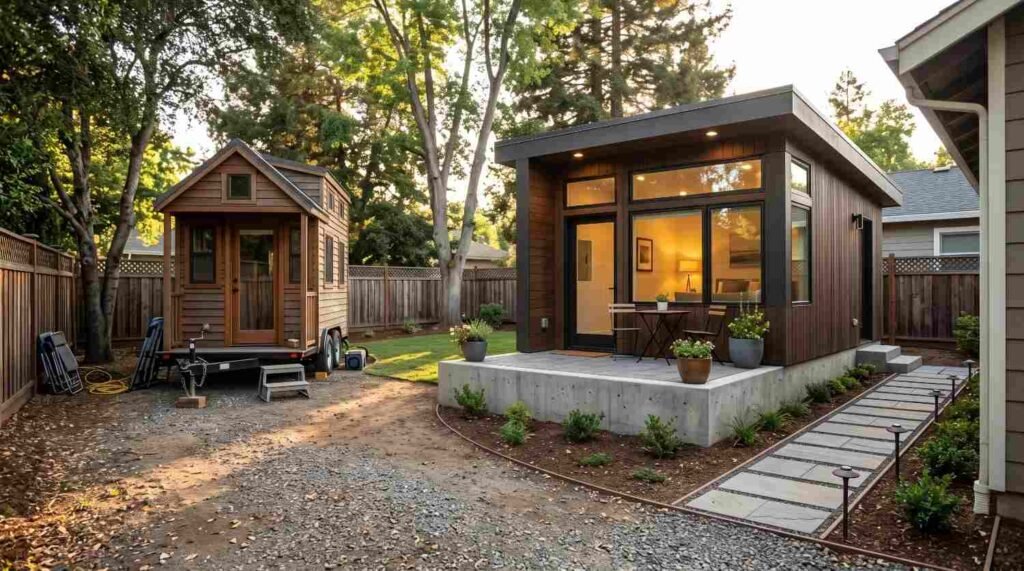
An ADU is a permanent structure built on a fixed foundation and tied to your property’s legal title. A tiny home is typically built on a trailer chassis and classified as personal property or a vehicle, not real estate. That distinction changes everything else about financing, permitting, and long-term value.
I get this question constantly from California homeowners weighing their options. And the confusion makes sense. Both structures are small, both promise flexibility, and both get marketed side by side online as if they’re interchangeable.
I want to walk you through how ADUs and tiny homes actually differ. I cover what each one is, how permitting and zoning treat them differently, what construction quality really looks like in each, and how cost and resale value stack up so you can pick the right path for your property.
What Is an ADU? Definition and Core Characteristics
An accessory dwelling unit is a secondary housing structure built on the same lot as a primary residence, permanently attached to a foundation, and connected to permanent utility systems. It falls under residential building codes in the state where it’s constructed.
I think of an ADU as a scaled-down version of a full home. It has plumbing tied into the main sewer or septic system, electrical wired to code, and a permanent foundation that qualifies it as real property.
California treats ADUs as a serious part of housing policy. The California Department of Housing and Community Development confirms that ADUs added to a property increase the assessed value of that property and are recorded as permanent improvements on the parcel.
Common ADU Types
There are three main configurations I run into most often.
A detached ADU stands as its own separate structure in the backyard. An attached ADU shares a wall with the primary home. A garage conversion repurposes existing square footage rather than adding new construction. Each type still requires a permanent foundation and full code compliance, regardless of size.
What Is a Tiny Home? Definition and Core Characteristics
A tiny home is a small-scale dwelling, typically under 400 square feet, built either on a permanent foundation or on a wheeled trailer chassis for mobility. The wheeled version is classified under vehicle or RV codes in most jurisdictions rather than residential building codes.
I want to be direct about this because it trips people up constantly. Tiny homes on wheels are NOT automatically legal dwellings on a piece of land. They fall into a legal gray zone depending on the county and how that jurisdiction chooses to classify recreational vehicles.
Tiny Homes on Wheels vs. Tiny Homes on Foundations
A tiny home on wheels moves with a trailer hitch and skips traditional foundation work entirely. A tiny home on a foundation gets treated far more like a small permanent structure and often needs to meet the same code standards as an ADU.
This single distinction determines almost everything downstream. It shapes financing options, insurance availability, and whether the structure adds to your property’s assessed value at all.
Foundation, Permitting, and Legal Classification Differences
An ADU requires a building permit, plan review, and inspection process identical in rigor to a full home addition. A tiny home on wheels often requires only a vehicle registration, and in many California counties, no residential permit whatsoever.
I’ve seen homeowners assume a tiny home skips bureaucracy entirely. That’s true in some counties and false in others, and the gap between those two outcomes creates real risk.
Zoning and Building Code Requirements
Local zoning ordinances dictate where an ADU can sit on a lot, how tall it can be, and how close it can sit to a property line. Tiny homes on wheels frequently fall outside these zoning rules because they’re not classified as permanent structures at all.
California passed statewide ADU streamlining laws specifically to reduce permitting friction for accessory dwelling units. Tiny homes on wheels received no equivalent statewide streamlining because they aren’t part of the same legal category.
Construction Quality, Materials, and Durability Comparison
An ADU gets built to the same residential building code as a full house, including structural engineering, insulation standards, and seismic requirements specific to California. A tiny home on wheels follows RV construction standards, which prioritize weight reduction over structural longevity.
I care about this difference a lot, because it’s where quality actually gets decided. Lightweight construction cuts towing weight on a tiny home. That same lightweight approach sacrifices insulation depth, wall thickness, and long-term structural resilience.
An ADU built on a permanent foundation uses standard framing lumber, code-compliant insulation, and full seismic bracing. A tiny home on wheels uses lighter materials engineered around a weight ceiling, which limits insulation R-value and reduces resistance to long-term wear.
Long-Term Performance and Maintenance
A permanently foundationed structure settles once and stays put. A wheeled structure experiences ongoing vibration and road stress every time it moves, which accelerates wear on seams, seals, and connections over its lifespan.
I always tell homeowners to think in decades, not years. An ADU built to residential code is engineered for 50+ years of service life. A tiny home on wheels is engineered closer to RV standards, which typically target a much shorter functional lifespan.
Cost, Financing, and Property Value Impact
An ADU typically costs more upfront because it requires a permanent foundation, full utility connections, and code-compliant construction. A tiny home on wheels costs less initially because it skips foundation work and often uses lighter, cheaper materials.
That upfront cost gap tells only part of the story. An ADU can be financed through a construction loan or home equity line because it’s classified as real property improvement. A tiny home on wheels typically only qualifies for personal loans or RV financing, which carry different terms entirely.
Resale Value and Investment Potential
An ADU adds directly to your home’s appraised value because appraisers count permanent square footage. A tiny home on wheels does not add to your appraised value in most cases, because appraisers exclude personal property from real estate valuations.
I see this play out constantly with investment-minded clients. An ADU functions as a long-term rental asset that increases the parcel’s overall value. A tiny home on wheels functions more like a depreciating vehicle asset, similar to an RV.
Which One Fits Your Goals? Use Cases and Decision Factors
An ADU fits homeowners planning long-term rental income, multigenerational housing, or a permanent value-add to their property. A tiny home fits people who want mobility, a lower upfront cost, or a temporary housing solution while they plan something bigger.
I ask every client the same question before we talk construction details. Are you building an asset that stays on this land forever, or are you building something that might move with you someday?
Questions to Ask Before You Choose a Builder
Ask what foundation type the builder specializes in and whether they hold licensing for residential code construction versus RV-standard construction. Ask for examples of completed ADUs or tiny homes with documented material specifications and inspection records.
A builder who can answer both questions clearly, with real project references, is one worth taking seriously. A builder who deflects the question is a red flag worth walking away from.
Conclusion
An ADU and a tiny home solve different problems entirely, from legal classification to long-term durability and resale value. Understanding these differences protects you from costly surprises during permitting, financing, and construction.
We build both structures to the highest construction standards California code allows, using durable materials and transparent project management from day one. Reach out to Tiny Home Builders California, and we’ll walk you through which option actually fits your land, your budget, and your long-term goals.
Frequently Asked Questions
Does an ADU add value to my property?
Yes. An ADU is a permanent structure that appraisers count as additional square footage, which directly increases your property’s assessed value.
Can I finance a tiny home on wheels with a mortgage?
No. A tiny home on wheels is classified as personal property in most cases, so it typically qualifies only for personal or RV-style financing instead.
Do tiny homes on wheels require a building permit in California?
It depends on the county. Many jurisdictions require only vehicle registration, while some require additional permits for utility hookups or placement.
Is an ADU more durable than a tiny home?
Generally yes. An ADU follows residential building code with full structural engineering, while a tiny home on wheels follows lighter RV-standard construction.
Can I convert my garage into an ADU instead of building new?
Yes. A garage conversion is one of the three common ADU types and often costs less than new detached construction.
What is the biggest legal difference between an ADU and a tiny home?
An ADU is real property tied to your land title, while a tiny home on wheels is typically classified as a vehicle under separate legal codes.
How long does an ADU typically last compared to a tiny home on wheels?
An ADU is engineered for 50 or more years of service life, while a tiny home on wheels follows RV standards built around a shorter functional lifespan.
ADU vs Tiny Home: Key Differences Explained
An ADU is a permanent structure built on a fixed foundation and tied to your property’s legal title. A tiny home is typically built on a trailer chassis and classified as personal property or a vehicle, not real estate. That distinction changes everything else about financing, permitting, and long-term value.
I get this question constantly from California homeowners weighing their options. And the confusion makes sense. Both structures are small, both promise flexibility, and both get marketed side by side online as if they’re interchangeable.
I want to walk you through how ADUs and tiny homes actually differ. I cover what each one is, how permitting and zoning treat them differently, what construction quality really looks like in each, and how cost and resale value stack up so you can pick the right path for your property.
What Is an ADU? Definition and Core Characteristics
An accessory dwelling unit is a secondary housing structure built on the same lot as a primary residence, permanently attached to a foundation, and connected to permanent utility systems. It falls under residential building codes in the state where it’s constructed.
I think of an ADU as a scaled-down version of a full home. It has plumbing tied into the main sewer or septic system, electrical wired to code, and a permanent foundation that qualifies it as real property.
California treats ADUs as a serious part of housing policy. The California Department of Housing and Community Development confirms that ADUs added to a property increase the assessed value of that property and are recorded as permanent improvements on the parcel.
Common ADU Types
There are three main ADU configurations I run into most often.A detached ADU stands as its own separate structure in the backyard. An attached ADU shares a wall with the primary home. A garage conversion repurposes existing square footage rather than adding new construction. Each type still requires a permanent foundation and full code compliance, regardless of size.
What Is a Tiny Home? Definition and Core Characteristics
A tiny home is a small-scale dwelling, typically under 400 square feet, built either on a permanent foundation or on a wheeled trailer chassis for mobility. The wheeled version is classified under vehicle or RV codes in most jurisdictions rather than residential building codes.
I want to be direct about this because it trips people up constantly. Tiny homes on wheels are NOT automatically legal dwellings on a piece of land. They fall into a legal gray zone depending on the county and how that jurisdiction chooses to classify recreational vehicles.
Tiny Homes on Wheels vs. Tiny Homes on Foundations
A tiny home on wheels moves with a trailer hitch and skips traditional foundation work entirely. A tiny home on a foundation gets treated far more like a small permanent structure and often needs to meet the same code standards as an ADU.
This single distinction determines almost everything downstream. It shapes financing options, insurance availability, and whether the structure adds to your property’s assessed value at all.
Foundation, Permitting, and Legal Classification Differences
An ADU requires a building permit, plan review, and inspection process identical in rigor to a full home addition. A tiny home on wheels often requires only a vehicle registration, and in many California counties, no residential permit whatsoever.
I’ve seen homeowners assume a tiny home skips bureaucracy entirely. That’s true in some counties and false in others, and the gap between those two outcomes creates real risk.
Zoning and Building Code Requirements
Local zoning and building code requirements dictate where an ADU can sit on a lot, how tall it can be, and how close it can sit to a property line. Tiny homes on wheels frequently fall outside these zoning rules because they’re not classified as permanent structures at all.
California passed statewide ADU streamlining laws specifically to reduce permitting friction for accessory dwelling units. Tiny homes on wheels received no equivalent statewide streamlining because they aren’t part of the same legal category.
Construction Quality, Materials, and Durability Comparison
An ADU gets built to the same residential building code as a full house, including structural engineering, insulation standards, and seismic requirements specific to California. A tiny home on wheels follows RV construction standards, which prioritize weight reduction over structural longevity.
I care about this difference a lot, because it’s where quality actually gets decided. Lightweight construction cuts towing weight on a tiny home. That same lightweight approach sacrifices insulation depth, wall thickness, and long-term structural resilience.
An ADU built on a permanent foundation uses standard framing lumber, code-compliant insulation, and full seismic bracing. A tiny home on wheels uses lighter materials engineered around a weight ceiling, which limits insulation R-value and reduces resistance to long-term wear.
Long-Term Performance and Maintenance
A permanently foundationed structure settles once and stays put. A wheeled structure experiences ongoing vibration and road stress every time it moves, which accelerates wear on seams, seals, and connections over its lifespan.
I always tell homeowners to think in decades, not years. An ADU built to residential construction quality standards is engineered for 50+ years of service life. A tiny home on wheels is engineered closer to RV standards, which typically target a much shorter functional lifespan.
Cost, Financing, and Property Value Impact
An ADU typically costs more upfront because it requires a permanent foundation, full utility connections, and code-compliant construction. A tiny home on wheels costs less initially because it skips foundation work and often uses lighter, cheaper materials.
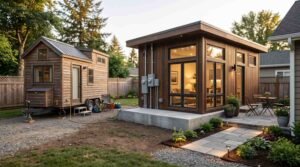
That upfront cost gap tells only part of the story. An ADU can be financed through a construction loan or home equity line because it’s classified as real property improvement. A tiny home on wheels typically only qualifies for personal loans or RV financing, which carry different terms entirely.
Resale Value and Investment Potential
An ADU adds directly to your home’s appraised value because appraisers count permanent square footage. A tiny home on wheels does not add to your appraised value in most cases, because appraisers exclude personal property from real estate valuations.
I see this play out constantly with investment-minded clients. An ADU functions as a long-term rental asset that increases the parcel’s overall value. A tiny home on wheels functions more like a depreciating vehicle asset, similar to an RV.
Which One Fits Your Goals? Use Cases and Decision Factors
An ADU fits homeowners planning long-term rental income, multigenerational housing, or a permanent value-add to their property. A tiny home fits people who want mobility, a lower upfront cost, or a temporary housing solution while they plan something bigger.
I ask every client the same question before we talk construction details. Are you building an asset that stays on this land forever, or are you building something that might move with you someday?
Questions to Ask Before You Choose a Builder
Ask what foundation type the builder specializes in and whether they hold licensing for residential code construction versus RV-standard construction. Ask for examples of completed ADUs or tiny homes with documented material specifications and inspection records.
A builder who can answer both questions clearly, with real project references, is one worth taking seriously. A builder who deflects the question is a red flag worth walking away from.
Conclusion
An ADU and a tiny home solve different problems entirely, from legal classification to long-term durability and resale value. Understanding these differences protects you from costly surprises during permitting, financing, and construction.
We build both structures to the highest construction standards California code allows, using durable materials and transparent project management from day one. Reach out to Tiny Home Builders California, and we’ll walk you through which option actually fits your land, your budget, and your long-term goals.
Frequently Asked Questions
Does an ADU add value to my property?
Yes. An ADU is a permanent structure that appraisers count as additional square footage, which directly increases your property’s assessed value.
Can I finance a tiny home on wheels with a mortgage?
No. A tiny home on wheels is classified as personal property in most cases, so it typically qualifies only for personal or RV-style financing instead.
Do tiny homes on wheels require a building permit in California?
It depends on the county. Many jurisdictions require only vehicle registration, while some require additional permits for utility hookups or placement.
Is an ADU more durable than a tiny home?
Generally yes. An ADU follows residential building code with full structural engineering, while a tiny home on wheels follows lighter RV-standard construction.
Can I convert my garage into an ADU instead of building new?
Yes. A garage conversion is one of the three common ADU types and often costs less than new detached construction.
What is the biggest legal difference between an ADU and a tiny home?
An ADU is real property tied to your land title, while a tiny home on wheels is typically classified as a vehicle under separate legal codes.
How long does an ADU typically last compared to a tiny home on wheels?
An ADU is engineered for 50 or more years of service life, while a tiny home on wheels follows RV standards built around a shorter functional lifespan.


