
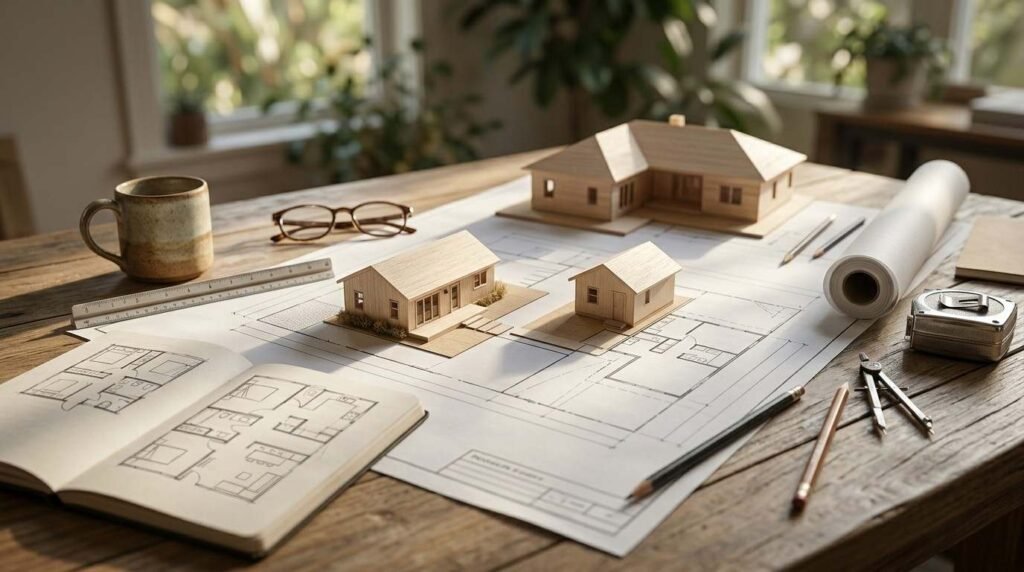
An ADU is a legally permitted secondary dwelling with its own kitchen, bathroom, and entrance, built on the same lot as a primary residence. A cottage or guest house often lacks that same legal independence, which changes everything about cost, permitting, and what you can actually do with the space. I’ve watched homeowners fall in love with a floor plan before checking which category it falls into, and that order of operations costs them months.
Getting this distinction wrong in California is expensive. Zoning boards reject plans, lenders deny financing, and rental income plans fall apart when a “guest house” turns out to be impermissible as a rental unit.
I walk through what separates these three structure types, what each one actually costs to build, how California law treats them differently, and how to figure out which one fits your property and your goals. Then I cover the legal landscape, the real cost breakdown, how to match the right structure to your situation, and what the build process looks like once you’ve made that call.
What Is an ADU, Cottage, and Guest House? (Core Definitions)
These three terms get used interchangeably in casual conversation, and that’s exactly the problem. Each one carries a distinct legal and structural meaning in California, and that meaning determines what you’re allowed to build and how.
I’ve had clients arrive with a Pinterest board full of “guest cottages” that were actually zoned as ADUs in the photos they were pulling from. The label matters less than the classification underneath it.
What Qualifies as an Accessory Dwelling Unit
An accessory dwelling unit is a secondary residential structure on a single-family or multifamily lot that includes independent living facilities, its own kitchen, bathroom, and sleeping area. California’s Department of Housing and Community Development confirms ADUs can be attached, detached, or converted from existing space like a garage.
That independence is the legal trigger. Because it functions as a complete dwelling, an ADU can be rented out separately from the main house.
I tell every homeowner the same thing here: if you want rental income, you’re building an ADU by definition, not a guest house.
What Defines a Cottage in Residential Construction
A cottage, in most California municipal codes, describes a small, freestanding structure that may or may not meet ADU standards. Some cottages are built specifically as ADUs and labeled that way for marketing. Others are smaller accessory structures that don’t include full independent living facilities.
The word “cottage” isn’t itself a legal classification in most jurisdictions. It’s descriptive, not regulatory, so I always push clients to ask their local planning department how the structure will actually be classified before they fall for the aesthetic.
What Makes a Structure a Guest House
A guest house traditionally refers to a structure meant for temporary occupancy by visitors, not permanent independent living. Many California jurisdictions restrict guest houses from having full kitchens specifically to prevent them from functioning as rental units.
That kitchen restriction is the detail people miss. A guest house with a full kitchen installed without proper permitting can trigger code enforcement, and I’ve seen it happen to homeowners who thought they were being resourceful.
Key Structural and Design Differences Between the Three
Beyond legal labels, these structures differ in what they physically contain and how they connect to utilities. That physical reality is what inspectors and appraisers actually evaluate.
Size, Layout, and Utility Requirements
ADUs in California are subject to statewide minimum and maximum size allowances, typically permitting up to 1,200 square feet for detached units depending on local ordinance. Cottages and guest houses often fall under separate, smaller size caps set by local code rather than state law.
Layout requirements track the same logic. An ADU needs a fully separated living space, while a guest house layout can flow more loosely since it isn’t meant for permanent independent occupancy.
Foundation, Utilities, and Independent Living Capability
An ADU requires its own utility connections capable of supporting independent living: water, sewer or septic capacity, and electrical service sized for full-time occupancy. Guest houses sometimes share utility connections with the main home, which simplifies the build but limits what the structure can legally become later.
This is where I see the most regret. Homeowners who build a guest house on shared utilities to save money often can’t convert it into a rental ADU without a full utility retrofit down the line.
ADU vs Cottage vs Guest House: Legal Classification in California
Legal classification is the single biggest factor separating these structures, and it’s decided at both the state and local level simultaneously.
Zoning Rules and Local Ordinances
Local zoning ordinances define lot coverage limits, setback requirements, and height restrictions that differ by structure type. A guest house might face a stricter setback requirement than an ADU because state law has specifically preempted local restrictions on ADUs in many cases.
Every city and county in California handles this differently, so a rule that applies in one municipality may not apply thirty miles away. I always recommend a direct call to the local planning department before finalizing any design.
Permitting Requirements by Structure Type
ADU permitting in California follows a streamlined, state-mandated ministerial process in most jurisdictions, meaning cities can’t use discretionary review to reject a compliant ADU application. Guest houses and general accessory structures often go through standard permitting review, which can take longer and carries more subjective approval risk.
That streamlined ADU process exists because of specific state legislation, which I cover next.
California State Laws Governing ADUs Specifically
State law has reshaped ADU policy dramatically over the past several years, and it’s worth understanding why ADUs get legal treatment that cottages and guest houses simply don’t.
Statewide ADU Legislation and Recent Updates
California has passed a series of ADU-specific laws since 2016 that limit how restrictive local jurisdictions can be regarding ADU size, parking requirements, and owner-occupancy rules. The California Department of Housing and Community Development tracks these changes and confirms that local agencies must approve compliant ADU applications within a mandated timeframe.
No equivalent statewide framework exists for cottages or guest houses. Those structures remain almost entirely governed by whatever the local municipal code says.
How State Law Overrides Local Restrictions
When a local ordinance conflicts with state ADU law, state law generally wins. This is called preemption, and it’s the reason ADU approvals move faster and more predictably than guest house or cottage approvals in most California cities.
I explain this to clients as leverage. Building an ADU gives you legal protections a “guest cottage” application simply doesn’t carry.
Cost Comparison: Building an ADU vs Cottage vs Guest House
Cost differences between these three structure types come down to square footage, utility independence, and the complexity of the permitting path.
Average Construction Cost Ranges by Type
ADU construction costs in California commonly run higher per square foot than a basic guest house because of the independent utility, kitchen, and code-compliance requirements. A stripped-down guest house without a kitchen or full bathroom can cost meaningfully less to build on the same footprint.
That said, cheaper upfront doesn’t always mean better value. A guest house built without full utilities saves money today and limits your options for the next decade.
Hidden Costs: Permits, Utilities, and Site Work
Permit fees, utility hookup costs, and site preparation frequently get underestimated in early budgeting conversations. ADU projects often carry impact fees tied to their classification as a full residential unit, while guest houses may avoid some of those fees precisely because they aren’t classified as independent dwellings.
Site work costs grading, access, utility trenching apply to all three structure types roughly equally, and I never let a client skip this line item in their budget.
Property Value and Investment Impact
The structure type you choose directly shapes what you can do with the finished space, both immediately and at resale.
Rental Income Potential by Structure Type
Only an ADU can typically be rented out as an independent unit under California law, since it meets the definition of a complete dwelling. A guest house without a kitchen generally can’t be legally rented as a separate residence, regardless of how it looks or how it’s marketed online.
This single fact drives most of my clients’ final decision. If rental income is the goal, the ADU classification isn’t optional.
Resale Value and Appraisal Considerations
Appraisers evaluate ADUs differently than guest houses because ADUs carry documented income potential and legal independence that shows up in comparable sales data. A well-built guest house adds value too, but it’s typically valued as an amenity rather than as income-producing square footage.
I tell every investor-minded client the same thing: build for the appraisal you want, not just the structure you like the look of.
Choosing the Right Option for Your Property and Goals
Once the legal and cost pictures are clear, the decision usually comes down to how you actually plan to use the space.
Best Fit for Multigenerational Living
Families housing aging parents or adult children often lean toward an ADU specifically because it offers full independent living, a private kitchen, bathroom, and entrance without sacrificing proximity. That independence matters for both privacy and daily logistics.
A guest house works fine here too, provided nobody needs full-time independent living facilities.
Best Fit for Rental Income or Guest Use
If the goal is short-term guest hosting only, a guest house without a kitchen keeps costs lower and permitting simpler. If the goal is long-term rental income, the ADU path is the only one that gets you there legally in most California jurisdictions.
I ask this question first, before we ever discuss floor plans, because it changes the entire project scope.
Construction Timeline and Process Differences
Timeline expectations differ meaningfully across these three structure types, largely because of the permitting path each one follows.
Design and Approval Timeline by Type
ADU approvals in California move on a mandated ministerial timeline in most cities, often resolving faster than discretionary guest house or cottage applications that face standard planning review. That predictability is valuable when a project has a hard completion deadline.
Guest house approvals can stretch longer simply because they’re subject to more local discretion.
Build Duration and Project Management Factors
Actual construction duration depends more on square footage and site conditions than on legal classification alone. A 600-square-foot ADU and a 600-square-foot guest house take roughly the same amount of time to physically build once permits clear.
The real timeline difference happens before ground ever breaks, in the approval phase.
Common Mistakes Homeowners Make When Choosing
The most expensive pitfall is building a guest house on shared utilities with the intention of converting it into a rental ADU later, as retrofitting separate sewer lines, panel capacity, and an unpermitted kitchen often costs far more than roughing them in from day one.
Homeowners also frequently assume California’s streamlined state ADU protections apply to any backyard build, only to face strict local setbacks, subjective discretionary reviews, or code enforcement violations because the structure was formally permitted as an accessory cottage or guest quarters rather than a true independent dwelling.
Misjudging Zoning, Budget, or Long-Term Use
The most expensive mistake I see is building a guest house on a budget, then trying to convert it into a rental ADU two years later. That retrofit, adding a kitchen, upgrading utilities, and refiling permits, often costs more than building it correctly the first time.
The second most common mistake is assuming state ADU protections apply to a structure that was never actually classified as an ADU. They don’t. Classification has to be right from the permit application forward.
How to Work With a Builder to Get It Right
Protect your investment by confirming in writing exactly how the builder plans to classify the project with your local planning department before any architectural drafting begins.
Ask direct questions about whether the proposed utility trenching and electrical capacity are engineered for independent full-time living or future conversion, and choose a team that understands how local municipal codes align with state preemption rules so your structure is built legally, efficiently, and on budget the first time.
Questions to Ask Before Committing to a Structure Type
Ask any builder directly how they plan to classify the structure with your local planning department, and get that answer in writing before design work begins. Ask what utility capacity the structure will have, and whether that capacity supports future conversion if your needs change.
We walk every client at Tiny Home Builders California through this classification conversation before a single design line gets drawn, because getting it wrong on paper is far more expensive than getting it wrong on a whiteboard.
Conclusion
ADUs, cottages, and guest houses look similar on the surface but carry very different legal weight, cost structures, and long-term flexibility. The right choice depends on classification, utility independence, and what you actually need the space to do.
California’s ADU laws now offer real advantages in permitting speed and rental legality that cottages and guest houses simply don’t share. That gap is worth understanding before you commit to a design.
We help homeowners across California choose the right structure from day one and build it correctly the first time. Reach out to Tiny Home Builders California to map out the option that actually fits your property and your goals.
Frequently Asked Questions
What is the main difference between an ADU and a guest house?
An ADU includes full independent living facilities, including a kitchen, while a guest house typically lacks a full kitchen and can’t legally function as a separate rental unit in most California jurisdictions.
Can a guest house be converted into an ADU later?
Converting a guest house into an ADU usually requires adding full kitchen facilities and upgrading utility connections, then refiling for ADU classification with the local planning department.
Do California ADU laws apply to cottages and guest houses too?
California’s statewide ADU protections, including streamlined permitting timelines, apply specifically to structures classified as ADUs and generally don’t extend to cottages or guest houses.
Which costs more to build, an ADU or a guest house?
An ADU typically costs more per square foot than a basic guest house because it requires a full kitchen, bathroom, and independent utility installations that a guest house can often skip.
Can I rent out a guest house for long-term income?
Most California jurisdictions don’t allow guest houses without full kitchens to be rented as independent long-term units, which is why rental income plans typically require ADU classification instead.
How long does ADU permitting take compared to a guest house?
ADU permitting in California follows a mandated ministerial review process in most cities, often resolving faster than standard discretionary review required for guest houses.
Does building an ADU increase my property value more than a guest house?
ADUs often add more appraised value because they carry documented rental income potential, while guest houses are typically valued as an amenity rather than income-producing square footage.
What should I ask a builder before choosing between these three options?
Ask how the builder plans to classify the structure with local planning, what utility capacity it will have, and whether the design supports future conversion if your needs change.


