
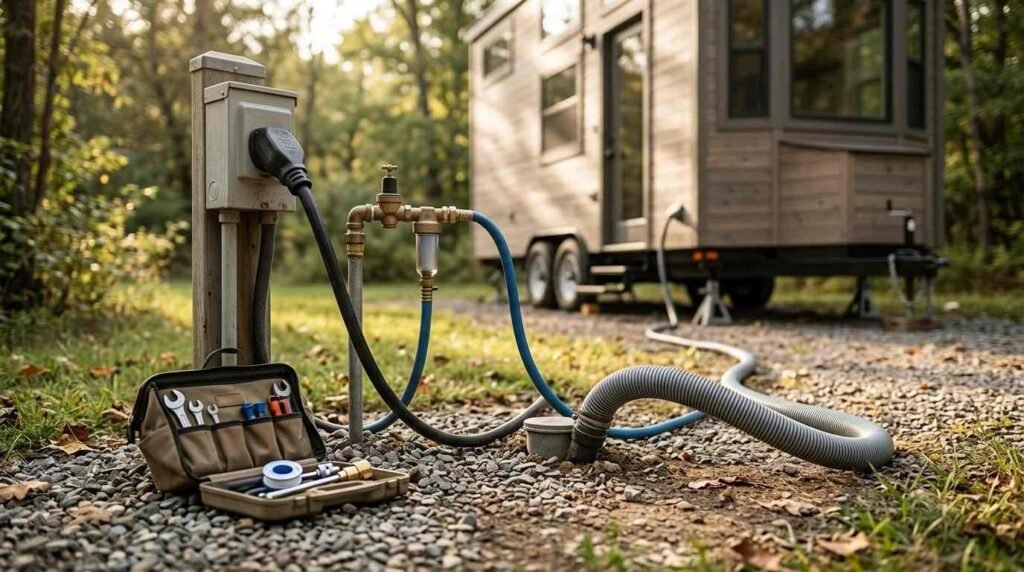
Water and power decide where a tiny house can actually live. I have watched people fall in love with a build, then get stuck for months figuring out how to hook up water, sewer, and electricity once it lands on a piece of land or a pad site. Every hookup path- RV park, grid-tied, or fully off-grid- comes with its own equipment list, cost range, and rulebook.
Getting this wrong stalls a move-in date or triggers a code violation that costs real money to fix. I have seen owners install the wrong amperage service, or skip a permit step, and end up ripping out work that was already paid for. None of this is complicated once the systems are laid out clearly.
I cover what hooking up actually means for a tiny house, how RV park and grid connections work in practice, what off-grid power, water, and wastewater systems require, and how heating, connectivity, and cost stack up across every option. By the end, the right hookup path for a specific piece of land or lifestyle becomes obvious.
What “Hooking Up” a Tiny House Actually Means
Hooking up a tiny house means connecting it to the three utilities every home needs: water, power, and wastewater removal. A tiny house on wheels handles this differently than a stationary tiny house on a foundation.
Tiny house hookup is the process of connecting a small dwelling’s water, electrical, and sewage systems to an external source, whether that source is a utility company, a campground pedestal, or a self-contained off-grid system. Every hookup decision traces back to this three-system framework.
The Three Core Utility Systems Every Tiny House Needs
Water supply, electrical service, and wastewater disposal make up the full hookup picture. Skipping any one of them turns a tiny house into a camping trailer instead of a livable home.
I always tell people to map out all three before choosing land or a park. A great electrical setup means nothing if there is no plan for graywater.
Mobile vs Stationary Setup Differences
A tiny house on wheels connects and disconnects like an RV, using quick-connect hoses and cords built for regular movement. A stationary tiny house on a permanent foundation gets hard-plumbed and hard-wired, much closer to a standard home installation.
Movement frequency changes almost every decision downstream, including permit requirements and equipment durability needs.
Hooking Up at an RV Park or Campground
RV parks offer the fastest path to full utility hookup because the infrastructure already exists. Water spigots, sewer drains, and electrical pedestals sit right at the site, and connecting takes an afternoon rather than a construction project.
This route works best for people testing tiny house living before committing to land ownership.
Water Hookup at RV Parks
A drinking-water-rated hose connects the tiny house’s fresh water inlet to the park’s spigot, and a pressure regulator prevents park water pressure from damaging interior plumbing. I never skip the regulator step. Municipal park water pressure runs higher than most tiny house plumbing is rated for, and that mismatch causes slow leaks that show up months later.
Sewer and Wastewater Hookup at RV Parks
A sewer hose runs from the tiny house’s waste outlet directly into the park’s sewer connection, typically a capped pipe at ground level. A slinky-style flexible hose with a secure clamp on both ends stops leaks and smells at the connection point.
Black water and gray water often share one line at RV parks, so a straight-through connection usually covers both.
Electrical Hookup (30-Amp vs 50-Amp Service)
Most RV parks offer either 30-amp or 50-amp service, and matching a tiny house’s electrical draw to the right amperage protects the system. 30-amp service handles basic appliances and lighting, while 50-amp service supports larger loads like electric ranges, multiple air conditioners, or an EV charger running simultaneously.
Tiny house electrical service is a connection type rated in amperage that determines how much simultaneous electrical load a dwelling can safely draw from an external power source. A dogbone adapter converts a 50-amp tiny house cord down to a 30-amp pedestal, or the reverse, when park service does not match the house’s factory wiring.
Connecting to the Municipal Grid on Private Land
Grid-tied setups on private land turn a tiny house into a permanent residence with full utility company service. This route takes longer upfront, but it delivers the most stable, long-term utility access of any hookup type.
I recommend this path to anyone planning to stay on one piece of land for years rather than months.
Permitting for Grid-Tied Tiny Houses
Local building departments require permits before any utility company connects water, power, or sewer service to a structure. Permit requirements shift by county and city, and a tiny house often gets classified differently depending on square footage, foundation type, and whether it sits on wheels or a permanent slab.
Water and Sewer Connection to Municipal Lines
A licensed plumber ties the tiny house’s water line into the municipal main, and a separate line connects to either the municipal sewer system or a septic tank on the property. Septic system design depends heavily on soil type and the number of expected occupants, so a percolation test usually comes first.
Electrical Panel and Meter Installation
A licensed electrician installs a dedicated electrical panel and meter base, and the utility company runs service to that meter once inspection passes. An electrical meter base is the enclosure that houses the utility company’s metering equipment and marks the legal point of connection between a structure and the public grid. Utility companies will not energize a line until final inspection sign-off happens.
Going Off-Grid: Power Systems for Tiny Houses
Off-grid power means the tiny house generates and stores its own electricity instead of pulling from a utility line. Solar arrays paired with battery banks handle most daily loads, while generators cover gaps during low-sun stretches.
This path demands the most upfront investment, and it delivers the most independence from land location or utility availability.
Solar Power Systems and Battery Banks
A solar array captures sunlight through photovoltaic panels, a charge controller regulates the power flowing into a battery bank, and an inverter converts stored DC power into usable AC power for household appliances. The U.S. Department of Energy reports that a typical residential solar setup pays for itself in energy savings within 6 to 10 years, and that math holds up even at the smaller scale of a tiny house system.
Battery bank sizing depends on daily energy consumption and the number of cloudy days a location experiences in a typical season.
Generators as Backup or Primary Power
A generator burns gasoline, propane, or diesel to produce electricity on demand, and most off-grid tiny house owners run one as backup rather than a primary source. Fuel storage and noise both factor into placement decisions, and a transfer switch keeps generator power from backfeeding into a solar system.
Off-Grid Water Solutions
Off-grid water means the tiny house stores or captures its own supply rather than connecting to a pipe. Fresh water tanks and rainwater catchment cover most off-grid needs, sometimes working together as a combined system.
Fresh Water Tanks and Delivery
A fresh water tank stores a fixed supply that gets refilled through delivery service or manual hauling, and tank size determines how often refills happen. A family of four typically drains a 100-gallon tank within about a week of normal use.
Rainwater Catchment Systems
A rainwater catchment system routes runoff from a roof through gutters into a filtered storage tank, and a first-flush diverter keeps the initial dirty runoff out of the clean storage supply. A rainwater catchment system is a water collection setup that channels precipitation from a roof surface into filtered storage for household use. Catchment volume depends entirely on local rainfall patterns and roof surface area.
Off-Grid Wastewater and Sewage Management
Off-grid wastewater management replaces a sewer connection with self-contained systems that treat or store waste on-site. Composting toilets, graywater systems, and blackwater tanks each handle a different part of the waste stream.
Composting Toilets
A composting toilet separates liquid and solid waste, using heat, ventilation, and sometimes additives to break down solid waste into a soil-like material over time. A composting toilet is a waterless fixture that converts human waste into compostable material through aerobic decomposition. Most off-grid tiny house owners empty the solid waste chamber every three to eight weeks depending on usage.
Greywater Systems
Greywater refers to wastewater from sinks and showers, excluding toilet waste, and a greywater system typically filters and redirects this water for irrigation or further treatment. Local health codes govern exactly how greywater can be discharged, and some jurisdictions ban surface discharge entirely.
Black Water Holding Tanks
A black water holding tank stores toilet waste until it gets pumped out by a septic service, and tank capacity determines how often that pump-out needs to happen. Most off-grid tiny house setups pair a 30 to 40 gallon black tank with a pump-out schedule of every two to four weeks.
Heating, Cooling, and Propane Hookups
Climate control in a tiny house depends heavily on propane and compact HVAC equipment, especially in off-grid setups where running a full-size furnace draws too much power. Propane fuels cooking, heating, and hot water in most tiny house builds regardless of hookup type.
Propane Tank Sizing and Safety
Propane tank size ranges from small 20-pound cylinders used for cooking up to large 100-pound or 420-gallon tanks that fuel whole-house heating systems. A licensed propane technician handles tank placement and line connections, since improper installation creates a real fire and explosion risk.
Mini-Split and Off-Grid HVAC Options
A mini-split system delivers efficient heating and cooling without ductwork, drawing far less power than a central HVAC system. Energy Star data shows ductless mini-split heat pumps can cut heating and cooling energy use by roughly 50% compared to electric resistance heating, which matters enormously when every watt comes from a limited battery bank.
Internet and Connectivity Off-Grid
Staying connected off-grid usually comes down to cellular data or satellite service, since wired internet rarely reaches remote parcels. Both options run entirely on the tiny house’s existing power system.
Cellular Hotspots and Satellite Internet
A cellular hotspot pulls data through nearby cell towers, working well within range of decent signal, while satellite internet services work almost anywhere with a clear view of the sky. Satellite equipment draws more continuous power than a cellular hotspot, which factors into off-grid power budgeting.
Costs of Each Hookup Type Compared
Cost varies dramatically across RV park, grid-tied, and off-grid hookups, and comparing them side by side makes the trade-offs obvious. RV park hookup costs the least upfront but carries ongoing site fees, while off-grid costs the most upfront with no recurring utility bill.
RV Park vs Grid vs Off-Grid Cost Breakdown
RV park hookup typically runs a few hundred dollars in hoses, cords, and adapters, plus a monthly site fee. Grid-tied connection on private land often costs several thousand dollars in permitting, trenching, and utility hookup fees. A complete off-grid power, water, and wastewater system commonly runs into the tens of thousands, depending on solar capacity and tank sizing.
Long-term costs flip the picture. Off-grid ownership eliminates monthly utility and site fees entirely once the system is paid for.
Permits, Codes, and Legal Considerations by Hookup Type
Every hookup type answers to some form of local regulation, and ignoring that reality creates expensive problems later. RV parks self-regulate through park rules, while grid and off-grid setups on private land answer to county building and health departments.
Zoning and Land Use Rules
Zoning determines whether a tiny house can legally sit on a given parcel at all, separate from utility questions entirely. Agricultural, residential, and rural zoning designations each carry different rules about accessory dwellings and minimum square footage.
Working With Inspectors and Utility Companies
A building inspector signs off on electrical, plumbing, and structural work before a utility company will activate service, and scheduling these inspections early prevents move-in delays. Utility companies also maintain their own separate approval process for new service connections, distinct from local building department sign-off.
Conclusion
Hooking up a tiny house comes down to matching water, power, and wastewater systems to a chosen setting. RV parks, the grid, and off-grid land each demand a different mix of equipment, permits, and cost.
Getting these systems right the first time protects both the investment and the daily comfort of living in the space. The choice ultimately depends on land, budget, and how much independence a homeowner wants from utility companies.
We help homeowners plan tiny house builds with hookup requirements in mind from day one. Reach out to Tiny Home Builders California to map out the right power, water, and wastewater setup for any piece of land.
Frequently Asked Questions
Can a tiny house connect to city water and sewer?
Yes, a tiny house connects to city water and sewer when it sits on land zoned for that connection and passes local permitting and inspection. A licensed plumber ties the water line into the municipal main and connects wastewater to the sewer system.
How much solar power does an off-grid tiny house need?
Most off-grid tiny houses need between 800 and 3,000 watts of solar capacity depending on appliance load and battery bank size. Daily energy consumption and average sunlight hours in the location determine the exact number.
Do tiny houses need a special electrical hookup?
Tiny houses need an electrical hookup matched to their amperage rating, typically 30-amp or 50-amp, similar to RV electrical standards. A dogbone adapter bridges a mismatch between the house’s cord and the available service.
Is it legal to live off-grid in a tiny house in California?
Legality depends on county zoning and whether the tiny house meets local building and health code requirements for water and waste disposal. Some California counties permit off-grid living with approved composting toilets and water storage; others require a septic system.
What is the cheapest way to hook up a tiny house?
RV park hookup is typically the cheapest option, requiring only hoses, cords, and adapters plus a site fee. Off-grid and grid-tied setups on private land carry far higher upfront equipment or permitting costs.
How often does a black water tank need to be emptied?
A typical 30- to 40-gallon black water tank needs emptying every two to four weeks under normal single- or double-occupant use. Usage frequency and tank size both affect that timeline directly.


