
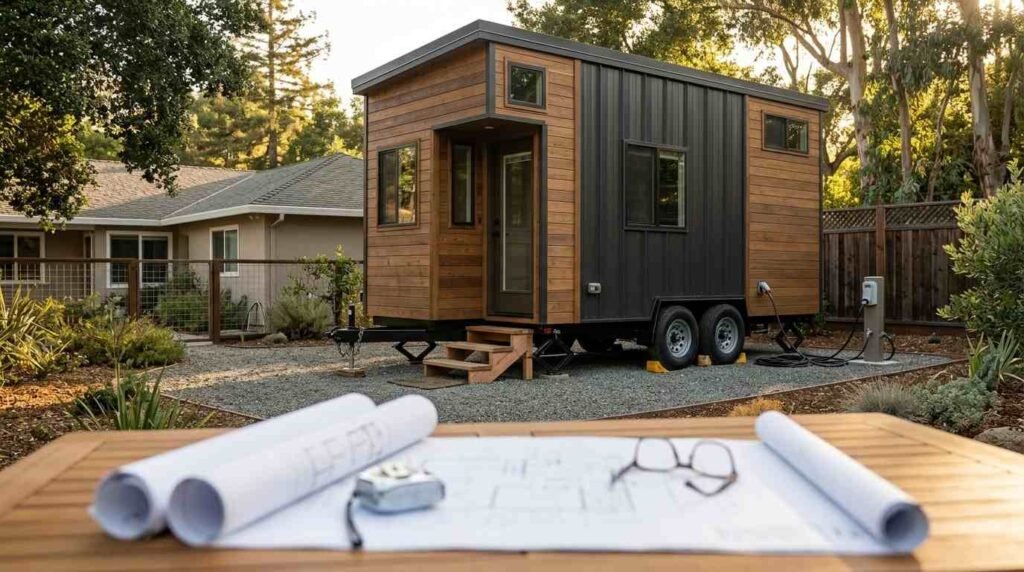
A tiny house on wheels is legally classified as a recreational vehicle in most of California, not a permanent dwelling, and that single distinction controls almost everything about where you can park it. The short answer is this: your options come down to private property as a permitted ADU, RV parks and campgrounds, or specific tiny-house-friendly jurisdictions that have written new ordinances. Street parking, unpermitted backyard living, and most vacant land don’t qualify no matter how good the location looks.
I’ve watched too many people buy or build a tiny house first and ask about legal parking second. That order causes real problems: fines, forced moves, financing headaches, months of wasted rent. Getting the zoning question answered early changes the entire trajectory of the project.
Here’s what I’m covering: how California classifies these homes and why that classification creates so much confusion, the zoning and state laws that actually govern placement, where you can legally park on private land or in RV communities, where you’re guaranteed to run into trouble, the permits and utility rules that come with legal placement, and how to confirm everything before you spend a dollar.
What Makes Tiny House Parking a Legal Gray Area
Tiny houses on wheels sit in an odd space between two legal categories that were never built with them in mind. That mismatch is the root of almost every parking dilemma owners run into.
RVs vs. Dwellings: How Classification Changes Everything
A recreational vehicle is a vehicle built for temporary or recreational occupancy, not permanent residency, and California treats most tiny houses on wheels exactly this way when they’re built on a trailer chassis. That classification puts them under vehicle code and RV park rules instead of residential building code.
I see this trip people up constantly. A tiny house can look, function, and feel like a permanent home while carrying a legal status that restricts it to temporary or recreational placement. The trailer and axles that make it mobile are the same features that keep it out of standard residential zoning.
Builders certified through the RV Industry Association get a different set of doors open RV parks and campgrounds that require RVIA certification for insurance and liability reasons. A tiny house without that certification gets locked out of those communities entirely, no matter how well it’s constructed.
Why Rules Vary So Much by City and County
California doesn’t have one statewide tiny house law. Zoning is set at the city and county level, and each jurisdiction interprets state ADU legislation, RV codes, and residential codes differently.
That’s why a placement that’s fully legal in Fresno County can be a code violation two counties over. I always tell people the same thing: the state law sets the ceiling, but the local planning department sets the actual rule on the ground.
Zoning Codes and Land Use Classifications in California
Zoning determines what structures can legally exist on a piece of land, and it’s the first filter every tiny house placement has to pass through.
Residential Zoning and Accessory Dwelling Unit (ADU) Rules
An accessory dwelling unit is a secondary housing unit on a residential lot that meets a jurisdiction’s specific size, utility, and permitting requirements. Many California cities now allow a tiny house on wheels to qualify as an ADU when it’s on a permanent foundation or meets a locality’s mobile ADU provisions.
The catch is that “on wheels” and “ADU-qualified” don’t automatically go together. Some counties require the wheels removed or skirting installed before they’ll issue an ADU permit, which changes the whole legal character of the structure.
I recommend calling the planning department before assuming ADU status applies. The rules shift often enough that what worked for a neighbor last year isn’t guaranteed today.
Agricultural and Rural Zoning Allowances
Agriculturally zoned land in California often has more flexibility for temporary or seasonal dwellings tied to farm work, which opens a door tiny house owners frequently overlook. Rural counties tend to enforce zoning less aggressively than dense urban areas.
That flexibility isn’t unlimited. Ag zoning still requires the structure to serve a documented agricultural purpose in many counties, and pure residential use without that connection can still draw a violation.
California State Laws Affecting Tiny Houses on Wheels
State legislation sets the baseline that every county and city has to work within, even when local rules add more restrictions on top.
AB 68, AB 881, and SB 13 ADU Legislation Impact
California’s Department of Housing and Community Development confirms that AB 68, AB 881, and SB 13 collectively reduced parking requirements, shortened permit timelines, and expanded where ADUs can be built statewide. These bills were written with backyard cottages in mind, but many counties now extend the same framework to tiny houses on wheels that meet foundation and utility standards.
The practical effect is real. Permit approval timelines that used to stretch past 120 days now move faster in jurisdictions that adopted the state’s streamlined ADU process.
Vehicle Code Requirements for THOWs Registered as RVs
A tiny house on wheels registered as an RV has to meet California vehicle code standards covering dimensions, weight, and equipment before it can legally travel on public roads. Registration status also determines which insurance products and RV park agreements apply.
This registration path keeps the structure classified as a vehicle rather than a dwelling, which matters when a local zoning office is deciding whether your placement counts as residential occupancy.
Parking a Tiny House on Wheels on Private Property
Private land ownership gives you the most control, but it doesn’t hand you unlimited freedom. Local code still governs what you can do on your own lot.
Backyard Placement as an ADU
Placing a tiny house in a backyard as a permitted ADU is one of the most stable long-term parking solutions available in California right now. It requires meeting setback distances, lot coverage limits, and utility connection standards specific to the jurisdiction.
I’ve worked through this process with owners in a handful of counties, and the setback requirement trips people up more than anything else. A lot that looks plenty big on paper can fail the permit application once required distances from property lines get factored in.
Permit Requirements for Long-Term Occupancy
Long-term occupancy on private land almost always requires a building permit, a certificate of occupancy, or an ADU permit; simple property ownership doesn’t grant automatic permission. Skipping this step is one of the most common and costly mistakes I see.
Working with a tiny house builder in California who already understands local permit requirements saves months of back-and-forth with planning departments. That knowledge is worth as much as the construction itself.
Parking a Tiny House on Wheels in RV Parks and Campgrounds
RV parks and campgrounds offer one of the clearest legal paths available, since they’re already zoned and licensed for this exact use case.
Length-of-Stay Restrictions
Most California RV parks cap continuous stays somewhere between 30 and 180 days, depending on the park’s business license and local zoning designation. Long-term or full-time living arrangements need a park explicitly licensed for that use.
I always tell people to get the stay limit in writing before signing anything. Verbal assurances from a park manager don’t hold up if the county later enforces its actual permit terms.
RV Certification Requirements (RVIA vs. NOAH)
RVIA certification and NOAH certification are the two main compliance standards RV parks check before allowing a tiny house on wheels onto their property. A structure without one of these certifications gets turned away at a significant share of parks, regardless of build quality.
This is a decision that has to happen before construction starts, not after. Retrofitting a completed tiny house to meet certification standards costs far more than building to that standard from day one.
Tiny House Friendly Cities and Counties in California
A growing number of California jurisdictions have written specific ordinances addressing tiny houses on wheels, and knowing which ones simplifies the entire search process.
Cities With Established Tiny House Ordinances
Fresno was among the first California cities to formally legalize tiny houses on wheels as permanent residences on a single-family lot, setting a precedent other jurisdictions have since studied. San Luis Obispo County and parts of Sonoma County have followed with their own updated provisions.
These ordinances typically specify minimum square footage, foundation requirements, and utility connections. Reading the actual ordinance text beats relying on secondhand summaries, since the details determine whether your specific build qualifies.
Counties Actively Updating Tiny House Policy
Several California counties are in active review of their tiny house policies as housing pressure continues to push local governments toward more flexible options. Policy in this space shifts fast enough that a county’s stance can change within a single legislative cycle.
I check in with local planning offices every few months for exactly this reason. What’s accurate today has a real chance of being outdated within a year.
Where You Cannot Legally Park a Tiny House on Wheels
Knowing where placement fails is just as important as knowing where it succeeds, and it saves owners from expensive trial and error.
Street Parking and Overnight Parking Restrictions
Overnight parking on public streets is restricted or banned outright in the vast majority of California cities, and a tiny house on wheels gets treated the same as any oversized vehicle under those ordinances. Citations and towing are standard enforcement responses.
This is the single most common mistake I see from new owners. Street parking might work for a night during transport, but it’s never a legitimate long-term solution.
HOA Restrictions and Deed Covenants
Homeowners association rules and deed covenants frequently prohibit RVs, trailers, and non-conforming structures on residential lots, and a tiny house on wheels usually falls squarely into that category. Local zoning approval doesn’t override a private HOA restriction.
I’ve seen owners get full city permit approval only to be blocked by their own HOA’s covenant language. Reading that document before buying land saves a painful surprise later.
Permits, Inspections, and Utility Hookup Requirements
Legal parking isn’t a one-time approval. It comes with ongoing compliance obligations tied to permits, inspections, and utilities.
Building Permits vs. RV Permits
A building permit applies when a tiny house is treated as a fixed dwelling, while an RV permit applies when it stays classified as a mobile vehicle, and each path carries different inspection requirements. Choosing the wrong path early creates rework and delay later.
Septic, Water, and Electrical Connection Rules
Every legal placement needs a compliant connection to water, sewer or septic, and electrical service, and California counties inspect these connections before issuing final approval. Off-grid systems are permitted in some rural counties but typically require separate permits of their own.
I recommend confirming utility rules for a specific parcel before finalizing any land purchase. A beautiful lot with no viable septic solution turns into a very expensive problem.
Risks of Parking a Tiny House on Wheels Illegally
Skipping the legal groundwork doesn’t just risk inconvenience. It creates financial and legal exposure that follows the owner directly.
Fines, Citations, and Forced Removal
Local code enforcement can issue daily fines for illegal occupancy, and in persistent cases, order the structure removed from the property entirely. Some counties escalate to liens against the land itself when fines go unpaid.
Insurance and Financing Complications
Insurance carriers routinely deny claims on tiny houses parked illegally, since coverage is contingent on the structure meeting its stated legal use. Financing and lending products tied to the property can also be affected when the placement violates local code.
I always push people to treat legal compliance as a financial protection issue, not just a bureaucratic one. An uninsured, unpermitted structure is a liability sitting on the land.
How to Confirm Legal Parking Before You Buy or Build
A short conversation with the right department before construction begins prevents nearly every problem covered above.
Questions to Ask Your Local Planning Department
Ask directly whether a tiny house on wheels qualifies as an ADU on the specific parcel, what foundation or wheel-removal requirements apply, and what utility connections the county requires for final approval. Get every answer confirmed in writing whenever the department allows it.
Working With a Tiny House Builder Who Knows Local Codes
An experienced tiny house builder in California has already navigated these zoning conversations across multiple counties and knows which questions actually matter. That experience shortens the research phase significantly and reduces the chance of a costly zoning mistake.
We walk clients through exactly this process at Tiny Home Builders California, connecting construction decisions to the local code realities that determine where the finished home can legally sit.
Conclusion
Where you can legally park a tiny house on wheels in California comes down to classification, zoning, and the specific rules of your city or county. Private ADU placement, licensed RV parks, and tiny-house-friendly jurisdictions remain the clearest paths forward.
Confirming these details before construction protects your investment and your ability to actually live in the home you build. We help clients at Tiny Home Builders California build with local code realities in mind from day one, so the home you design is a home you can legally place. Reach out to us before you break ground, and let’s map out where your tiny house can actually live.
Frequently Asked Questions
Can I legally park a tiny house on wheels in my backyard in California?
Yes, in many California jurisdictions, a tiny house on wheels can be permitted as an ADU in a backyard. Requirements vary by county, so confirming setback and utility rules first is essential.
Is it legal to live in a tiny house on wheels full-time in California?
It depends on classification and location. Full-time living is legal when the structure qualifies as a permitted ADU or sits in a jurisdiction with specific tiny house ordinances.
Do I need RVIA certification to park in an RV park?
Most California RV parks require RVIA or NOAH certification for insurance and liability reasons. A tiny house without either certification is often turned away regardless of build quality.
Can I park a tiny house on wheels on agricultural land?
Agricultural zoning sometimes allows more flexibility, but many counties require the structure to serve a documented farm-related purpose. Pure residential use without that connection can still trigger a violation.
What happens if I park a tiny house on wheels illegally?
Code enforcement can issue daily fines and order the structure removed. Illegal placement also commonly voids insurance coverage and complicates financing.
Are HOA rules stricter than city zoning approval?
Yes, in practice. A city can approve your placement while your HOA’s deed covenant still prohibits it, since HOA restrictions operate independently of municipal zoning.
Which California cities have specific tiny house ordinances?
Fresno was among the first to formally legalize tiny houses on wheels as permanent residences, with San Luis Obispo County and parts of Sonoma County adopting similar provisions since.
Can I park my tiny house on a public street overnight?
Overnight street parking is restricted or banned in most California cities for oversized vehicles, including tiny houses on wheels. It’s never a reliable long-term parking solution.
How do I confirm if my land allows tiny house parking?
Contact the local planning department directly and ask about ADU qualification, foundation requirements, and utility connection rules for your specific parcel before buying or building.


