
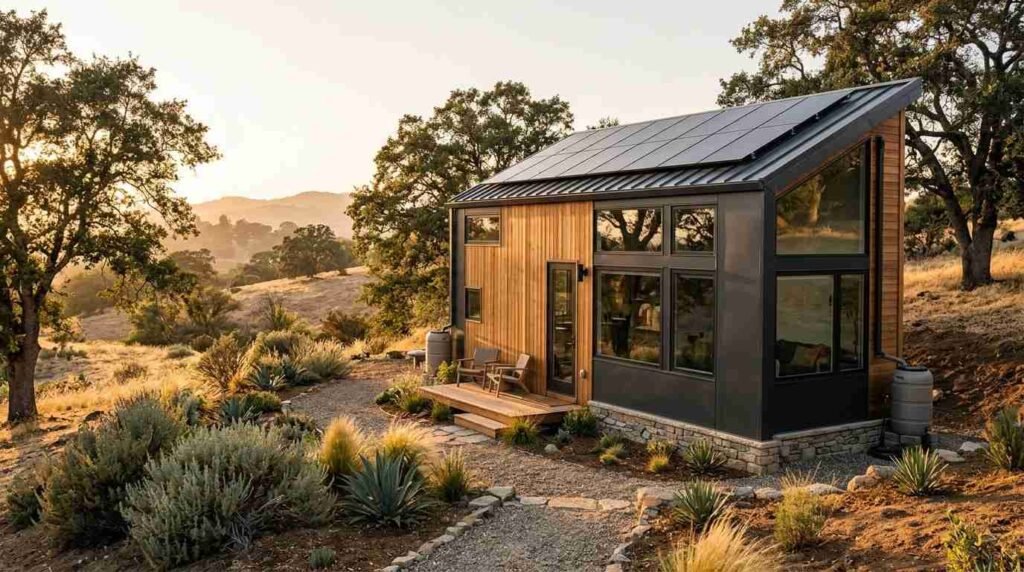
A well-designed solar and insulation package can cut a tiny house’s utility bills by more than half within the first year. I’ve watched homeowners obsess over the wrong features while ignoring the ones that actually move the needle on their monthly costs. And that gap between what looks eco-friendly and what actually saves money is where most tiny house budgets go sideways.
California’s climate and building codes make this decision even more specific. What works in a mild coastal microclimate doesn’t always pencil out the same way in the high desert or the Sierra foothills, and the incentives shift depending on where you build.
I’ll walk through what actually makes a tiny house eco-friendly, how solar, insulation, water systems, and materials each play into your upfront and long-term costs, what California’s rules mean for your build, and how to prioritize features when your budget can’t cover everything at once.
What Makes a Tiny House Truly Eco-Friendly
An eco-friendly tiny house is a compact dwelling that reduces its environmental footprint through energy efficiency, sustainable materials, water conservation, and reduced resource consumption relative to conventional homes. That definition matters because “eco-friendly” gets slapped on products that barely qualify.
I look at four categories when I evaluate a build: energy systems, water systems, material sourcing, and passive design. A home that nails two out of four isn’t eco-friendly; it’s partially eco-friendly, and that distinction affects your actual savings.
Sustainable Materials vs. Green Certifications
Certifications like LEED or Energy Star tell you a product met a testing standard. They don’t automatically tell you it’s the right material for a 200-square-foot footprint. I’ve seen certified materials underperform in tiny homes because the certification was designed around full-size house assumptions.
Sustainable materials, on the other hand, get judged on sourcing, embodied carbon, and how they behave in a small, tightly sealed structure. Both matter, but they answer different questions.
How Eco-Features Differ From Standard Tiny Home Builds
Standard tiny home builds prioritize cost-per-square-foot and speed. Eco-features add upfront cost in exchange for lower operating costs, and that tradeoff only makes sense when the payback period fits your ownership timeline.
I always ask clients how long they plan to keep the home. A five-year flip and a forever-home decision lead to completely different feature lists.
Solar Power Systems and Energy Independence
Solar is usually the single biggest eco-investment on a tiny house, and it’s also the one with the clearest return on investment. The U.S. Department of Energy notes that residential solar systems typically pay for themselves within 6 to 10 years, and tiny homes often land on the shorter end of that range because their energy demand is so much lower.
A smaller roof means a smaller system, which means a smaller upfront cost. That math changes everything about how fast solar pays off on a tiny footprint compared to a full-size house.
Solar Panel Sizing for Tiny Home Roofs
Most tiny houses run on a 2 to 4 kW solar array, well below the 6 to 10 kW systems common on standard homes. I size the array against actual appliance load, not against roof space, because oversizing wastes money and undersizing leaves you dependent on grid backup.
Roof pitch and orientation matter more on a tiny house than a standard build simply because there’s less surface area to work with. Every degree of misalignment costs you real output.
Battery Storage and Off-Grid Capability
Battery storage is where the eco-friendly premium gets steep. A basic lithium battery bank adds thousands to the build, and going fully off-grid multiplies that cost again.
I tell most clients to grid-tie first and add storage later once the panels have proven their output. Retrofitting storage is straightforward on a well-designed electrical system.
High-Performance Insulation and Building Envelope
Insulation is the quiet workhorse of tiny house efficiency. A tightly sealed envelope reduces heating and cooling loads more than almost any other single feature, and it costs far less than solar per dollar of savings delivered.
I rank insulation above solar for most budgets because a poorly insulated tiny house will waste solar-generated power just as fast as grid power.
Insulation Materials That Perform in Small Spaces
Spray foam, rigid foam board, and sheep’s wool insulation all outperform standard fiberglass batts in tiny house walls, mainly because tiny house wall cavities are thinner and every R-value point counts more.
Spray foam costs more upfront but seals air gaps that batts simply can’t reach in tight framing. That air-sealing quality often matters more than the raw R-value number on the product label.
Air Sealing and Thermal Bridging Prevention
Thermal bridging happens when a material conducts heat through the wall assembly faster than the surrounding insulation allows, and tiny houses see this constantly at steel frame junctions and window edges.
Continuous exterior insulation breaks that bridge. It’s a small added material cost that prevents a chronic, invisible energy leak for the life of the home.
Water Conservation and Greywater Systems
Water systems in a tiny house serve two goals at once: cutting utility bills and enabling off-grid or low-hookup living. A composting toilet alone eliminates the water and sewer connection cost entirely in many builds.
I treat water conservation as both an environmental feature and a genuine construction cost reducer, especially on rural California lots without existing utility infrastructure.
Composting Toilets and Water-Saving Fixtures
A composting toilet uses no water and no sewer connection, which can save thousands in septic or hookup costs on a remote lot. Paired with low-flow fixtures, a tiny house can cut water consumption by more than half compared to a standard bathroom setup.
The tradeoff is maintenance. Composting toilets need regular emptying and a bit of a mindset shift for anyone used to conventional plumbing.
Rainwater Harvesting for Tiny Homes
Rainwater collection systems capture roof runoff into a storage tank for irrigation or, with filtration, potable use. In California’s dry season, that stored water often becomes the deciding factor between a self-sufficient property and one still tethered to a water truck delivery schedule.
Tank size and roof catchment area determine how much you actually collect. A small tiny house roof limits volume, so this feature works best paired with realistic water-use expectations.
Sustainable and Reclaimed Building Materials
Material choice affects both the embodied carbon of the build and its long-term durability. Reclaimed wood, recycled metal siding, and low-VOC finishes reduce environmental impact while often costing less than premium new materials.
I source reclaimed material locally whenever the project timeline allows for it, since shipping distance erodes a lot of the environmental benefit reclaimed materials are supposed to offer.

Reclaimed Wood, Metal, and Low-VOC Finishes
Reclaimed wood carries character and history that new lumber can’t replicate, and it often costs less per board foot than premium new hardwood. Low-VOC paints and finishes protect indoor air quality, which matters even more in a tightly sealed 200-square-foot space than in a standard home.
Recycled metal siding holds up well against California wildfire risk zones, adding a durability benefit on top of the sustainability angle.
Durability Tradeoffs of Eco-Materials
Not every eco-material lasts as long as its conventional counterpart. Bamboo flooring, for example, scratches more easily than hardwood despite its fast-growing sustainability credentials.
I walk clients through these trade-offs honestly. An eco-material that needs replacement in eight years isn’t actually the cheaper long-term choice once you factor in that replacement cost.
Passive Design Strategies That Reduce Utility Costs
Passive design costs nothing extra in materials, only planning. Orienting the home correctly and placing windows with intention can cut heating and cooling loads before a single mechanical system gets installed.
This is the most overlooked eco-feature category because it doesn’t show up as a line item on a materials invoice, yet it drives real ongoing savings.

Orientation, Window Placement, and Natural Ventilation
South-facing windows capture winter sun in most of California, while properly placed operable windows create cross-ventilation that reduces air conditioning dependence in summer. This decision gets locked in the moment the foundation or trailer position is set.
I map the sun path against the lot before finalizing window placement. Getting this wrong on a tiny house is far more costly to fix than on a full-size home, because there’s rarely room to add a window later.
Thermal Mass and Passive Cooling
Materials like concrete countertops or tile flooring absorb heat during the day and release it slowly at night, smoothing out temperature swings without any mechanical system running.
In hot inland California climates, thermal mass paired with night ventilation can meaningfully reduce reliance on air conditioning through the shoulder seasons.
Energy-Efficient Appliances and Smart Systems
Appliances sized correctly for tiny house demand use a fraction of the energy that standard full-size appliances draw. A mini-fridge and a two-burner induction cooktop simply don’t need the power a full kitchen suite requires.
Smart systems layer on top of that efficiency by giving homeowners real visibility into where their energy actually goes.

Right-Sizing Appliances for Tiny Footprints
Oversized appliances waste energy and waste space in a home where every square foot counts double. Induction cooktops heat faster and lose less energy than gas or standard electric coils, making them a strong fit for compact kitchens.
Combination washer-dryer units and compact heat-pump water heaters round out the short list of appliances built specifically for this scale.
Smart Thermostats and Energy Monitoring
A smart thermostat learns occupancy patterns and adjusts heating and cooling automatically, which matters more in a tiny house where temperature swings happen fast due to the small air volume.
Real-time energy monitoring lets homeowners catch a phantom load or a malfunctioning appliance before it shows up as a surprise on the utility bill.
Upfront Cost vs. Long-Term Savings Breakdown
Every eco-feature comes with a payback period, and understanding that number is the difference between a smart investment and an expensive feeling of doing the right thing. Solar might run 6 to 10 years to break even, while basic insulation upgrades often pay back in 2 to 4 years.
I build a simple cost-versus-payback table for every client before we finalize the feature list, because sticker price alone tells you nothing about long-term value.
Payback Periods for Common Eco-Features
Insulation upgrades typically deliver the fastest payback, followed by water-saving fixtures, then solar, then battery storage as the slowest-recovering investment. Reclaimed materials often cost less upfront, so they don’t carry a traditional payback period at all.
Ranking features by payback speed helps prioritize a limited construction budget toward the choices that recover cost the fastest.
Financing and Incentive Programs in California
State and utility rebate programs frequently offset a meaningful chunk of solar and efficiency upgrade costs for California homeowners. The California Energy Commission administers incentive programs that can reduce the net cost of qualifying solar and storage installations.
I recommend checking current program eligibility before finalizing a solar system size, since incentive structures shift from year to year.
California-Specific Regulations and Incentives
California’s building code adds a layer of complexity that doesn’t exist in every state. Title 24 energy standards apply to most permitted residential structures, tiny houses on foundations included.
I walk every California client through these requirements early, because a design that ignores Title 24 can face costly revisions mid-build.

Title 24 Energy Code Considerations
Title 24 sets minimum energy efficiency requirements covering insulation, window performance, and mechanical systems for permitted structures in California. The California Energy Commission confirms these standards apply statewide and are updated on a regular cycle.
Tiny houses built on wheels as RVs often fall outside Title 24 jurisdiction, while foundation-built tiny homes generally must comply. That distinction changes your design requirements substantially.
Local Rebates and Permitting Notes
Permitting requirements and available rebates vary significantly by county and even by city within California. Some jurisdictions actively encourage tiny house construction with streamlined ADU permitting, while others still lack clear pathways.
I check local permitting rules before finalizing any eco-feature that requires inspection sign-off, since a rejected permit costs more time than the feature ever saves in utility bills.
How to Prioritize Eco-Features on a Budget
Nobody builds every eco-feature on their first tiny house. Budget constraints force real tradeoffs, and knowing which features to prioritize protects both your wallet and your long-term satisfaction with the home.
I always start with the features that cost the least and save the most, then work toward the bigger investments as budget allows.
High-ROI Features to Start With
Insulation upgrades, LED lighting, and passive design choices like window placement cost little to nothing extra and deliver savings from day one. These belong in every eco-friendly tiny house build regardless of budget size.
Water-saving fixtures and a properly sized mini-split system round out the short list of features that pay for themselves quickly.
Features Worth Delaying or Skipping
Battery storage and full off-grid systems carry the longest payback periods and the highest upfront cost. I tell most clients to delay these until after move-in, once actual energy use patterns are confirmed.
Some reclaimed material choices also cost more than expected once transportation and finishing labor get factored in, so I evaluate those case by case rather than assuming reclaimed always means cheaper.
Conclusion
Eco-friendly tiny house features connect directly to long-term cost savings when chosen with payback periods in mind. Solar, insulation, water systems, and passive design each contribute differently to that equation.
California’s climate and building codes shape which features make sense on your specific lot and timeline. Getting this right from the design phase avoids expensive changes later.
We help California homeowners build tiny houses that balance eco-friendly performance with real financial sense. Reach out to Tiny Home Builders California to start planning a build that pays you back.
Frequently Asked Questions
Do eco-friendly tiny houses actually cost less to build?
Not always upfront. Eco-features often add initial cost, but they lower ongoing utility bills, so the total cost of ownership drops over the life of the home.
What’s the fastest payback eco-feature for a tiny house?
Insulation upgrades typically pay back in 2 to 4 years, faster than solar or battery storage. They also require no ongoing maintenance once installed.
Is solar worth it on a tiny house roof?
Yes, for most California climates. Smaller roof size means a smaller, cheaper system, and lower energy demand shortens the payback period compared to full-size homes.
Do tiny houses need to meet Title 24 energy code?
Foundation-built tiny homes generally must comply with Title 24. Tiny houses built as RVs on wheels typically fall outside that jurisdiction.
Are composting toilets worth the maintenance tradeoff?
For off-grid or remote lots, yes. They eliminate sewer hookup costs entirely, though they require regular emptying and a shift in daily habits.
How much can insulation upgrades save on utility bills?
Well-insulated tiny houses often cut heating and cooling costs by more than half compared to standard-code insulation, since the small air volume responds quickly to envelope improvements.
Should I go off-grid on my first tiny house build?
Most builders recommend grid-tying first and adding battery storage later. This avoids paying for an oversized off-grid system before real energy use patterns are known.
What eco-features should I prioritize on a tight budget?
Start with insulation, passive window placement, and LED lighting. These cost little extra and deliver savings immediately, unlike higher-cost features like battery storage.


