
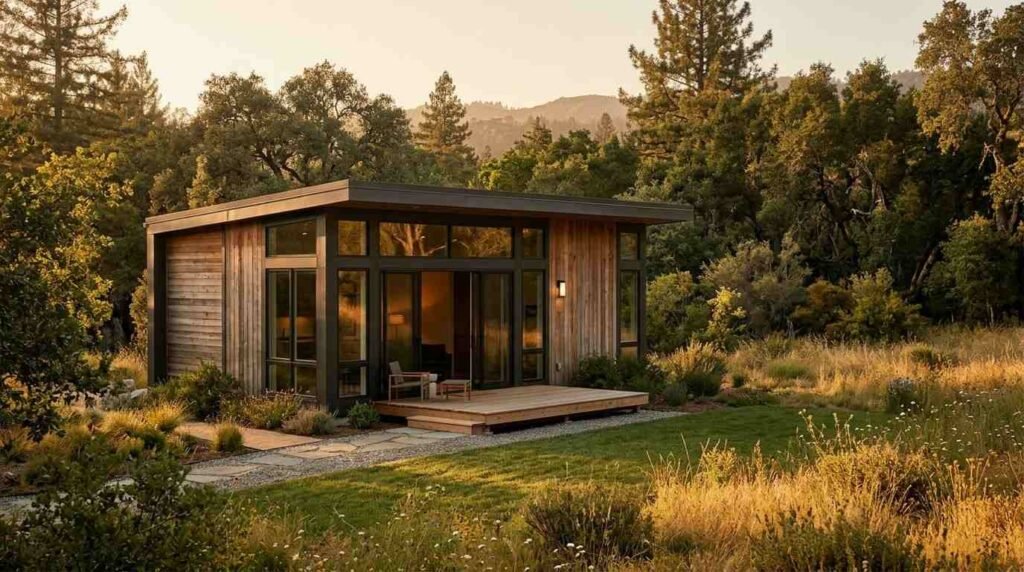
A park model home is a factory-built dwelling under 400 square feet that California classifies separately from both manufactured housing and RVs. Zoning rules, not the home’s construction, decide whether you can legally live in one on a given piece of land.
Most buyers assume if they own the land, they can place a park model home on it. That assumption causes permit denials, red tags, and costly relocations every year.
This guide covers what legally qualifies as a park model home, the state and county rules that govern placement, where you can put one on private, agricultural, or ADU-eligible land, and the permits, setbacks, and HOA restrictions that decide whether your plan holds up.
What Counts as a Park Model Home in California?
A park model home is a transportable recreational unit built on a single chassis, under 400 square feet, and intended for long-term or semi-permanent installation rather than frequent travel. California regulates it under a distinct category from manufactured homes and standard RVs.
The distinction matters because zoning codes reference these categories by name, not by appearance. A unit that looks identical to a tiny home on wheels can fall under completely different placement rules depending on how it’s titled and certified.
ANSI A119.5 is the certification standard that defines a true park model home, and inspectors check for this certification before approving placement in most jurisdictions.
Park Model Home vs. Tiny Home vs. RV – Legal Differences
The core legal difference comes down to certification and intended use, not size. Park model homes are certified to ANSI A119.5, RVs are certified to ANSI A119.2 for recreational travel, and tiny homes on wheels often carry no standardized certification at all, which leaves many counties uncertain how to classify them.
That certification gap is why some California counties treat tiny homes on wheels as RVs for placement purposes, restricting them to short-term stays, while a properly certified park model home can qualify for longer-term installation under park model-specific provisions.
Is a Park Model Home Considered a Permanent Dwelling?
A park model home is not automatically considered a permanent dwelling under California law, even when it sits on a fixed foundation for years. Permanent dwelling status depends on foundation type, utility connections, and local occupancy rules, not on how long the unit has been in place.
Counties that allow park models as permanent residences generally require a permanent foundation system and full utility hookups, treating the structure more like a manufactured home than a vehicle. Without those elements, many jurisdictions cap occupancy at seasonal or recreational use only.
I’ve seen homeowners get caught off guard when they assume years of continuous living automatically earns permanent status. It doesn’t. The paperwork and foundation type decide that, not the calendar.
California State Laws That Govern Park Model Placement
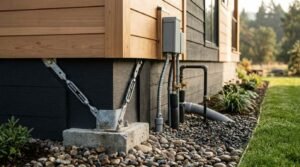
California regulates park model homes primarily through Title 25 of the California Code of Regulations, which falls under the Department of Housing and Community Development (HCD). Title 25 sets the construction and installation standards that every park model must meet before it can be legally occupied anywhere in the state.
HCD oversight means park model homes are inspected and registered similarly to manufactured homes, separate from the vehicle registration RVs go through with the DMV. This registration pathway is what allows a park model to be installed with a foundation rather than simply parked.
State law establishes the baseline, but it does not override local zoning. A park model can meet every Title 25 requirement and still be denied placement if the city or county zoning code doesn’t permit that land use in that specific zone.
Title 25 and HCD Regulations for Park Models
Title 25 requirements cover construction standards, fire safety, electrical systems, and installation specifications specific to park model units. HCD requires an insignia or label confirming compliance before a park model can be legally installed or sold within California.
| Requirement Area | What Title 25 Covers |
| Construction Standards | Structural integrity, materials, fire-rated assemblies |
| Installation | Foundation anchoring, tie-downs, utility connection specs |
| Registration | HCD insignia, title and registration documentation |
| Inspection | Pre-installation and occupancy inspections |
Zoning Classifications That Allow Park Model Homes
Zoning classification determines whether a park model home can be placed on a given parcel at all, regardless of what state law permits. Residential, agricultural, commercial, and mixed-use zones each carry different allowances, and most prohibit park models outright unless a specific overlay or variance applies.
Residential zones zoned for single-family use typically restrict placement to licensed mobile home parks unless the unit qualifies as an accessory dwelling unit. Agricultural zones are often more permissive, since many counties allow farmworker or caretaker housing in structures that meet park model specifications.
Mixed-use and rural residential zones vary the most by county, which makes a zoning verification call to the local planning department a non-negotiable first step before purchasing land with a park model in mind.
Residential, Agricultural, and Mixed-Use Zoning Differences
Each zoning category applies a different standard to park model placement, and confusing one for another is the single most common planning mistake buyers make.
- Single-family residential (R-1): Generally prohibits standalone park models unless classified as an ADU.
- Agricultural (A-1, A-2): Often allows park models for farm labor housing or as a secondary dwelling.
- Rural residential: Frequently permits park models on larger lots with fewer density restrictions.
- Mixed-use/commercial: Rarely permits residential park model placement without a specific variance.
Can You Put a Park Model Home on Private Property?
You can put a park model home on private property in California if the parcel’s zoning designation permits that use and the unit meets foundation and utility requirements. Private ownership of the land does not override zoning law.
Owning the land only solves half the equation. The county still has to classify the zoning in a way that allows a park model as a dwelling, not just as storage or a recreational structure.
I always tell prospective buyers to confirm zoning before closing on land, not after. A beautiful rural lot can still come back zoned in a way that blocks residential park model use entirely.
Placing a Park Model Home in a Licensed Mobile Home Park
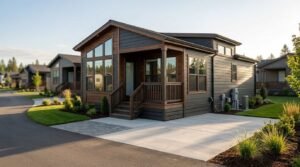
A licensed mobile home park is the most straightforward path to legally placing a park model home, since these parks are zoned specifically for manufactured and park model housing. Park management and county permitting work together under pre-established rules.
These parks already carry the utility infrastructure, space allocations, and HCD-compliant pads that make installation faster than on raw land. The tradeoff is less control over lot size, design restrictions, and monthly space rent obligations.
Licensed parks remain the lowest-friction option for anyone prioritizing speed and certainty over land ownership and long-term flexibility.
Placing a Park Model Home on Agricultural or Rural Land
Agricultural and rural zoning often provides the most flexibility for park model placement outside of licensed parks, particularly on parcels designated for farm use or low-density rural residential development. Many counties permit a secondary dwelling for farm labor or family use under these classifications.
Rural parcels also tend to carry fewer neighbor-proximity restrictions, though well and septic requirements add their own permitting layer that residential-zoned properties with municipal utilities don’t face.
Park Model Homes as ADUs (Accessory Dwelling Units)
A park model home can qualify as an Accessory Dwelling Unit (ADU) in California when it meets the state’s ADU standards for foundation, utility connection, and size, even though it was originally built as a factory unit. ADU classification opens up residential lots that would otherwise prohibit standalone park model placement.
California’s statewide ADU law pushed cities to streamline approval processes, and several jurisdictions now explicitly recognize manufactured and park model units as eligible ADU structures as long as they’re permanently affixed. This creates a legal path onto single-family residential lots that pure park model zoning would normally block.
The unit still needs to pass the same inspection and foundation requirements any ADU would, so a park model being “ADU-eligible” in one city doesn’t guarantee approval everywhere.
California ADU Law and Park Model Eligibility
California’s ADU legislation requires most cities to approve qualifying ADUs within 60 days of a complete application, and several counties have extended that streamlined process to cover manufactured and park model units on permanent foundations.
Eligibility generally requires the unit to meet local setback minimums, connect to the same utility systems as the primary residence, and pass structural inspection equivalent to stick-built ADU standards.
County-by-County Variation in Park Model Placement Rules
Park model placement rules vary significantly from one California county to the next, and no statewide standard dictates lot size, setback distance, or permitted zoning categories uniformly. What’s approved in one county can be denied two counties over on an otherwise identical parcel.
Rural counties with lower population density tend to have more permissive agricultural and rural residential allowances, while coastal and high-density counties often impose stricter design review and density caps. This variation is exactly why pulling the local zoning code before purchasing land matters more than any general state guideline.
Builders who work across multiple counties learn quickly that assuming consistency between jurisdictions is one of the fastest ways to delay a project by months.
Permits Required to Place a Park Model Home
Placing a park model home in California requires a combination of foundation, utility connection, and occupancy permits issued by the local building department, in addition to the HCD insignia confirming Title 25 compliance. Skipping any one of these typically blocks final occupancy approval.
The permitting sequence usually starts with a zoning verification letter, followed by foundation plans, utility connection permits for water, sewer, or septic, and electrical, and finishes with a final inspection before an occupancy certificate is issued.
Foundation, Utility Hookup, and Occupancy Permits
Each permit type addresses a different compliance requirement, and most counties require them in sequence rather than in parallel.
| Permit Type | Purpose | Typically Issued By |
| Foundation Permit | Confirms anchoring/tie-down meets code | County Building Department |
| Utility Connection Permit | Approves water, sewer/septic, electrical hookup | County Public Works/Health Dept |
| Occupancy Permit | Confirms unit is legally habitable | County Building Department |
Setback, Lot Size, and Spacing Requirements
Setback and lot size requirements for park model homes depend entirely on the property’s zoning designation, with most residential and rural zones requiring a minimum distance from property lines, roads, and neighboring structures. These distances typically range from 10 to 25 feet depending on the zone.
Minimum lot size requirements also vary, with some agricultural zones allowing park models on parcels as small as one acre, while certain residential overlays require significantly more land per dwelling unit.
Spacing rules between multiple structures on the same parcel add another layer, particularly when a park model is being added as a secondary unit alongside an existing primary residence.
HOA and Deed Restrictions That Can Override Zoning
A homeowners association or deed restriction can prohibit a park model home even when local zoning law would otherwise allow it. HOA covenants operate independently of municipal zoning and are enforced through private legal agreements rather than the county planning department.
Deed restrictions recorded decades ago sometimes contain language banning “mobile,” “manufactured,” or “temporary” structures that courts have interpreted broadly enough to include park model homes, regardless of modern certification standards.
Checking the preliminary title report and any recorded CC&Rs before purchasing land is a step too many buyers skip, only to discover the restriction after the unit has already arrived.
Utility Connection Requirements for Legal Placement
Legal placement of a park model home requires connection to an approved water source, sewer or septic system, and electrical service that meets the same standards applied to conventional residential construction. A unit running on temporary hookups typically cannot receive a permanent occupancy permit.
Properties without existing municipal utility access need a septic system evaluation and well permitting before placement can move forward, which adds both cost and timeline that buyers on raw rural land frequently underestimate.
Where You Cannot Legally Place a Park Model Home
Certain zoning categories and locations prohibit park model homes outright, regardless of land ownership, HCD certification, or foundation quality. Pure commercial zones, industrial zones, and most dense urban residential zones without ADU provisions fall into this category.
Floodplain-designated parcels, areas lacking approved utility access with no feasible well or septic option, and land under certain conservation easements also commonly block placement. Some HOA-governed communities ban them entirely through covenant language regardless of underlying zoning.
Confirming a “no” answer early saves far more time and money than discovering it after a unit has been purchased and delivered.
Steps to Confirm a Property Is Zoned for a Park Model Home

Confirming zoning eligibility before purchasing land or ordering a park model home prevents the most common and costly placement mistakes. The process follows a predictable sequence regardless of county.
- Call the county planning department and ask specifically whether park model homes are permitted in the parcel’s zoning designation.
- Request a zoning verification letter in writing, since verbal confirmation isn’t always reliable for future disputes.
- Check for HOA or deed restrictions through a preliminary title report.
- Confirm utility access, including water, sewer/septic feasibility, and electrical service availability.
- Review setback and lot size requirements specific to that zoning category.
- Determine ADU eligibility if the parcel is zoned single-family residential.
- Apply for permits in sequence starting with zoning verification, then foundation, utility, and occupancy permits.
Conclusion
A park model home’s legal placement depends on zoning classification, HCD compliance, permits, and local restrictions working together, not on land ownership alone. California’s rules shift by county, zone, and even HOA covenant.
Every property tells a different story once you dig into agricultural overlays, ADU eligibility, and utility access. Verifying zoning before you buy land or order a unit protects your entire investment.
We help California homeowners navigate these placement decisions from day one. Reach out to Tiny Home Builders California before you commit to land or a build.
Frequently Asked Questions
Is it legal to live in a park model home full-time in California?
Full-time living in a park model home is legal in California when the unit meets Title 25 requirements and sits on a zoning-approved parcel with a permanent foundation. Without that combination, occupancy is typically restricted to seasonal or recreational use.
Do park model homes need a permanent foundation?
Park model homes need a permanent foundation to qualify as a full-time residence or ADU in most California jurisdictions. Units on temporary supports are generally classified as recreational and face stricter occupancy limits.
Can I place a park model home on land I own in California?
You can place a park model home on land you own only if the parcel’s zoning designation allows that use. Ownership alone does not override local zoning or HOA restrictions.
Are park model homes allowed in all mobile home parks?
Park model homes are not automatically allowed in every mobile home park, since individual parks set their own size, age, and design restrictions on top of county zoning rules. Confirming park-specific rules before purchase is essential.
Does a park model home count toward property taxes?
A park model home counts toward property taxes once it’s permanently affixed to a foundation and registered with the county assessor rather than the DMV. Units still titled as vehicles are taxed differently.
Can a park model home be used as a rental property?
A park model home can be used as a rental property when local zoning permits residential rental use and the unit meets occupancy and safety permitting requirements. Short-term rental rules add additional local restrictions in many counties.
What size lot do I need for a park model home in California?
Lot size requirements for a park model home range from about one acre in some agricultural zones to larger minimums in certain residential overlays. The exact requirement depends entirely on the parcel’s zoning classification.


