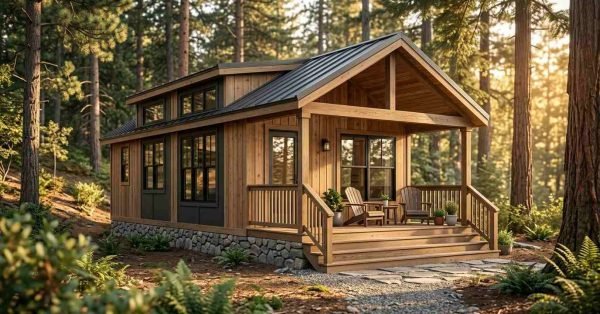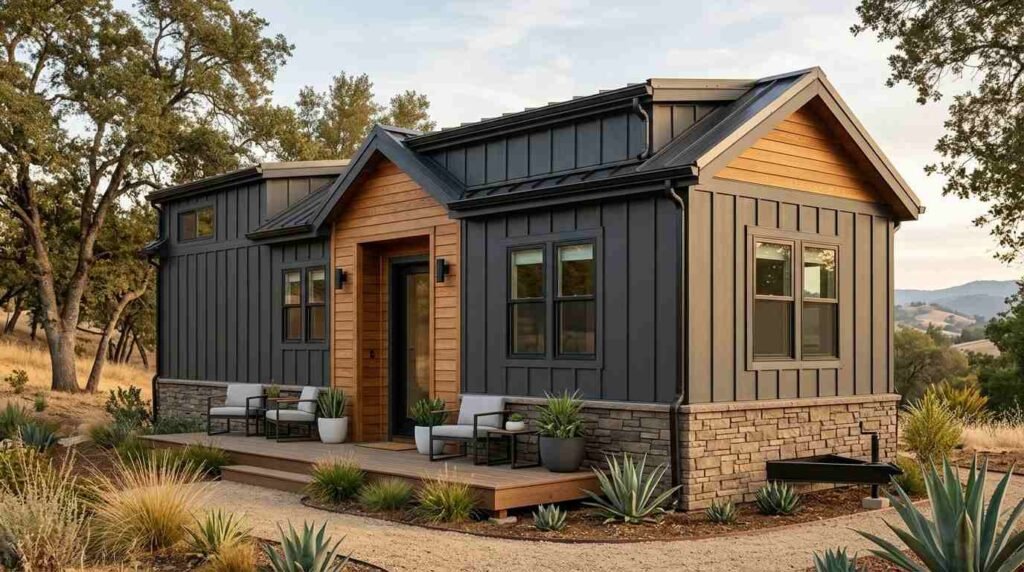
I’ve walked prospective homeowners through this decision more times than I can count, and the question is always the same: which siding actually holds up. Park model home siding is the exterior cladding material applied to a park model’s walls that protects the structure from weather, pests, and UV exposure while contributing to its insulation and visual style. It’s one of the few decisions that affects your home’s appearance, energy bills, and maintenance workload all at once.
Get this choice wrong and you’re repainting, resealing, or replacing panels within five years instead of twenty.
This guide covers how siding functions on a park model structure and how that differs from a stick-built home, the full range of material options from vinyl to fiber cement to stucco, how those materials stack up on durability, cost, and energy performance, and what matters specifically if you’re building in California’s varied climate zones. I’ll also cover installation, maintenance, and how siding choice plays into resale value.
What Siding Does for a Park Model Home
Siding is the exterior layer of a park model home that shields the structural wall assembly from moisture, wind, pests, and sun exposure. I think of it as the home’s first line of defense everything behind it depends on it holding up.
A park model’s wall cavity is thinner than a standard home’s, since these units are built to meet transportable dimensions. That makes the siding’s weatherproofing job even more important, because there’s less buffer between the exterior surface and the living space.
Beyond protection, siding contributes to thermal performance. Certain materials add a modest R-value boost, while others rely entirely on the insulation behind them. I always tell clients that siding and insulation are a system, not two separate decisions.
Weatherproofing, Insulation & Structural Protection
Weatherproofing works through a layered approach: the siding itself, a water-resistant barrier underneath, and properly flashed seams at windows, doors, and corners. Miss any one of these layers and water finds its way in eventually.
Structural protection matters more on a park model than people expect, since these homes experience vibration during transport that can stress seams and fasteners. I’ve seen poorly installed siding develop gaps within the first year specifically because of transport stress that wasn’t accounted for during construction.
How Park Model Siding Differs From Traditional Home Siding
Park model siding must meet lighter weight and transport-durability standards that traditional residential siding never has to withstand. A material that performs fine on a stationary foundation can crack, loosen, or warp after a few hundred miles on a trailer chassis.
Traditional stick-built homes follow the International Residential Code, while park models typically fall under ANSI A119.5, the standard enforced by the Recreational Vehicle Industry Association. That single difference changes which materials are approved and how they’re fastened.
I’ve also noticed that traditional homes can use heavier materials like full-thickness stone veneer without a second thought, where a park model builder has to calculate every pound against the trailer’s weight rating.
Transport, Weight & Code Differences (RVIA vs. HUD vs. IRC)
Three code frameworks govern manufactured and park model structures, and builders sometimes blur the lines between them in marketing materials. ANSI A119.5 governs most park models, HUD code governs manufactured housing built for permanent placement, and the IRC governs conventional site-built homes.
Weight limits under A119.5 push builders toward lighter cladding systems, which is why vinyl, engineered wood, and lightweight metal panels dominate this category rather than heavier masonry options.
Key Factors That Determine the Right Siding Choice
The right siding material depends on four interacting factors: your local climate, the home’s lot placement, your maintenance tolerance, and your total project budget. I walk every client through these before we even discuss specific products, because the “best” material changes entirely depending on the answers.
Climate dictates moisture exposure, UV intensity, and temperature swings the siding has to survive. A home parked in coastal fog behaves completely differently than one in a dry inland valley, and I’ve seen the same vinyl product perform beautifully in one location and warp within three summers in another.
Lot placement matters more than people assume. A park model nestled under tree cover deals with constant moisture and organic debris, while one in open sun faces UV degradation and thermal cycling that stresses seams and fasteners.
Maintenance tolerance is the honest conversation nobody wants to have upfront. Wood siding looks beautiful, but it needs resealing on a schedule, while fiber cement and vinyl ask for almost nothing once installed correctly.
Climate, Lot Placement, Budget & Maintenance Tolerance
Budget interacts with all three other factors rather than standing alone. A lower upfront cost on vinyl might mean a higher total cost over 20 years if your climate accelerates wear, compared to a higher upfront investment in fiber cement that barely needs attention.
I always recommend running the numbers over a 15–20 year horizon rather than comparing sticker prices, since that’s the only way to see which material actually delivers the better value for your specific situation.
Vinyl Siding for Park Model Homes
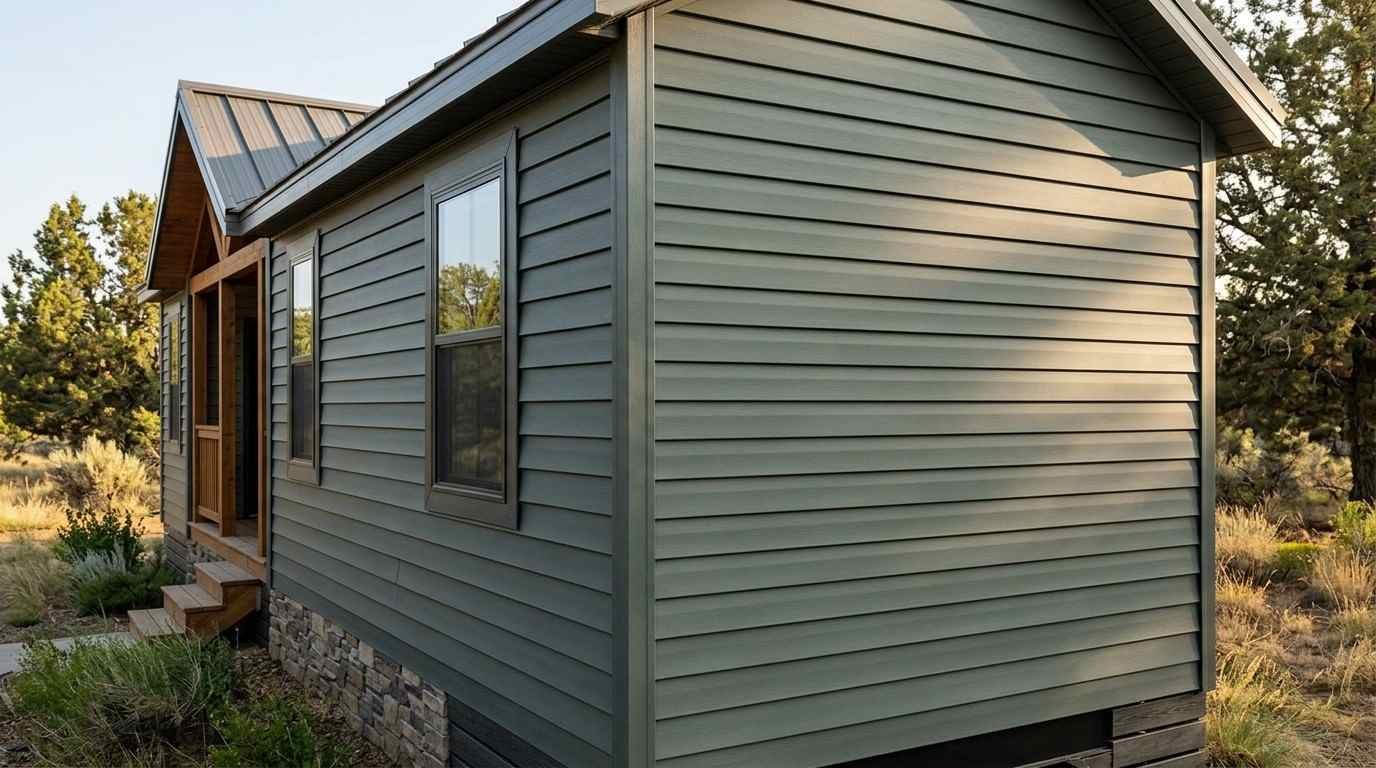
Vinyl siding is a PVC-based exterior cladding material that offers low maintenance, moderate durability, and the lowest upfront cost among common park model siding options. It’s the most widely used material in this category for good reason it’s light, affordable, and forgiving during installation.
Vinyl handles moisture well since it doesn’t rot or support mold growth the way wood can. Where it struggles is extreme heat, where lower-grade panels can warp or fade faster than homeowners expect.
I steer clients toward thicker-gauge vinyl (around .044 inch or higher) specifically for California’s hotter inland regions, since the thin economy panels just don’t hold their shape under sustained heat.
Fiber Cement Siding (James Hardie & Similar Products)
Fiber cement siding is a composite material made from cement, sand, and cellulose fibers that delivers superior fire resistance, durability, and a wood-like appearance without wood’s maintenance demands. It’s become my default recommendation for clients who want a long-term, low-hassle exterior.
Research from the Insurance Institute for Business & Home Safety consistently rates fiber cement among the most fire-resistant common siding materials, which matters enormously for California placements near wildland areas. The material simply doesn’t ignite or contribute fuel the way wood or certain vinyl products can under direct flame exposure.
Fiber cement does weigh more than vinyl, which means a park model builder needs to confirm the chassis and wall framing can accommodate the additional load before specifying it. It also costs more upfront, typically landing in the mid-to-upper range of the material options covered here.
Installation requires more skill than vinyl, since fiber cement needs to be cut, fastened, and sealed correctly to avoid moisture intrusion at the seams. I’ve seen beautiful fiber cement installations and I’ve seen sloppy ones, and the difference always comes down to installer experience rather than the product itself.
The payoff is longevity. A properly installed and maintained fiber cement exterior routinely lasts 30 to 50 years, which changes the entire cost-per-year calculation compared to cheaper materials that need replacement twice in that same window.
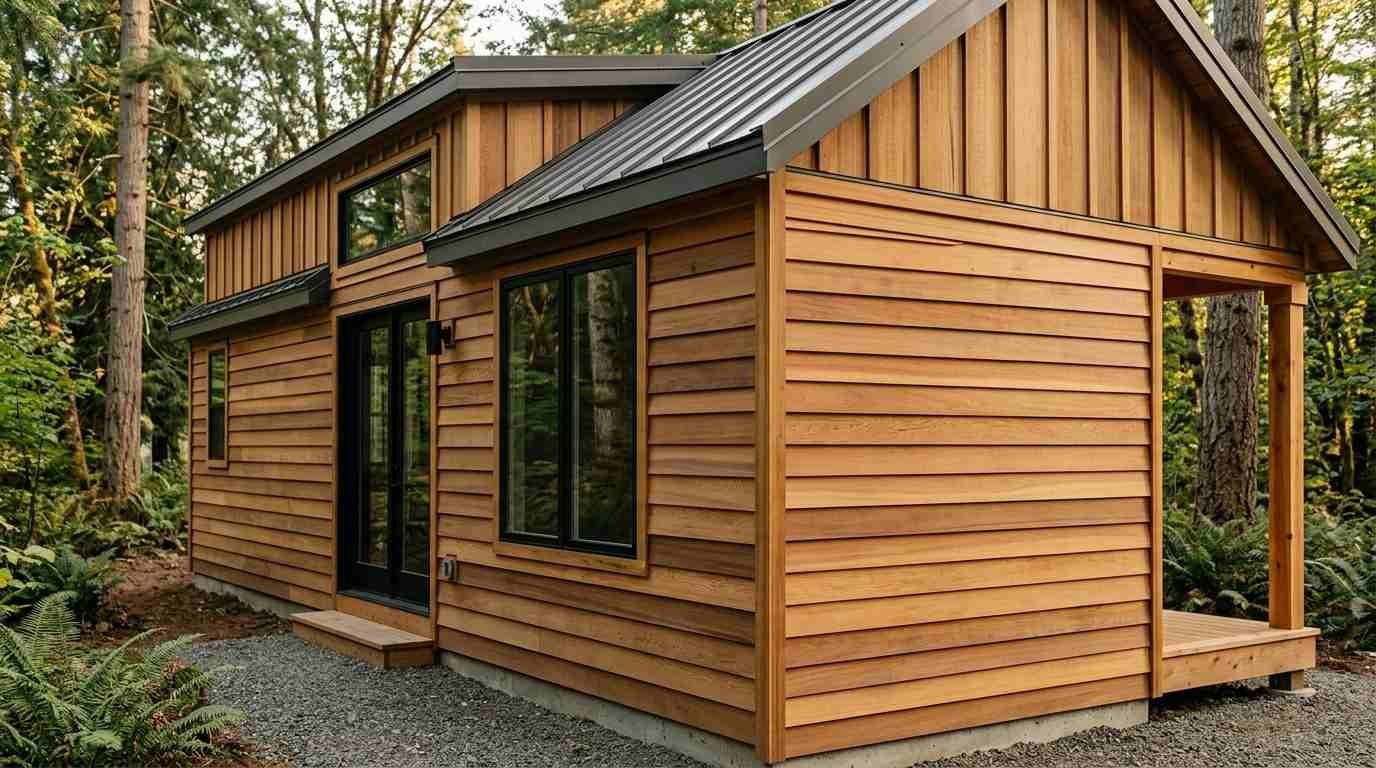
Wood and Engineered Wood Siding
Wood siding is a natural or engineered cladding material that offers a classic aesthetic and genuine insulation value but requires the most ongoing maintenance of any common option. I love how it looks, and I’m always upfront with clients about what that look costs in upkeep.
Engineered wood products address some of real wood’s weaknesses by resisting rot and insect damage better than solid lumber, while still needing periodic resealing or repainting to maintain their protective coating.
Metal Siding (Steel and Aluminum Panels)
Metal siding uses steel or aluminum panels that offer excellent durability, fire resistance, and a modern aesthetic with minimal maintenance over the home’s lifespan. It’s gaining popularity among clients who want a contemporary look paired with near-zero upkeep.
Steel panels resist denting better than aluminum, while aluminum resists corrosion better in coastal environments where salt air accelerates rust on unprotected steel. I match the metal type to the home’s location rather than defaulting to one or the other.
Board and Batten Siding
Board and batten siding is a style of vertical cladding using wide boards with narrower strips covering the seams, available in wood, fiber cement, or vinyl materials. It’s a design choice as much as a material choice, since you can get this look in nearly any substrate.
I find clients gravitate toward board and batten when they want a farmhouse or modern-rustic exterior, and the vertical lines also tend to make a park model’s smaller footprint look taller and less boxy from the street.
Stone Veneer and Masonry Accents
Stone veneer is a thin, lightweight masonry product applied as an accent cladding, typically used on a park model’s lower walls or entry features rather than as full-coverage siding. Full stone is almost never practical given weight restrictions, but manufactured veneer gets you the look at a fraction of the weight.
I usually recommend veneer accents on no more than 20 to 30 percent of the exterior, both for weight management and because a little stone goes a long way visually on a smaller home.
Stucco Siding for Park Model Homes
Stucco is a cement-based exterior finish applied in multiple coats over a wire lath base, offering strong fire resistance and a Mediterranean or Southwestern aesthetic common throughout California. It performs especially well in dry, inland climates where it’s been used for generations.
Stucco’s main vulnerability is cracking from structural movement, which matters more on a park model than a site-built home given the vibration from transport and periodic relocation some owners plan for.
Comparing Durability Across Siding Materials
Fiber cement and metal siding lead common park model options in overall durability, typically lasting 30 to 50 years compared to 15 to 25 years for standard vinyl and wood products.
| Material | Typical Lifespan | Impact Resistance | Weathering Performance |
| Vinyl | 15–25 years | Moderate | Good, except extreme heat |
| Fiber Cement | 30–50 years | High | Excellent |
| Wood | 15–20 years (with maintenance) | Low-Moderate | Fair, needs upkeep |
| Metal | 30–50 years | High | Excellent |
| Stucco | 25–40 years | Moderate | Excellent in dry climates |
Lifespan, Impact Resistance & Weathering by Material
Impact resistance matters more than people initially think, especially near trees, in hail-prone inland valleys, or anywhere landscaping maintenance happens close to the walls. Metal and fiber cement shrug off impacts that would dent vinyl or gouge wood.
Cost Comparison of Park Model Siding Options
Installed siding costs for park model homes typically range from $3 to $7 per square foot for vinyl up to $9 to $14 per square foot for fiber cement, with wood and stucco falling in between.
| Material | Installed Cost Per Sq Ft |
| Vinyl | 3–7 |
| Wood | 6–10 |
| Metal | 7–12 |
| Fiber Cement | 9–14 |
| Stucco | 8–12 |
Installed Cost Per Square Foot by Material Type
These figures shift based on regional labor rates, which run higher across most of California than the national average. I always ask builders for an itemized quote separating material cost from labor, since that’s the only way to see where your money is actually going.
Energy Efficiency and Insulation Value of Siding Materials
Siding material contributes a modest amount to a home’s overall insulation value, but the wall assembly behind it does the majority of the thermal work. No siding material alone will make up for inadequate wall insulation, so I treat this as a secondary consideration rather than the primary one.
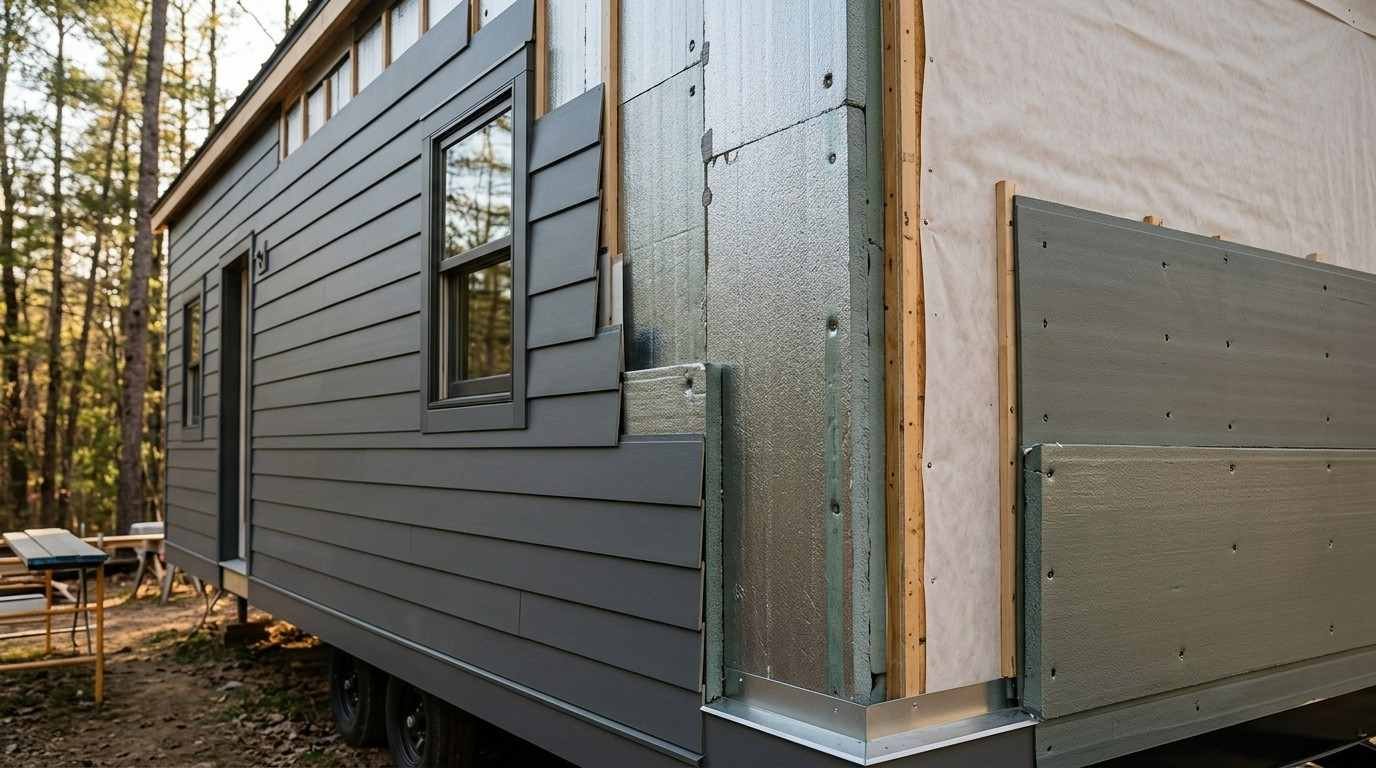
Insulated vinyl and certain fiber cement products include a foam backing that adds measurable R-value, which can meaningfully reduce thermal bridging at the studs compared to standard hollow-back panels.
R-Value Contribution and Thermal Bridging
Thermal bridging happens where studs interrupt the insulation layer, creating thin spots where heat transfers more easily. A continuous insulation layer behind the siding addresses this directly, and it’s worth the modest added cost in most California climate zones.
Best Siding Choices for California Climate Zones
California’s siding needs vary dramatically by region, with coastal areas prioritizing moisture and salt resistance, inland valleys prioritizing heat tolerance, and wildland-adjacent areas prioritizing fire resistance above all else.
Coastal fog and salt air accelerate corrosion on unprotected metal and can trap moisture against wood siding if ventilation isn’t handled correctly. I lean toward fiber cement or properly sealed vinyl for these locations.
Inland valleys see sustained summer heat that stresses lower-grade vinyl and can cause warping. Thicker vinyl, metal, or stucco handle these temperature swings far better.
Coastal Humidity, Inland Heat & Wildfire-Prone Areas
Wildfire-prone areas carry the strictest requirements of all, since California’s wildland-urban interface zones mandate specific ignition-resistant materials by code rather than by preference.
Fire-Resistant Siding Requirements in California
Homes placed within designated Wildland-Urban Interface zones in California must use siding materials that meet Chapter 7A of the California Building Code, which restricts combustible materials in high fire-risk areas. This isn’t optional guidance it’s enforced code compliance tied to your building permit.
Fiber cement, stucco, and certain metal products typically satisfy these requirements, while standard vinyl and untreated wood generally do not meet the ignition-resistance threshold on their own.
Wildland-Urban Interface (WUI) Code Compliance
Compliance gets verified during the permitting and inspection process, so I always confirm WUI zone status before finalizing material selection rather than discovering a conflict after the home is already built.
California Building Codes and Siding Permit Considerations
Siding installation on a park model home placed permanently in California typically requires permit approval confirming the material meets local fire, wind, and moisture-resistance codes. Requirements shift by county and by whether the home sits in a mobile home park versus private land.
I always recommend confirming local requirements with the county building department before ordering materials, since a mismatch discovered mid-project causes delays that are entirely avoidable with upfront verification.
How Siding Is Installed on Park Model Homes
Siding installation on a park model follows the same core sequence as traditional construction: a water-resistant barrier goes on first, followed by the siding material, with careful flashing at every penetration point. Where it differs is the attention paid to transport durability if the home will be moved after initial construction.
Fastener spacing tends to be tighter on a park model specifically to withstand the vibration of transport, and experienced installers account for this from the start rather than treating it as an afterthought.
Maintenance Requirements by Siding Material
Maintenance needs vary significantly by material, ranging from near-zero upkeep for fiber cement and metal to annual sealing and periodic repainting for wood siding. I set expectations with every client on this point specifically, because maintenance cost compounds over decades.
Vinyl needs occasional washing to prevent dirt buildup but rarely needs anything beyond that. Stucco holds up well with minimal attention but benefits from periodic crack inspection.
Cleaning, Repainting & Sealing Schedules
Wood siding typically needs resealing or repainting every three to seven years depending on sun exposure and climate severity. Skipping this schedule is the single most common reason I see premature wood siding failure.
Signs of Siding Failure and When to Replace It
Warning signs of failing siding include visible warping, cracking, persistent moisture stains on interior walls, and soft spots when pressed, all of which indicate the protective barrier has been compromised. Catching these early prevents far more expensive structural repairs down the line.
I tell homeowners to do a visual walk-around twice a year, paying special attention to corners, seams, and areas near ground contact where moisture problems typically start first.
Exterior Color and Style Trends for Park Model Homes
Current exterior trends for park model homes favor warm neutrals, matte black accents, and natural wood-tone combinations that create a modern-rustic aesthetic. Darker colors do absorb more heat, which matters in California’s sunnier regions and is worth weighing against pure aesthetic preference.
I’ve noticed two-tone combinations gaining popularity, pairing a primary neutral body color with a contrasting accent on gables or entry features for visual depth on a smaller structure.
How Siding Choice Affects Resale and Property Value
Durable, low-maintenance siding materials like fiber cement and metal tend to support stronger resale value than budget vinyl, since buyers recognize the reduced future maintenance burden. I’ve seen this play out directly in how quickly certain homes move compared to others with dated or deteriorating exteriors.
First impressions matter disproportionately in resale situations, and siding condition is one of the first things a prospective buyer notices before ever stepping inside.
Questions to Ask Your Builder About Siding and Cladding
The most important questions to ask a builder about siding cover the material’s fire rating, expected lifespan, warranty terms, and whether the installation meets local code requirements for your specific placement location. I encourage every client to ask these directly rather than accepting generic marketing claims about “premium” or “durable” materials.
Ask specifically about the gauge or thickness of vinyl products, the brand and product line for fiber cement, and whether the quoted price includes the water-resistant barrier and flashing details, since these are often where corners get cut.
A builder who answers these questions clearly and specifically, with documentation to back it up, is demonstrating the kind of transparency that tends to carry through the entire construction process.
Conclusion
Siding affects your park model home’s weather resistance, energy performance, maintenance workload, and resale value all at once. California’s climate diversity, fire codes, and permit requirements make material selection a decision worth getting right the first time.
We’ve seen how fiber cement, metal, and stucco consistently outperform budget options over a home’s lifetime. The right cladding choice depends on your specific climate zone and long-term goals.
We build every home with this level of scrutiny built in. Reach out to Tiny Home Builders California to talk through the right siding system for your project.
Frequently Asked Questions
What is the best siding for a park model home in California?
Fiber cement and metal siding perform best across most California climate zones due to their fire resistance and durability. The right choice still depends on your specific region and whether you’re in a wildfire-prone area.
How much does it cost to side a park model home?
Siding costs typically range from $3 to $14 per square foot installed, depending on material. Vinyl sits at the lower end while fiber cement and metal command higher prices.
Does park model siding need to meet fire codes in California?
Yes, homes in Wildland-Urban Interface zones must use siding that meets Chapter 7A of the California Building Code. This requirement is verified during the permitting process.
How long does vinyl siding last on a park model home?
Vinyl siding typically lasts 15 to 25 years depending on thickness and climate exposure. Thinner economy-grade panels tend to fail faster in high-heat regions.
Can wood siding be used on a park model home?
Yes, wood and engineered wood siding can be used, though they require more frequent maintenance than other materials. Resealing or repainting every three to seven years is typically necessary.
What siding material adds the most resale value?
Low-maintenance, durable materials like fiber cement and metal tend to support stronger resale value. Buyers recognize the reduced long-term maintenance burden these materials offer.
How is siding different on a park model home versus a regular house?
Park model siding must meet lighter weight and transport-durability standards under ANSI A119.5 code. Traditional homes follow the International Residential Code and face no transport-related weight restrictions.