Financing and insurance for a tiny home on wheels work differently than they do for a traditional house, because your home is legally a vehicle in most cases. That single distinction shapes your loan options, your policy type, and your long-term costs.
I talk with California buyers every week who assume a mortgage is the starting point. It rarely is, and learning that late costs money, time, and momentum on a build.
This guide covers classification, mortgage limits, loan types, lender criteria, real financing costs, insurance policies, coverage details, certification effects, parking rules, and a practical planning sequence.
What Financing and Insurance Mean for a Tiny Home on Wheels
A tiny home on wheels is a permanent-quality dwelling built on a road-legal trailer chassis. Lenders and insurers do not see it as a house. They see a titled asset that moves, and that changes the entire paperwork trail.
I find this the single most useful thing to understand before shopping for money or coverage. Everything downstream follows from it.
How a THOW Is Legally Classified in California
California treats most tiny homes on wheels as recreational vehicles or park trailers, registered through the DMV rather than recorded as real property. The state’s Department of Housing and Community Development oversees manufactured and mobile home standards, while road-legal trailers fall under vehicle code.
Some counties now allow a THOW as a backyard dwelling under local ADU rules. Others still classify it strictly as a vehicle, no matter how it is finished inside.
Why Classification Drives Every Loan and Policy Decision
Classification decides which lenders will even open a file. A vehicle title routes you toward RV lenders and chattel financing, while a permanent foundation opens conventional mortgage doors.
Insurance follows the same logic. Carriers price a movable dwelling against collision, transit, and theft risks that a fixed house never faces.
RVIA, ANSI, and HUD Certification at a Glance
Three certification paths matter most. RVIA certification confirms a build meets NFPA 1192 and ANSI standards for recreational vehicles, ANSI A119.5 covers park model RVs, and HUD certification applies to manufactured homes on permanent chassis.
RVIA certification unlocks the widest set of RV loans and insurance policies. Self-built and non-certified homes still get covered, though the carrier list shrinks and premiums climb.
Why Traditional Mortgages Rarely Apply to Tiny Homes on Wheels
Mortgages attach to land and permanent structures. A home on wheels fails both tests in nearly every underwriting guideline, and no amount of interior craftsmanship changes that.
The Permanent Foundation Requirement
Fannie Mae, Freddie Mac, FHA, and VA programs all require a dwelling affixed to a permanent foundation on land the borrower owns or leases long-term. HUD’s manufactured housing program sets similar foundation criteria for its own loan products.
A trailer chassis with axles and a hitch disqualifies the structure. Remove the wheels and set the home on a permanent foundation for a tiny home, and the conversation changes entirely.
Appraisal, Comparable Sales, and Lender Risk
Appraisers need comparable sales to establish value, and THOW sales data stays thin in most California markets. Without comps, an underwriter cannot defend the collateral value.
Lenders also weigh recovery risk. A movable asset is harder to secure and easier to relocate, so they price and structure loans accordingly.
The Main Tiny Home Financing Options Available in California
Six financing paths cover almost every buyer I work with. Each one carries a different rate range, term length, and approval standard.
| Option | Typical Term | Rate Range | Best Fit |
| RV loan | 10–20 years | 7–11% | RVIA-certified builds |
| Personal loan | 2–7 years | 8–20% | Smaller budgets, no certification |
| Builder financing | 5–15 years | Varies | Turnkey custom builds |
| Home equity / HELOC | 10–30 years | 7–10% | Existing homeowners |
| Chattel loan | 10–20 years | 8–12% | Titled personal property |
| Credit union program | 7–15 years | 6–10% | Members with strong credit |
RV Loans for Certified Tiny Homes on Wheels
RV loans give tiny home buyers the closest thing to mortgage-style terms. Lenders extend 10 to 20 year repayment on certified units, which keeps monthly payments manageable.
Certification remains the gatekeeper. Most RV lenders require RVIA or ANSI documentation before funding, and that requirement traces straight back to your builder.
Personal and Unsecured Loans
Personal loans skip collateral entirely and close fast, sometimes within a week. They work well for buyers financing part of a build rather than the whole thing.
The tradeoff shows up in the term and the rate. Shorter repayment windows push monthly payments higher than an equivalent RV loan.
Builder and Manufacturer Financing Programs
Many established builders partner with lenders who already understand THOW collateral. That familiarity removes the education step that kills so many bank applications.
We coordinate this early with our clients because approval timelines and build timelines need to match. A funded buyer waiting on a build slot beats a finished home waiting on a loan.
Home Equity Loans and HELOCs
Homeowners with equity hold the strongest position. A HELOC secured by an existing property sidesteps the entire classification problem, since the collateral is real estate.
Rates land lower and terms stretch longer. The risk moves onto your primary residence, which deserves honest thought before signing.
Chattel and Personal Property Loans
Chattel loans finance movable property using the asset itself as collateral. Manufactured housing lenders use them constantly, and several extend the same structure to park model and THOW purchases.
Terms sit between RV loans and personal loans. Titling requirements are strict, so the DMV paperwork needs to be clean.
Credit Union and Specialty Lender Programs
Credit unions often show the most flexibility, especially California institutions with green-building or alternative-housing programs. Decisions happen locally rather than through a national underwriting engine.
Specialty tiny home lenders round out the field. They know the product, ask the right questions, and rarely need convincing that a 300-square-foot home is a real home. 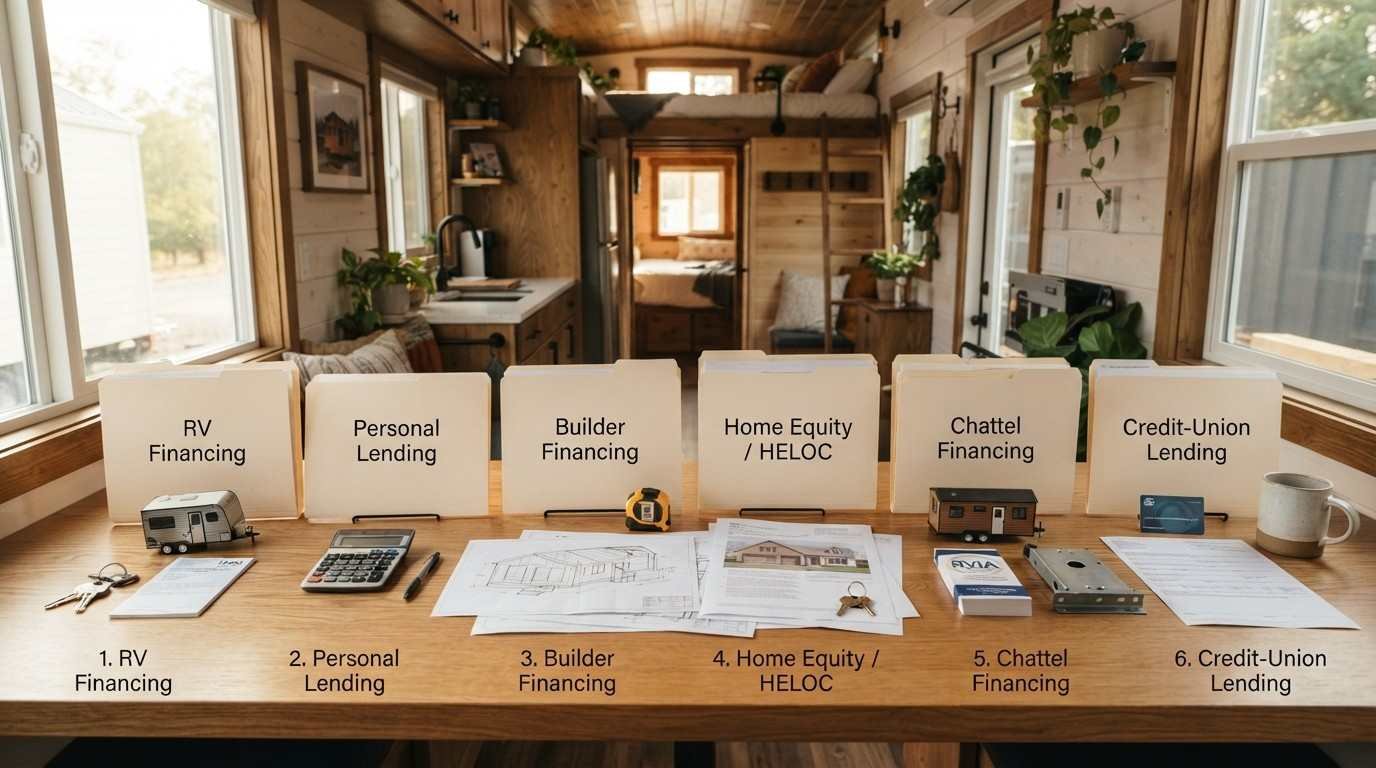
How Lenders Evaluate a Tiny Home Loan Application
Underwriting a THOW loan blends vehicle lending with home lending. Lenders look at you, then they look at the asset, and the asset review surprises most first-time buyers.
Credit Score, Debt-to-Income, and Down Payment Ranges
Most RV and specialty lenders want a credit score in the high 600s or better for competitive pricing. Debt-to-income ratios typically need to stay under 43%, mirroring conventional mortgage thresholds.
Down payments run 10 to 20 percent on secured loans. Stronger credit and certified builds pull that number toward the low end.
Build Documentation Lenders Ask For
Lenders request the build contract, itemized specifications, trailer VIN, certification labels, and a projected completion date. Missing documents stall files longer than weak credit does.
I keep this package assembled from day one on our projects. It moves applications through faster and answers underwriter questions before they get asked.
Why Build Quality Affects Loan Approval
A lender funding a 15-year term needs the asset to survive 15 years. Framing method, moisture management, insulation approach, and construction quality standards all feed into that judgment.
Certified builds from established shops clear underwriting with far less friction. That advantage is worth real money over the life of a loan.
Understanding the True Cost of Financing a Tiny Home
Sticker price tells you very little about what a tiny home actually costs you. Rate, term, and resale behavior together determine the real number.
Interest Rates, Terms, and Total Loan Cost
A 15-year RV loan at 9% on a $120,000 build produces roughly $99,000 in total payments beyond principal reduction schedules that favor early years. The same amount on a 5-year personal loan at 14% costs less in total interest but demands a far higher monthly payment.
Longer terms lower the payment and raise lifetime cost. I walk clients through both columns so the decision reflects cash flow and total spend together.
Depreciation, Appreciation, and Resale Value
Vehicles depreciate, and homes on wheels sit in an odd middle ground. Well-built, certified units hold value noticeably better than budget builds, and California demand supports resale in most metros.
Build quality drives that outcome more than any market factor. Materials, joinery, systems, and finish work determine whether a buyer five years out sees value or a project.
Insurance Options for Tiny Homes on Wheels
Insurance for a THOW comes from five main directions. Which one fits depends on certification, placement, and how often the home moves.
RV and Recreational Vehicle Policies
RV policies are the most common route for certified tiny homes. They bundle liability, collision, comprehensive, and contents coverage in a structure carriers already understand.
Full-timer endorsements matter here. A standard RV policy assumes recreational use, and living in the home year-round requires that extra layer.
Mobile and Manufactured Home Policies
Homes placed semi-permanently on a pad sometimes qualify for mobile home policies. Coverage looks more like homeowners insurance, with dwelling limits and personal liability built in.
Carriers usually want the wheels removed or the unit skirted and anchored. Movement disqualifies the policy in most contracts.
Specialty Tiny Home Insurance Carriers
A handful of carriers now write purpose-built tiny home policies. They handle self-built units, non-certified builds, and unusual placements that mainstream insurers decline.
Premiums run higher. The coverage fits the actual asset, which beats a cheap policy that denies the claim you eventually file.
Builder’s Risk Coverage During Construction
Builder’s risk protects the structure, materials, and equipment while a build is underway. Theft from a build site and weather damage to unfinished framing both fall inside it.
We carry this on our projects and recommend buyers confirm it in writing. The gap between “under construction” and “insured dwelling” is where expensive surprises live.
Transit and Towing Coverage
Moving a tiny home creates a distinct risk window. Transit coverage handles damage during towing, and liability during transport protects against third-party claims on the road.
Many owners discover this gap the day they schedule a move. Confirming it beforehand takes one phone call.
What Tiny Home Insurance Actually Covers
Policy language decides your outcome, not the policy name. Reading the declarations page carefully separates real protection from assumed protection.
Dwelling, Contents, and Liability Coverage
Dwelling coverage rebuilds or repairs the structure. Contents covers what is inside, and liability protects you when someone gets hurt on your property or a claim names you.
Replacement cost beats actual cash value on a well-built home. The premium difference is small compared with a depreciated payout on custom cabinetry and finishes.
California-Specific Risks: Wildfire, Earthquake, Flood
California adds three risks that shape every policy conversation. Wildfire exposure drives pricing across much of the state, and the California FAIR Plan serves properties that standard carriers decline.
Earthquake and flood coverage sit outside standard policies almost universally. Both require separate endorsements or standalone policies.
Common Exclusions and Coverage Gaps
Standard exclusions include wear and tear, mold, pest damage, and faulty workmanship. That last one puts your builder’s competence directly into your risk profile.
Vacancy clauses catch people too. Leaving a home unoccupied for extended periods voids coverage under many contracts.
How Certification and Build Standards Affect Insurability
Insurers price uncertainty. Documented standards remove uncertainty, and that shows up directly in your premium and your carrier options.
Why Insurers Ask Who Built Your Tiny Home
Underwriters ask about the builder because professional construction correlates with fewer claims. Electrical, plumbing, and structural failures dominate tiny home loss data, and all three trace to workmanship.
A licensed builder with certification history gets your file approved. A self-build without documentation narrows the field to specialty carriers.
Documentation That Lowers Premiums
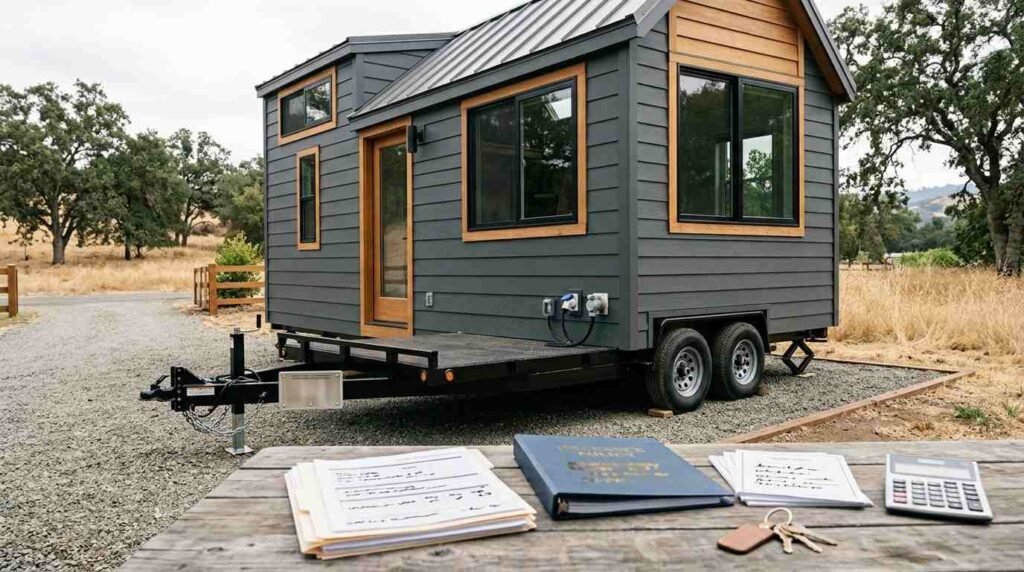
Keep certification labels, electrical and plumbing inspection records, appliance serial numbers, material specifications, and dated build photos. Carriers reward organized files with better pricing.
I hand clients a complete build binder at delivery for exactly this reason. It serves the insurance application, the loan file, and eventual resale.
Where You Park Changes Your Financing and Insurance
Placement is not a detail. It determines legality, policy type, and sometimes whether a lender funds at all.
ADU Ordinances, Zoning, and Placement Rules
California ADU law has expanded steadily, and state ADU guidance governs what local jurisdictions may require. Some cities now recognize movable tiny homes as ADUs, which changes classification and insurance eligibility.
Rules vary sharply by county and city. Verifying local ADU and zoning requirements before signing a build contract prevents the worst kind of expensive mistake.
Owned Land, Leased Pads, and Tiny Home Communities
Owning the land gives you the most financing leverage and the cleanest insurance path. Leased pads in tiny home communities simplify utilities and legality while limiting equity building.
Community rules also affect coverage. Some parks require minimum liability limits and proof of insurance before your unit arrives.
Building Your Financing and Insurance Plan Step by Step
Sequence matters more than speed. I run this order with every client because each step unlocks the next.
Start with placement, since location determines classification. Confirm zoning and pad availability before anything else moves.
Next, set your certification target with your builder. That decision defines your lender pool and your carrier pool simultaneously.
Then get pre-qualified, lock your build contract, bind builder’s risk coverage, and line up the permanent policy for delivery day. Financing and insurance close together, not sequentially.
Mistakes That Cost Tiny Home Buyers Money
The same handful of errors repeats constantly. Every one of them is avoidable with a week of upfront work.
Buyers skip certification to save money, then discover no lender will fund and no mainstream carrier will write. That saving becomes a five-figure problem.
Others sign a build contract before confirming where the home may legally sit. And a surprising number carry no builder’s risk coverage during construction, leaving months of exposure uninsured.
Underinsuring finishes ranks high too. Custom millwork and premium appliances cost real money to replace, and an undersized dwelling limit pays a fraction of what you spent.
Questions to Ask Your Builder, Lender, and Insurer
Good questions surface problems early. I encourage buyers to ask all of these before committing to anyone.
Ask your builder about certification path, trailer specifications, warranty terms, and documentation provided at delivery. Ask whether they carry builder’s risk and general liability coverage.
Ask lenders about certification requirements, term length, prepayment penalties, and total cost across the loan. Ask insurers about full-time occupancy endorsements, replacement cost versus actual cash value, wildfire eligibility, and transit coverage.
Write the answers down. Comparing written answers across three builders and three lenders makes the right choice obvious.
Conclusion
Classification, loan type, lender criteria, certification, coverage limits, and placement all connect. Understanding those links puts you in control of both cost and risk.
The tiny home market keeps maturing, and lender and carrier options expand alongside it. Deeper guides on each piece help you go further.
We build certified, well-documented tiny homes that lenders fund and insurers cover. Talk with Tiny Home Builders California about your project.
Frequently Asked Questions
Can I get a mortgage on a tiny home on wheels in California?
No. Mortgages require a permanent foundation and real property status. A THOW on a trailer chassis needs RV, chattel, personal, or home equity financing instead.
Do I need RVIA certification to insure a tiny home on wheels?
No, but it helps enormously. Certified homes qualify for mainstream RV policies at better rates, while non-certified builds rely on specialty carriers charging higher premiums.
What credit score do I need for tiny home financing?
Most RV and specialty lenders want scores in the high 600s or above. Higher scores unlock lower rates, longer terms, and smaller down payment requirements.
How much does tiny home insurance cost per year in California?
Annual premiums typically run several hundred to a few thousand dollars. Certification, build value, wildfire exposure, and occupancy type drive the final number.
Does a tiny home on wheels lose value like an RV?
Not identically. Certified, professionally built units hold value considerably better than budget builds, and strong California demand supports resale in most markets.
Can I insure a tiny home I built myself?
Yes, through specialty carriers. Expect higher premiums, an inspection requirement, and detailed documentation of electrical, plumbing, and structural work.
Does my tiny home need separate insurance while being towed?
Usually yes. Transit and towing coverage protects the home during transport, and many standard policies exclude damage that happens on the road.