
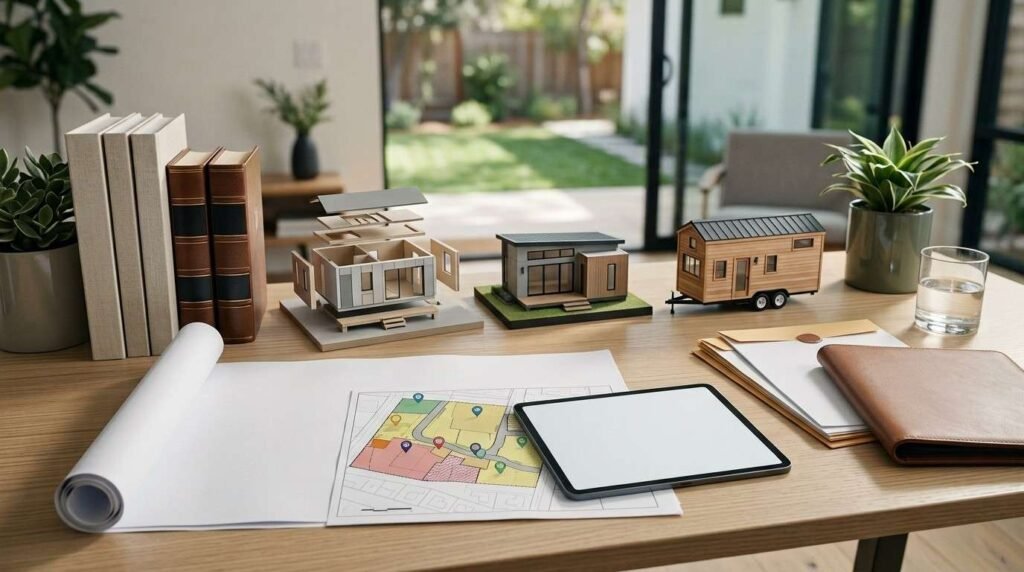
An accessory dwelling unit is a legally independent living space located on the same parcel as a primary home, and its legal classification decides what you can build, where, and how. I have watched that single classification question reshape entire projects for homeowners and investors.
Classification controls your permit path, your code requirements, your financing options, and your resale value. Getting it wrong costs money, months, and sometimes the entire project.
This guide covers ADU definitions, unit classifications, movable and manufactured units, building codes, zoning, permitting, state-by-state law, California specifics, ownership impacts, and verification steps.
What Is an ADU and Why State Laws Matter
An accessory dwelling unit is a secondary housing unit built on a lot that already contains a primary residence, and it operates under a distinct set of legal rules from the main house. I run into this confusion constantly with clients. They assume an ADU follows the same permitting path as a home addition, and it doesn’t.
California treats ADUs as a housing policy tool, not just a construction category. State lawmakers have pushed cities to loosen restrictions because the state has a documented housing shortage. That context shapes every rule you’ll read below.
State vs. Local Jurisdiction Authority
Cities and counties still control some ADU details, but the state sets the floor. A city cannot impose stricter limits than state law allows on size, parking, or approval timelines. It can only be more permissive.
This matters because homeowners often call their city planning department and get an answer that sounds restrictive. I always cross-check that answer against state statute. Local staff sometimes cite outdated local codes that were never updated after a new state law overrode them.
California Statewide ADU Law Overview

California has passed a series of laws since 2016 that systematically stripped away local barriers to ADU construction. Three bills matter most right now: AB 68, SB 9, and SB 1211.
AB 68 eliminated many discretionary review requirements and forced ministerial approval in most cases. SB 9 expanded lot-split and duplex options that interact with ADU rules on the same parcel. SB 1211 arrived more recently and specifically addressed multi-unit ADU allowances on multifamily lots.
Key Statutes Governing ADUs (AB 68, SB 9, SB 1211)
AB 68 is the backbone. It requires cities to approve compliant ADU applications within 60 days without a public hearing. Before this law, some homeowners waited a year or more for a single-family ADU permit.
SB 1211, effective January 2025, raised the cap on detached ADUs allowed on multifamily-zoned lots from two to up to eight units, depending on existing unit count. Legislative Analyst’s Office data shows California approved over 28,000 ADU permits in 2023 alone, according to the California Department of Housing and Community Development, reflecting how these law changes translated into real construction volume.
Size, Height, and Setback Limits
State law sets maximum size at 1,200 square feet for detached ADUs, though many cities allow more under local ordinance. Height caps run 16 to 25 feet depending on lot type and proximity to the primary residence.
Setback requirements dropped significantly under recent reforms. A rear or side setback of just four feet from the property line is now the standard minimum, a huge shift from the 10-foot-plus setbacks common a decade ago.
Junior ADU (JADU) Size Rules
A Junior ADU is capped at 500 square feet and must be built within the walls of the existing primary residence. It shares at least one wall with the main house and can use an existing bathroom rather than requiring a new one.
JADUs face fewer parking and utility connection requirements than detached ADUs. That makes them the fastest, cheapest compliance path for homeowners working with tight lots or tight budgets.
Zoning and Lot Eligibility Requirements

Most residential zones in California now permit at least one ADU by right. Single-family and multifamily zoned lots both qualify, though multifamily lots gained expanded rights under SB 1211.
Historic districts and coastal zones sometimes add layers of review that single-family interior lots don’t face. I tell every client to check coastal commission jurisdiction before assuming a straightforward approval timeline.
Owner-Occupancy Requirement Changes
Owner-occupancy mandates have been repealed for most ADUs built between 2020 and 2025 under a series of legislative extensions. This means an investor can build an ADU and rent out both the primary home and the ADU without living on-site.
This rule has flipped back and forth legislatively, so I always verify current status before a client finalizes financing plans built around rental income from both units.
Permitting Process and Approval Timelines
Ministerial approval means no public hearing, no discretionary design review, and no conditional use permit. The building department checks your plans against objective standards, and either approves or requests corrections.
The 60-day clock starts once a complete application is submitted. Incomplete applications don’t start the clock, which is where most delays actually happen. I’ve watched projects lose six weeks over a single missing soils report.
Ministerial Approval Rules
A jurisdiction cannot deny an otherwise-compliant ADU application based on subjective design preferences. It can only deny it for failing objective, published standards like setback distance or maximum height.
This protects homeowners from a planning commissioner who simply doesn’t like a design. And it means your architect’s job is compliance, not persuasion.
Parking Requirements and Exemptions
State law waives parking requirements entirely for ADUs within a half-mile of public transit, in a historic district, or on a lot where the existing garage is converted into the ADU. Most urban and suburban California lots qualify under at least one exemption.
Where parking is still required, it’s one space per ADU, and that space can be uncovered, in tandem, or in a setback area. This is far less restrictive than parking rules for standard residential additions.
Utility Connections and Impact Fees
ADUs under 750 square feet are exempt from utility connection fees and impact fees in most California jurisdictions. Above that threshold, fees apply proportionally to the ADU’s square footage relative to the primary home.
Water and sewer connections sometimes require a separate meter depending on the utility provider, not the state law itself. Every provider handles this differently, so I have clients check with their specific water district early.
Fee Waivers for Smaller ADUs
The fee exemption under 750 square feet was designed specifically to encourage smaller, more affordable units. A 2025 state housing report found ADUs under 750 square feet cost on average 30% less to permit than larger units, per the California Housing Partnership.
Building right at or just under that threshold often saves thousands in fees alone, which changes the math on whether a slightly smaller unit makes more financial sense.
Recent Legislative Changes (2024–2026)
SB 1211 took effect January 1, 2025, and remains the most significant recent shift, expanding detached ADU allowances on multifamily lots. Alongside it, several bills tightened enforcement against cities that were slow-walking approvals or imposing informal barriers beyond what state law permits.
2026 brought clarifying language around fire safety access requirements for ADUs on lots with limited street frontage. Homeowners planning a build this year need to check whether their lot configuration triggers the newer fire access standard.
New Laws Affecting Multi-ADU Lots
Lots zoned multifamily can now pursue up to eight detached ADUs depending on the number of existing units on the parcel. This shift specifically targets property owners and small investors looking to add substantial rental capacity on underutilized land.
The math changes fast here. A fourplex lot that previously qualified for two ADUs now qualifies for considerably more, assuming site constraints like setbacks and parking don’t limit the count first.
How ADU Laws Affect Design and Construction Choices

Every rule above translates directly into design decisions. A 500-square-foot JADU cap forces efficient layout choices that a 1,200-square-foot detached unit never has to consider.
Setback minimums determine where a unit can physically sit on a lot, which then determines orientation, natural light, and how much yard space survives construction. Compliance isn’t a paperwork exercise. It shapes the actual building.
Working With a Builder Who Understands Compliance
A builder who treats ADU compliance as an afterthought creates expensive problems mid-project. We approach every ADU project by confirming the applicable statute and local ordinance before drawing a single line, because a redesign after submission costs far more than getting it right the first time.
This is where craftsmanship and legal knowledge intersect. A well-built ADU respects both the structural code and the zoning code, and most delays I see trace back to a builder who only understood one of the two.
Common Compliance Mistakes Homeowners Make
Homeowners frequently assume their city’s website reflects current state law. It often doesn’t, especially in smaller municipalities that haven’t updated planning department pages since the last major bill passed.
Another common mistake is submitting an incomplete application to save time, which backfires by resetting the 60-day ministerial clock. I’ve also seen owners size a unit at 1,210 square feet without realizing ten extra feet pushed them past a fee exemption threshold.
A third mistake involves ignoring HOA restrictions that sit separately from state and local law. State ADU law overrides many HOA restrictions, but not all of them, and that distinction catches people off guard.
Conclusion
ADU laws shift fast, and California’s rules on size, zoning, permitting, and fees now favor homeowners more than at any point in the past decade. Recent legislation like SB 1211 keeps expanding what’s possible on a given lot.
Understanding these rules before design begins saves time, money, and avoidable redesigns. Compliance and craftsmanship aren’t separate conversations.
We build ADUs that meet current California law from day one, so contact Tiny Home Builders California to start your project with a clear, compliant plan.
Frequently Asked Questions
What is the maximum size allowed for an ADU in California?
State law caps detached ADUs at 1,200 square feet, though some cities permit larger units. Junior ADUs are capped separately at 500 square feet.
Do I need a permit to build an ADU in California?
Yes, every ADU requires a building permit reviewed through the ministerial approval process. Cities cannot require a public hearing for compliant applications.
How long does ADU approval take in California?
Jurisdictions must approve or deny a complete ADU application within 60 days. The clock only starts once the application is fully complete.
Are parking spaces required for an ADU?
Many ADUs qualify for a full parking exemption based on transit proximity or garage conversion status. When required, only one space applies per unit.
Can I rent out my ADU without living on the property?
Owner-occupancy requirements have been suspended for most ADUs permitted between 2020 and 2025. Confirm current status before finalizing plans, since this rule has changed multiple times.
What is SB 1211 and how does it change ADU rules?
SB 1211 took effect in January 2025 and expanded the number of detached ADUs allowed on multifamily-zoned lots to up to eight units. It specifically targets property owners with existing multi-unit buildings.
Do ADUs under 750 square feet avoid impact fees?
Yes, most California jurisdictions waive utility connection and impact fees for ADUs under 750 square feet. This exemption was designed to encourage smaller, more affordable units.
Does my HOA have authority over ADU construction?
HOAs retain some restrictions, but state ADU law overrides many blanket HOA bans. Specific design and use restrictions still need individual review against current statute.


