
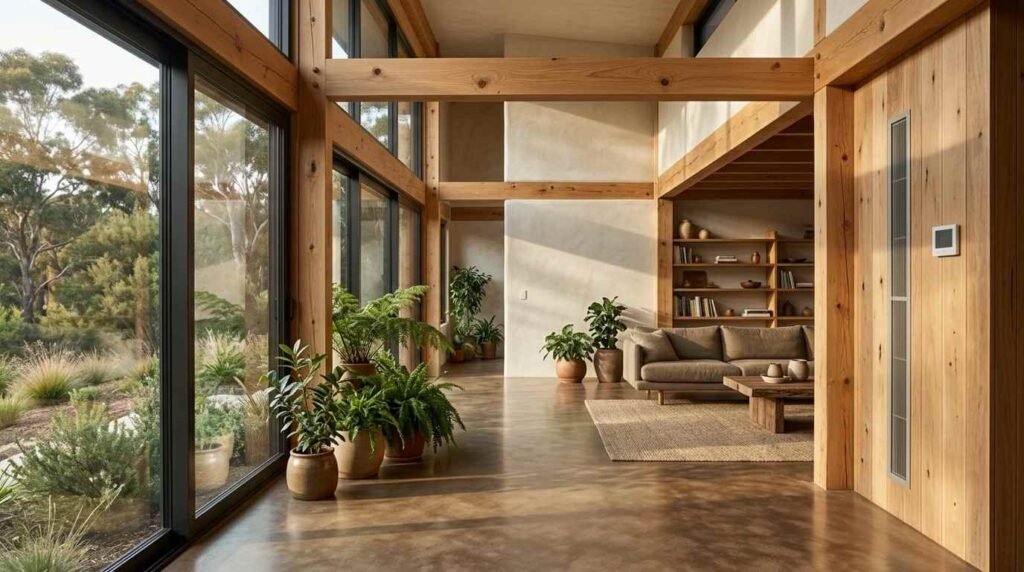
The features that pay off fastest are almost never the flashiest ones. A tight, well-sealed building envelope and a right-sized heat pump system typically return more value per dollar than solar panels alone, because they cut energy loss year-round instead of just offsetting it.
I’ve watched homeowners chase certifications and gadgets while skipping the insulation upgrade that would’ve cut their bills in half. The eco-friendly features worth paying for are the ones that quietly reduce a home’s operating cost for decades, not the ones that look good on a spec sheet.
I walk through what actually makes a feature eco-friendly, the building envelope and energy systems that carry the biggest long-term payoff, the materials and water systems that round out a genuinely sustainable build, and how to prioritize all of it against a real construction budget.
What Makes a Custom Home Feature Truly “Eco-Friendly”
Eco-friendly construction is a building approach that reduces a home’s environmental impact through material choice, energy performance, and resource efficiency across its full lifecycle. That definition matters because a lot of products get labeled “green” without doing much of anything for long-term performance.
I look at three things when I evaluate whether a feature earns the label: does it reduce energy consumption, does it reduce water consumption, and was it manufactured or sourced with a lower environmental footprint than the standard alternative? A feature that only hits one of those three is still worth considering. A feature that hits all three is where the real value sits.
Embodied carbon is the piece most homeowners miss entirely. It’s the total carbon emitted producing and transporting a material before it ever reaches the job site, and it matters as much as what the material does once installed.
A concrete slab and a wood-framed floor system can have wildly different embodied carbon footprints even though both perform identically once built. That’s why material sourcing gets its own section later in this guide instead of getting bundled into “sustainable materials” as an afterthought.
Upfront Cost vs. Long-Term Value: How to Think About ROI
Every eco-friendly feature carries two price tags. There’s the number on the construction invoice, and there’s the number that shows up over 10, 20, or 30 years of ownership. Homeowners who only look at the first number consistently make the wrong call.
Payback period is the metric I come back to constantly. It’s simply the years it takes for cumulative energy or water savings to equal the upfront cost premium of the feature. Some features pay back in three years. Others take fifteen. Both can still be worth it depending on how long you plan to own the home.
Here’s a rough framework I use with clients evaluating options on a real budget:
| Feature Category | Typical Cost Premium | Typical Payback Period | Resale Impact |
| High-performance insulation & envelope | 3–6% of build cost | 4–8 years | Strong – buyers notice utility bills |
| Solar power system | 2–4% of build cost | 6–10 years | Strong – increasingly expected in California |
| Efficient HVAC/water heating | 1–3% of build cost | 3–7 years | Moderate |
| Sustainable materials | 1–5% of build cost | Rarely direct payback | Moderate – durability driven |
| Water conservation systems | 0.5–2% of build cost | 5–12 years | Growing, especially in drought regions |
| Smart home energy systems | 1–2% of build cost | 4–9 years | Moderate |
Appreciation matters here too. Homes with documented energy performance upgrades in California consistently appraise higher than comparable homes without them, because buyers are pricing in future utility costs whether they realize it or not.
High-Performance Insulation and Building Envelope Upgrades
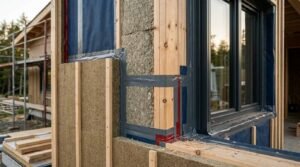
The building envelope is the single biggest lever for long-term energy performance, and it’s the one feature category I never let a client skip regardless of budget constraints. It’s also the least visible one, which is exactly why it gets underfunded so often.
R-value measures a material’s resistance to heat flow, and higher numbers mean better insulating performance. Standard California builds often land in the R-13 to R-21 range for walls. High-performance builds push toward R-21 to R-30, plus continuous exterior insulation that eliminates thermal bridging through the framing itself.
Air sealing works alongside insulation, not instead of it. A perfectly insulated wall with gaps around windows, outlets, and penetrations still leaks conditioned air constantly. Blower door testing during construction catches these gaps before drywall goes up, which is far cheaper than fixing them after the fact.
Thermal bridging happens wherever framing members interrupt continuous insulation, creating a direct path for heat transfer. Advanced framing techniques and exterior insulating sheathing both address this, and I push for one or the other on every custom build I’m involved with.
A well-executed envelope upgrade routinely cuts heating and cooling loads by 30 to 50 percent compared to code-minimum construction. That number alone changes the sizing and cost of every mechanical system that follows.
Solar Power and Energy Generation Systems
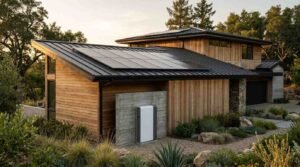
Solar has become close to standard on new California custom homes, partly because of state building code requirements and partly because the economics have gotten genuinely good. But not every solar setup delivers the same value, and the differences matter more than most homeowners realize going in.
Photovoltaic panel efficiency and orientation determine actual output far more than panel count does. A smaller, well-oriented, south-facing array on an unshaded roof consistently outperforms a larger array fighting shade or poor angles.
Net metering lets excess power generated during the day get credited against grid power drawn at night, and California’s net metering rules have shifted meaningfully in recent years. The California Public Utilities Commission’s NEM 3.0 framework reduced export compensation rates significantly starting in 2023, which shifted the economics toward pairing solar with battery storage rather than relying on grid credit alone.
Battery storage captures that daytime excess for evening and nighttime use instead of exporting it at a lower credit rate. It adds meaningful upfront cost, but it’s increasingly what makes solar’s long-term math work under current California rate structures.
Sizing the system to actual household consumption, not roof capacity, is where I see the most waste in solar planning. An oversized system under NEM 3.0 rules delivers a worse return than a right-sized one paired with storage.
Energy-Efficient HVAC and Water Heating Systems
Once the envelope is tight, the mechanical systems inside it can be smaller, cheaper, and dramatically more efficient than they’d need to be in a leaky home. This is the sequencing mistake I see most often: homeowners spec expensive HVAC before addressing the envelope, then pay for capacity they didn’t need to buy.
Heat pumps handle both heating and cooling through a single system, moving heat rather than generating it, which makes them substantially more efficient than traditional furnace-and-AC setups. Modern cold-climate heat pumps perform well even in California’s occasional cold snaps, and they eliminate combustion appliances from the home entirely.
SEER rating measures cooling efficiency, and higher numbers mean lower energy use per degree of cooling delivered. Code minimums in California sit in the SEER 14-15 range currently, while high-performance systems reach SEER 20 or higher.
Tankless water heating eliminates standby heat loss that traditional tank systems carry constantly, heating water on demand instead of maintaining a hot reservoir around the clock. Heat pump water heaters take this further, using the same heat-transfer principle as HVAC heat pumps to cut water heating energy use substantially compared to standard electric resistance units.
Sustainable and Durable Building Materials

Material choice is a sustainable building practice that reduces environmental impact through sourcing, manufacturing process, and expected service life. Durability is the piece that gets undervalued here, because a material that lasts twice as long effectively cuts its lifecycle environmental footprint in half.
Reclaimed and engineered wood products reduce demand on virgin timber while often outperforming standard lumber structurally. Engineered lumber in particular resists warping and shrinkage better than dimensional lumber, which reduces callbacks and repairs over the life of the home.
Low-VOC materials release fewer volatile organic compounds into indoor air, which matters for both environmental impact and indoor air quality. The EPA’s research on indoor air quality notes that indoor air can carry pollutant concentrations several times higher than outdoor air, largely from building materials and finishes off-gassing over time.
Metal, fiber-cement, and certain composite siding products carry higher upfront cost but dramatically longer service life than vinyl or standard wood siding, which reduces both replacement waste and long-term maintenance cost. I steer clients toward whichever option matches the local climate exposure rather than defaulting to whatever’s cheapest at the yard.
Water Conservation and Smart Irrigation Features
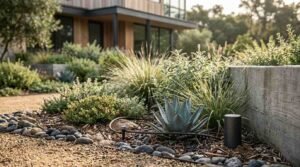
California’s drought cycles make water conservation features less of an environmental nicety and more of a practical necessity. Homes built without water-efficient fixtures and landscaping in drought-prone regions face a real risk of restricted water use during future shortages.
Low-flow fixtures reduce water consumption at every tap, showerhead, and toilet without a noticeable difference in daily use. Modern low-flow toilets in particular use roughly a third of the water older models require per flush, with no functional tradeoff.
Greywater systems capture water from showers, sinks, and laundry for reuse in landscape irrigation, cutting outdoor water demand substantially in a state where outdoor use often accounts for more than half of total household consumption.
Drought-tolerant landscaping and smart irrigation controllers round out the water strategy. Weather-based irrigation controllers adjust watering schedules automatically based on actual conditions, eliminating the waste of fixed-schedule sprinkler systems running during rain.
Smart Home Technology for Energy and Resource Management
Smart home systems don’t generate savings on their own, but they make every other efficient system in the home perform closer to its potential. That distinction matters, because homeowners sometimes treat smart tech as the eco-friendly feature itself rather than the layer that optimizes everything else.
Smart thermostats learn household patterns and adjust heating and cooling automatically, typically reducing HVAC energy use by a meaningful margin compared to a fixed manual schedule. They also flag performance issues early, before a failing system turns into an expensive repair.
Energy monitoring systems break down consumption by circuit or appliance, showing homeowners exactly where power is going in real time. That visibility alone tends to change behavior and catch problems, like a failing appliance drawing far more power than it should.
Automated lighting, smart irrigation controllers, and leak-detection sensors round out the category. Leak detection in particular can prevent water damage that would otherwise cost far more than the sensor itself, both in repair cost and in wasted water before the leak gets noticed.
Certifications, Ratings, and Standards Worth Knowing
Certifications exist to give homeowners a verified benchmark instead of relying on a builder’s marketing claims alone. Not all of them carry equal weight, and knowing the difference saves you from paying for a label without the performance behind it.
LEED certification is a third-party verified rating system evaluating a home’s sustainability across energy, water, materials, and indoor environmental quality. It’s rigorous but comes with real administrative cost and time, which makes it more common on larger or higher-budget custom builds.
Energy Star certification focuses specifically on energy performance, verified through testing rather than self-reported claims. It’s a lighter-weight, more accessible standard than LEED for most custom home projects.
California’s Title 24 energy code sets mandatory minimum efficiency standards for all new residential construction in the state, covering insulation, HVAC efficiency, and increasingly, solar requirements. The California Energy Commission’s Title 24 standards get updated on a roughly three-year cycle, with each revision raising the efficiency floor statewide.
Understanding which standard a builder is targeting, code-minimum, Energy Star, or full LEED – tells you a lot about how seriously sustainability is actually being treated on your project versus how it’s being marketed.
How to Prioritize Eco-Friendly Features on a Real Budget

Nobody builds with an unlimited budget, so the real skill is sequencing eco-friendly investments in the order that delivers the most value first. I walk every client through the same priority logic regardless of their total budget size.
Envelope and insulation come first, always. Every other system in the home performs better and can be sized smaller once the envelope is tight, which means this investment pays dividends across every category that follows it.
Efficient mechanical systems come second, sized appropriately for the now-tighter envelope. This is where heat pumps and tankless or heat pump water heating earn their keep, especially once oversized capacity is no longer needed.
Solar and battery storage come third, once the home’s actual energy demand has been reduced by the first two categories. Sizing solar to a home that hasn’t been optimized yet means paying for more panels than necessary.
Materials, water systems, and smart technology round out the list, added based on remaining budget and specific priorities like drought resilience or long-term maintenance reduction. None of these are optional in the sense of not mattering. They’re simply lower-leverage than the first three categories on a strict dollar-for-dollar basis.
Conclusion
Eco-friendly features earn their cost when they reduce energy, water, or maintenance demand for decades, not when they simply carry a green label. The envelope, mechanical systems, and solar deliver the strongest long-term returns of any category covered here.
California’s climate, codes, and utility rates all continue to shift, which keeps rewarding homes built with genuine performance in mind over ones built to a marketing checklist. That gap in outcomes tends to widen with time.
We build every custom home around this same priority logic. Reach out to Tiny Home Builders California to talk through which eco-friendly features make sense for your budget and property.
Frequently Asked Questions
What eco-friendly home feature has the best return on investment?
High-performance insulation and building envelope upgrades typically return the most value, cutting heating and cooling loads by 30 to 50 percent while reducing the cost of every mechanical system installed afterward.
Is solar worth it on a new custom home in California?
Solar is worth it when sized to actual household consumption and paired with battery storage, especially under current NEM 3.0 net metering rules that reduced export credit rates starting in 2023.
How much more does it cost to build an eco-friendly custom home?
Cost premiums vary by feature category, ranging from roughly 0.5% for water conservation systems to 6% for a high-performance building envelope, with most categories paying back within 4 to 10 years.
Do eco-friendly features increase home resale value?
Documented energy performance upgrades consistently appraise higher in California, since buyers increasingly price in future utility costs when comparing similar homes.
What’s the difference between LEED and Energy Star certification?
LEED evaluates a home’s sustainability across energy, water, materials, and air quality through a rigorous third-party process, while Energy Star focuses specifically on verified energy performance with less administrative overhead.
Should I prioritize solar or insulation first on a limited budget?
Insulation and envelope upgrades come first, since a tighter envelope reduces the energy demand solar needs to offset and allows smaller, less expensive mechanical systems throughout the home.
Are low-VOC materials actually necessary for a healthy home?
Low-VOC materials meaningfully reduce indoor air pollutant concentrations, which the EPA notes can run several times higher indoors than outdoors, largely due to standard building materials and finishes.
Does California require solar on new custom homes?
California’s building code has required solar on most new residential construction since 2020, though sizing requirements depend on the home’s square footage and energy design.


