Electrical system design for tiny homes on wheels is the engineering process of sizing, routing, and protecting power in a mobile dwelling. It covers load calculation, shore power, solar, batteries, grounding, and code compliance. I treat it as the backbone of a safe, livable tiny home.
Power failures in a tiny home are not minor annoyances. They shut down heating, refrigeration, and water. Getting the design right protects your investment and your daily comfort for decades.
I cover definitions, codes, load math, shore power, off-grid systems, panels, wiring, DC circuits, HVAC loads, efficiency, mistakes, documentation, costs, and builder questions.
What Electrical System Design Means for a Tiny Home on Wheels
Electrical system design is the complete plan that determines how power enters a tiny home, how it moves through the structure, and how it gets used safely. In a tiny home on wheels, that plan has to survive highway vibration, temperature swings, and constantly changing power sources.
I think of it as three linked decisions. How much power do you need, where does it come from, and how do you protect everything in between.
Most homeowners I talk with assume wiring is wiring. But a 400-square-foot dwelling that moves down the freeway at 65 miles per hour behaves nothing like a foundation home with a fixed 200-amp service and a buried ground rod.
Why Mobile Homes Are Wired Differently Than Site-Built Houses
A site-built house sits still. Its conductors stay in place, its ground path connects to earth permanently, and its service size rarely changes.
A tiny home on wheels breaks all three assumptions. Vibration loosens terminations, the ground reference shifts every time you unplug, and the available amperage depends entirely on what pedestal or generator you connect to that week.
That mobility is why I design for the worst-case connection rather than the best one. A system that runs clean on a 30-amp campground pedestal also runs clean on a 50-amp home outlet.
The Three Power Pathways: Shore, Solar, and Generator
Every tiny home on wheels draws from one of three sources. Shore power is a plug-in connection to an existing electrical service. Solar generates on-site DC power stored in batteries. A generator provides backup AC output on demand.
Good design accommodates all three without rewiring. I build the panel and transfer arrangement first, then let the owner add solar or a generator later.
The U.S. Department of Energy notes that residential solar planning starts with an accurate load assessment rather than panel count. That principle drives every tiny home electrical decision I make.
Codes, Standards, and Certifications That Govern Tiny Home Wiring
Tiny homes on wheels occupy a regulatory gray zone. They are legally vehicles in most contexts, yet they function as dwellings, so two different rulebooks apply depending on who inspects them.
I design to the stricter of the two. That approach keeps a home insurable, financeable, and movable across jurisdictions.
NEC Requirements Versus RV Standards (NFPA 1192 and ANSI A119.5)
The National Electrical Code governs permanent dwellings and sets the baseline for conductor sizing, protection, and grounding. RV standards like NFPA 1192 and ANSI A119.5 govern vehicles and address mobility-specific concerns.
A tiny home built to RV standards gets a certification label that many parks require. A tiny home built to NEC standards satisfies dwelling inspectors. I build to both where they overlap and note where they diverge.
California Title 24 and Local Jurisdiction Realities
California adds an energy layer. Title 24 building energy efficiency standards drive appliance efficiency, lighting, and in many cases solar readiness for residential structures.
Anywhere in California, the practical answer depends on your county. Some jurisdictions treat a certified THOW as an RV with no building permit. Others require it to meet dwelling standards when placed as an accessory unit.
Third-Party Inspection and Certification Labels
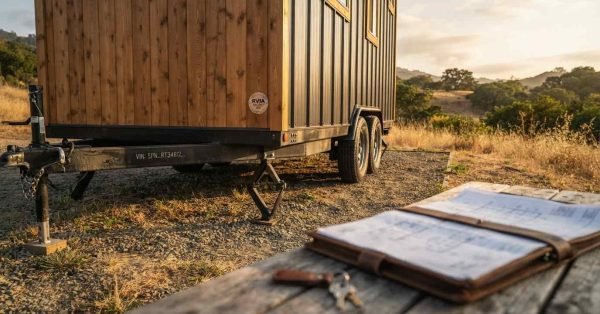
A certification label is third-party proof that someone qualified verified the electrical work. RVIA and NOAH are the two labels I see most often on tiny homes on wheels.
I recommend certification for anyone who plans to move, park in commercial communities, or finance the build. It also settles insurance conversations quickly.
Electrical Load Calculation and Sizing the System
Load calculation is the math that determines every downstream decision. It tells you what service size you need, what wire gauge to run, how large a battery bank has to be, and how many solar panels actually pay off.
I start every project here. Skipping this step is the single most common reason tiny home electrical systems underperform.
Building a Realistic Appliance Load List
I list every device that draws power, its wattage, and how many hours per day it runs. A mini-split, induction cooktop, water heater, refrigerator, and laptop charger produce very different daily energy profiles.
Two homes with identical square footage often differ by a factor of three in daily consumption. Cooking method and heating method drive most of that gap.
The U.S. Energy Information Administration reports that space conditioning and water heating account for roughly half of residential energy use. In a tiny home, those two loads dominate even harder.
30-Amp Versus 50-Amp Service Decisions
A 30-amp service delivers about 3,600 watts on a single 120-volt leg. A 50-amp service delivers roughly 12,000 watts across two legs. That difference decides whether you run an induction range and air conditioning simultaneously.
I specify 50-amp service on most builds and design the load list to run comfortably on 30 amps. That gives owners flexibility without stranding them at a limited pedestal.
Peak Draw, Continuous Draw, and Headroom
Continuous draw is what your home pulls during normal operation. Peak draw is the momentary surge when a compressor or motor starts. Both matter, and they matter differently.
I size conductors and breakers for continuous load, then verify that inverters and generators handle surge. Leaving 20 to 25 percent headroom prevents nuisance tripping and extends component life.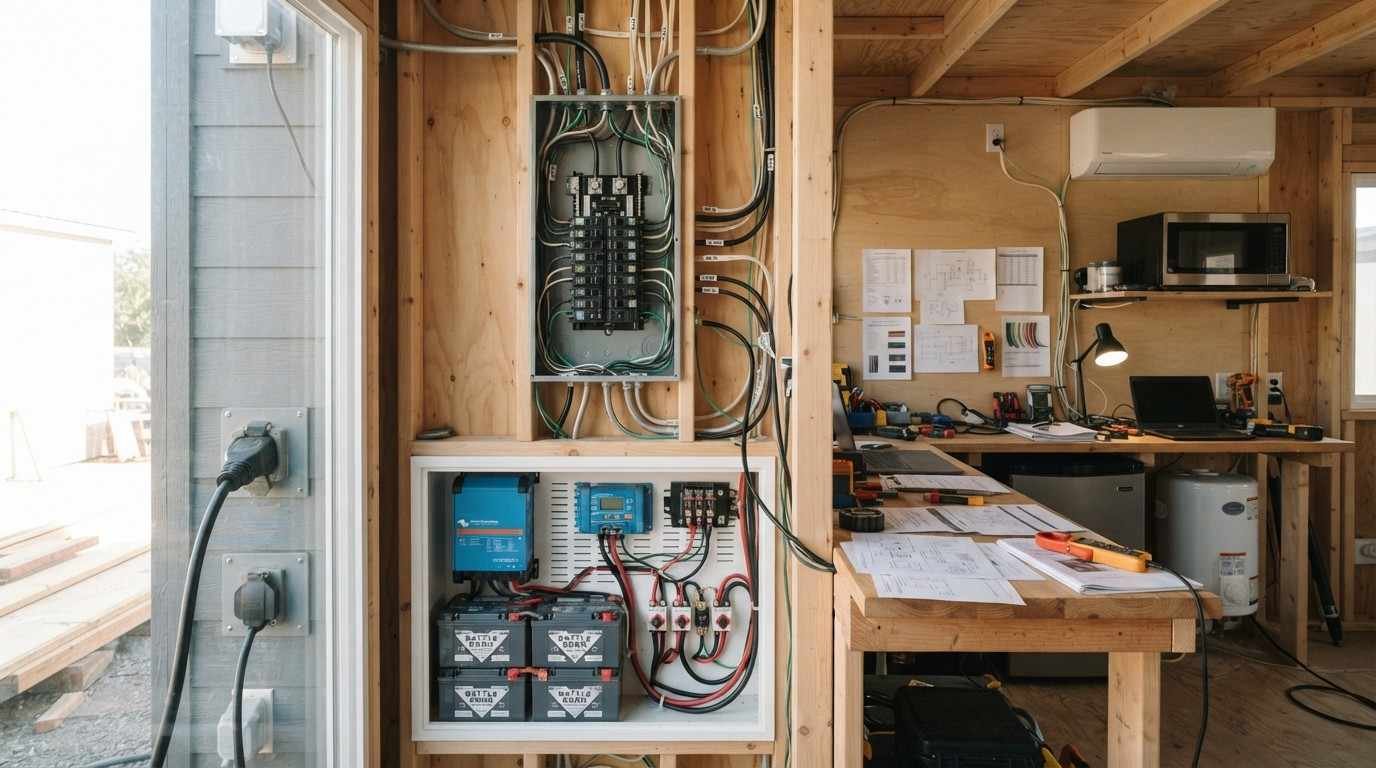
Shore Power, Inlets, and Transfer Between Sources
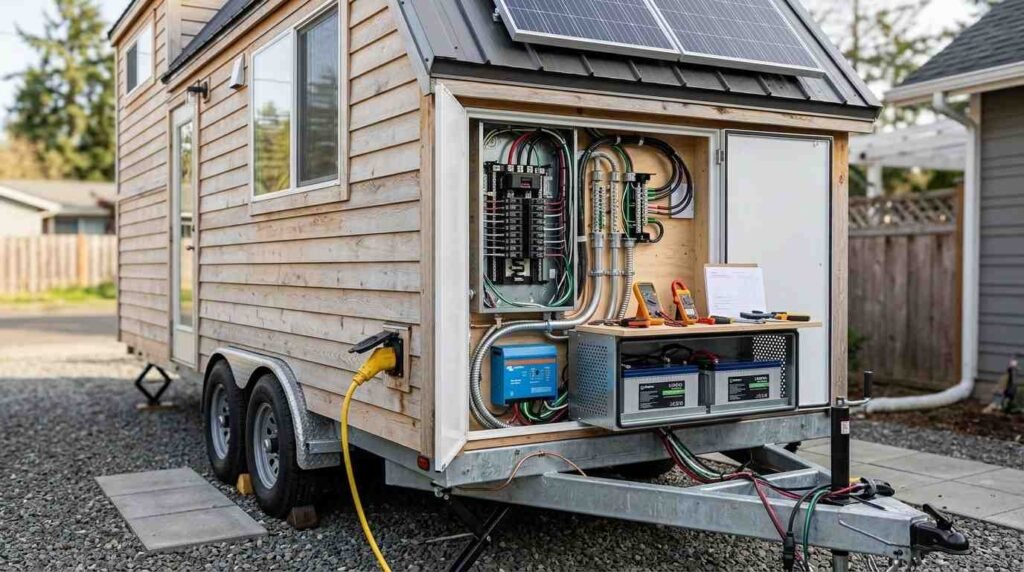
Shore power is the most common way a tiny home on wheels gets electricity. The connection point looks simple, but it carries every amp the home uses, so the hardware quality matters enormously.
I treat the inlet, cord, and transfer device as a single system. A weak link anywhere creates heat, voltage drop, and eventual failure.
Power Inlets, Cords, and Pedestal Connections
A recessed marine-grade inlet resists weather and vibration better than a standard exterior receptacle. Cord length affects voltage drop, and long undersized cords are a leading cause of appliance damage.
I specify the shortest practical cord in the correct gauge. Then I add surge protection at the connection, because campground and residential pedestals both deliver dirty power more often than people expect.
Manual Versus Automatic Transfer Switching
A transfer switch decides which source feeds the panel. Manual switches cost less and demand owner attention. Automatic switches sense available power and change sources without intervention.
I install automatic transfer on any home with both solar and shore power. It removes the possibility of back-feeding a source, which is the dangerous failure mode in dual-source systems.
Off-Grid Power: Solar Arrays, Batteries, and Inverters
Off-grid capability separates a tiny home that must stay plugged in from one that goes anywhere. The system is straightforward in concept and unforgiving in execution.
Solar panels generate DC power. A charge controller regulates it into a battery bank. An inverter converts stored DC into the AC power your outlets and appliances use.
I size it in that order, and I size it from the load list, never from a panel-count guess.
Roof-Mounted Solar and Charge Controllers
Roof area limits array size on a tiny home. A typical THOW roof supports somewhere between 1,000 and 2,500 watts of panels depending on trailer length and vent placement.
MPPT charge controllers extract meaningfully more energy than older PWM designs, especially in partial shade and cold weather. I use MPPT on every build.
Panel orientation on a mobile structure changes constantly, which is why oversizing the array slightly beats optimizing tilt.
Lithium Versus Lead-Acid Battery Banks
Lithium iron phosphate batteries deliver more usable capacity, longer cycle life, and lower weight than lead-acid at the same rated amp-hours. Lead-acid costs less upfront and tolerates simple charging.
Weight matters on a trailer with a fixed axle rating. I choose lithium on most builds for the weight savings alone, then account for cold-weather charging protection.
Inverter, Inverter-Charger, and Pure Sine Wave Output
An inverter turns battery DC into household AC. An inverter-charger does that and also charges batteries from shore power or a generator, which consolidates hardware and simplifies wiring.
Pure sine wave output protects sensitive electronics, motors, and medical devices. Modified sine wave costs less and causes buzzing, heat, and premature failure in modern appliances. I never specify it.
Panels, Breakers, Grounding, and Bonding
The panel is where the design becomes physical. Every circuit originates here, every fault clears here, and every inspector looks here first.
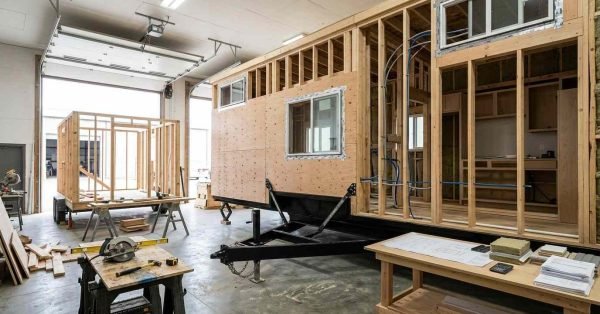
I lay out the load center before framing so conductor runs stay short and accessible.
Load Center Selection and Circuit Layout
A tiny home panel typically holds six to twelve circuits. I dedicate individual circuits to the mini-split, water heater, cooktop, refrigerator, and any bathroom receptacle.
Shared circuits create nuisance trips and complicate troubleshooting later. Labeling every breaker clearly saves the owner and the next electrician hours of guessing.
GFCI and AFCI Protection Requirements
Ground-fault circuit interrupter protection is required at kitchen, bathroom, exterior, and other wet-location receptacles. Arc-fault protection covers living areas and bedrooms where damaged conductors start fires.
A moving structure stresses conductors more than a static one, which makes AFCI protection genuinely valuable rather than a code formality. I install combination breakers wherever the code allows.
Grounding, Bonding, and Chassis Considerations
Grounding gives fault current a safe path back to the source. Bonding ties metal components together so they never sit at different potentials.
On a tiny home on wheels, the trailer chassis becomes part of the equipment grounding system. The neutral-to-ground bond stays at the source, not in the home’s panel, which is a detail I see wired wrong often on owner-built homes.
Wiring Methods, Conductors, and Vibration Durability
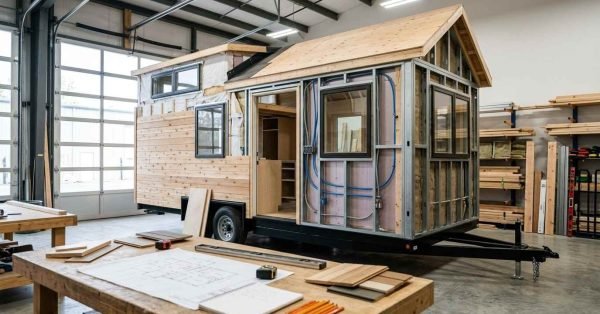
Wiring a structure that drives down the highway calls for choices a house electrician rarely thinks about. Vibration, flex, and thermal cycling all attack terminations and insulation.
This is where craftsmanship shows up years later, long after the drywall goes on.
Romex Versus Stranded Conductors in a Moving Structure
Solid-conductor NM cable, commonly called Romex, is the residential standard and satisfies dwelling inspectors. Stranded conductor handles repeated flex far better, which matters in a vehicle.
I use NM cable in static wall cavities and stranded conductor anywhere movement, flex, or vibration concentrates. That hybrid approach satisfies inspectors and survives transport.
Strain Relief, Conduit, and Penetration Sealing
Every conductor entering a box, panel, or appliance needs mechanical strain relief so vibration never pulls on a terminal. Conduit protects runs in exposed or high-abrasion locations.
Roof and wall penetrations get sealed properly or they leak. Water reaching an electrical run is how a small detail becomes a total loss.
12-Volt DC Systems and Dual-Voltage Design
Many tiny homes run a low-voltage DC system alongside standard household AC. DC skips the inverter entirely, which cuts conversion losses and keeps essentials running when the inverter sits idle.
I design dual-voltage systems on off-grid builds and skip DC entirely on homes that stay connected to shore power.
Where DC Makes Sense: Lighting, Fans, Water Pumps
LED lighting, roof vent fans, and water pumps all run efficiently on 12 volts. Running these loads directly off the battery avoids inverter standby draw, which quietly consumes energy around the clock.
A refrigerator is the interesting case. DC compressor refrigerators cost more and use dramatically less energy than an AC unit fed through an inverter.
Keeping AC and DC Systems Separated and Labeled
AC and DC conductors belong in separate raceways and separate boxes. Mixing them creates confusion, code violations, and real shock hazards for anyone working on the home later.
I color-code and label both systems at every junction. Clear labeling is the cheapest safety feature in the entire build.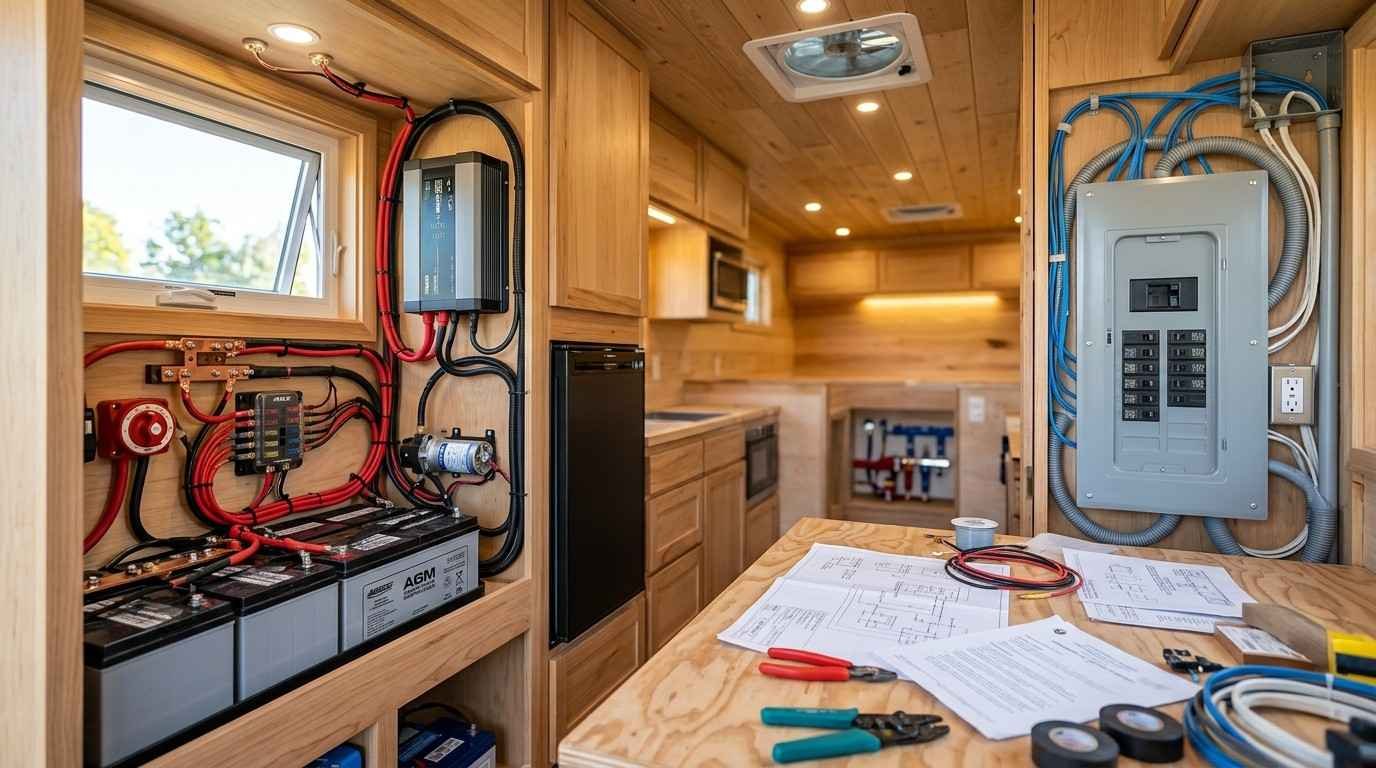
Electrical Planning for Heating, Cooling, and Water Heating
Comfort systems consume more electricity than everything else in a tiny home combined. Design them first, because they set the size of your service, battery bank, and array.
Mini-Splits, Resistance Heat, and Heat Pump Water Heaters
A ductless mini-split heat pump delivers heating and cooling at roughly three to four times the efficiency of resistance heat. That ratio decides whether off-grid operation is realistic.
Heat pump water heaters follow the same logic. ENERGY STAR reports heat pump models use about 70% less energy than standard electric resistance units.
Resistance heat still earns a place as backup. It costs almost nothing to install and rescues a cold night when the heat pump struggles.
Propane Offsets and Hybrid Energy Strategies
Propane handles cooking, water heating, and space heating with no electrical draw. Shifting those loads to propane shrinks the battery bank and array substantially.
I build hybrid systems for owners who want genuine off-grid independence. All-electric makes more sense for homes with reliable shore power.
Energy Efficiency and Long-Term Electrical Performance
An efficient tiny home needs a smaller electrical system, which costs less to build and less to run. Efficiency work pays twice.
Envelope Quality as an Electrical Design Decision
Insulation, air sealing, and window quality determine heating and cooling loads. A tight, well-insulated envelope cuts HVAC demand enough to shrink the entire power system.
I treat envelope decisions as electrical decisions. Spending on insulation regularly costs less than the extra solar and battery capacity a leaky envelope demands.
Monitoring, Metering, and Load Awareness
A battery monitor and energy meter turn invisible consumption into visible data. Owners who see their draw in real time change habits fast and rarely run out of power.
I install monitoring on every off-grid build. It converts a guessing game into management.
How do I know my tiny home’s electrical system was built correctly?
That question separates marketing claims from measurable quality. The next four sections cover what goes wrong, what documentation proves competence, what the work actually costs, and what to ask before you sign.
Common Electrical Design Mistakes in Tiny Homes on Wheels
Undersized service tops my list. A 30-amp system paired with an induction cooktop and air conditioning frustrates owners from day one.
Second is skipping the load calculation and buying solar by panel count. That produces systems that die every cloudy afternoon.
Third is poor termination quality. Loose lugs and unsupported conductors pass inspection and fail two years later after a few thousand highway miles.
I also see neutral-to-ground bonds duplicated in the home’s panel, missing AFCI protection, and inverters sized for continuous load with no surge margin. Each one is preventable with a proper design phase.
What Electrical Documentation a Quality Builder Provides
A one-line diagram showing every source, protective device, and circuit. A panel schedule matching the physical labels. A load calculation worksheet with real appliance data.
I also hand over component specification sheets, inverter and charge controller configuration settings, and any third-party certification paperwork.
Documentation is how a builder proves the work was engineered rather than improvised. A builder who cannot produce it likely did not create it.
Cost Ranges and Where Electrical Budget Actually Goes
Electrical work typically represents a meaningful slice of a tiny home budget, and off-grid capability drives the spread. A shore-power-only system costs a fraction of a full solar and lithium installation.
Batteries consume the largest share of an off-grid budget, followed by the inverter-charger and panels. Rough-in labor, panel, breakers, and conductors make up the base cost on every build.
I break out electrical as its own line item so owners see the tradeoff clearly. Deciding between all-electric and hybrid propane changes the number substantially.
Questions to Ask a Builder About Electrical System Design
Ask which code standard the build follows and whether the home carries a third-party label. Ask to see a completed load calculation from a previous project.
Ask how conductors are protected against vibration, whether AFCI protection is installed, and who performed the final inspection. Ask whether the design accommodates adding solar later.
The answers reveal process depth immediately. Builders who design systems answer specifically, and builders who improvise answer generally.
Conclusion
I covered load calculation, codes, shore power, solar, batteries, panels, grounding, wiring durability, DC circuits, HVAC loads, efficiency, mistakes, documentation, and cost.
Electrical design connects to every other quality decision in a tiny home, from envelope performance to appliance selection and long-term resale value.
We design and build electrical systems that last at Tiny Home Builders California. Reach out and we will engineer yours around how you actually live.
Frequently Asked Questions
Do tiny homes on wheels follow the NEC or RV electrical standards?
Both apply depending on jurisdiction and use. Vehicles follow RV standards like ANSI A119.5, while dwellings follow the NEC. Quality builders design to satisfy both.
How many amps does a tiny home on wheels need?
Most tiny homes work well on 50-amp service with a load list that runs comfortably on 30 amps. That combination handles appliances and keeps parking flexible.
Can a tiny home on wheels run entirely on solar?
Yes, with an accurate load calculation, adequate roof area, and a properly sized lithium battery bank. Propane for cooking and heating makes off-grid operation far easier.
Is a 12-volt DC system necessary in a tiny home?
Not for homes on shore power. DC systems help off-grid builds by powering lighting, fans, and pumps without inverter conversion losses or standby draw.
What electrical certification should a tiny home on wheels have?
RVIA or NOAH certification provides third-party verification of electrical work. Many parks, insurers, and lenders require one of these labels before approval.
Why does vibration matter in tiny home electrical systems?
Highway travel loosens terminations and abrades insulation. Stranded conductors, proper strain relief, and conduit protection prevent failures that static houses never face.
How much does a tiny home electrical system cost?
Shore-power-only systems cost far less than off-grid setups. Batteries and inverters drive most of the difference, so your power strategy determines the budget.