
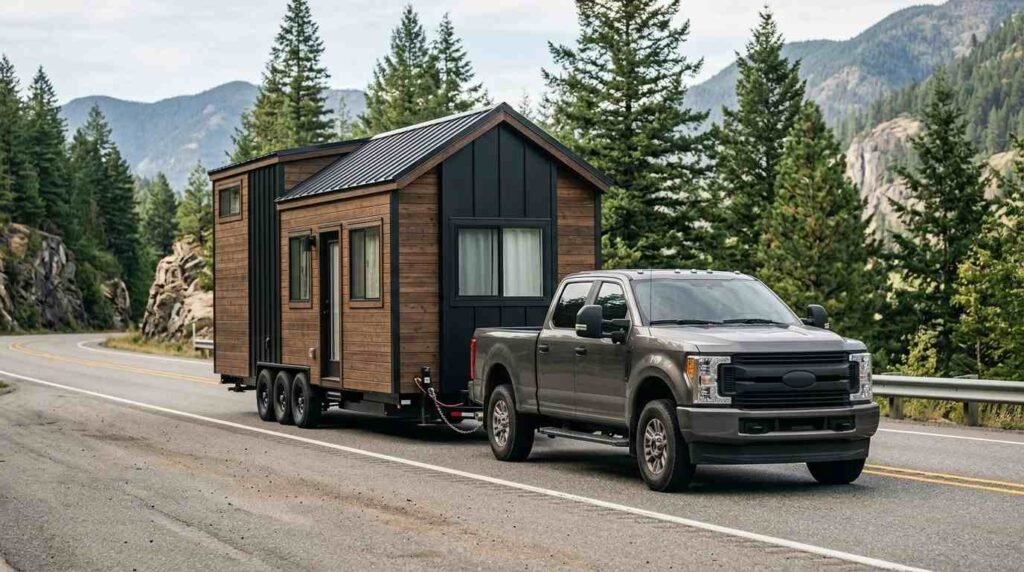
I tow a tiny house safely by matching my truck’s towing capacity to the trailer’s fully loaded GVWR, never the dry weight alone. A properly rated truck, the right hitch, and a pre-trip inspection prevent almost every serious towing accident. Most towing disasters trace back to one root cause: someone towed more house than their truck could handle.
Tiny houses look small, but a fully loaded one can weigh as much as a mid-size SUV or more. Skipping the math on weight, brakes, and truck capacity turns a weekend move into a roadside emergency. I’ve seen sway, blown tires, and hitch failures happen to people who never checked their numbers.
I walk through how to calculate real towing weight, pick the right truck, set up hitches and brakes correctly, and stay road-legal while driving safely across long distances. I also cover the mistakes that cause the most tiny house towing accidents, so you can avoid them before you ever hook up a trailer.
Understanding Tiny House Weight Classes and GVWR
Gross Vehicle Weight Rating is the maximum weight a trailer and its cargo can legally and safely reach when fully loaded. GVWR is a manufacturer-set limit stamped on the trailer’s certification label, and it always matters more than the trailer’s empty weight.
I never plan a tow around dry weight. Dry weight is the trailer with nothing inside it no water, no propane, no furniture, no belongings. A tiny house on wheels typically weighs 10,000 to 15,000 pounds dry, but loaded weight climbs fast once water tanks, appliances, and furniture get added.
Loaded weight is the only number that matters for choosing a truck. I add up dry weight plus every tank, appliance, and box of belongings, then compare that total against the trailer’s GVWR and my truck’s rated towing capacity.
Dry Weight vs. Loaded (GCWR) Weight
Gross Combined Weight Rating covers the truck, the trailer, and everything inside both of them combined. This is the number that actually determines whether a truck-and-trailer combination is safe and legal to drive.
I calculate GCWR by adding my truck’s curb weight, passengers, cargo, and the tiny house’s fully loaded weight together. That combined total has to stay under the truck manufacturer’s GCWR rating, not just under the truck’s advertised towing capacity.
A truck rated to tow 12,000 pounds doesn’t always have room for a 12,000-pound trailer once passengers and cargo get factored in. I check the door-jamb sticker on the truck for the real GCWR number before assuming anything.
Why Weight Determines Every Towing Decision
Every equipment choice downstream depends on getting weight right first. The hitch class, the brake controller setup, the tire load rating, and even the truck selection process all trace back to one number: fully loaded trailer weight.
I treat weight verification as step one, not an afterthought. A tiny house builder who provides accurate weight documentation on the trailer’s spec sheet makes this entire process faster and safer for the owner.
Choosing the Right Truck for Tiny House Towing
The right truck for towing a tiny house has a payload and towing capacity that exceeds the trailer’s fully loaded GVWR with a safety margin. Most tiny houses need at least a three-quarter-ton truck, though heavier builds require a one-ton diesel.
I never trust the “max towing capacity” number printed in truck ads. That figure usually reflects a stripped-down test truck with no passengers, no hitch, and no cargo nothing like real-world conditions.
Payload capacity matters just as much as towing capacity. Payload is what the truck itself can carry in its bed and cabin, and tongue weight from the trailer counts against that number directly.
Towing Capacity vs. Payload Capacity
Towing capacity measures what the truck can pull behind it. Payload capacity measures what the truck can carry on top of its own frame, including tongue weight pressing down on the hitch.
I add roughly 10 to 15 percent of the trailer’s loaded weight to estimate tongue weight, then confirm the truck’s payload rating covers that number plus passengers and gear. A truck with plenty of towing capacity can still be payload-overloaded the moment a family and their luggage climb in.
Half-Ton, Three-Quarter-Ton, and One-Ton Trucks Compared
Half-ton trucks handle small, lightly loaded tiny houses under roughly 7,000 pounds, and even then only with the right towing package installed. Three-quarter-ton trucks cover most standard tiny houses in the 10,000 to 14,000 pound range comfortably.
One-ton trucks, especially diesel models, are built for the heaviest tiny houses and long highway hauls with steep grades. I recommend one-ton trucks whenever the loaded trailer weight approaches 14,000 pounds or the trip covers serious elevation changes.
Trailer Hitches, Brakes, and Towing Equipment Requirements
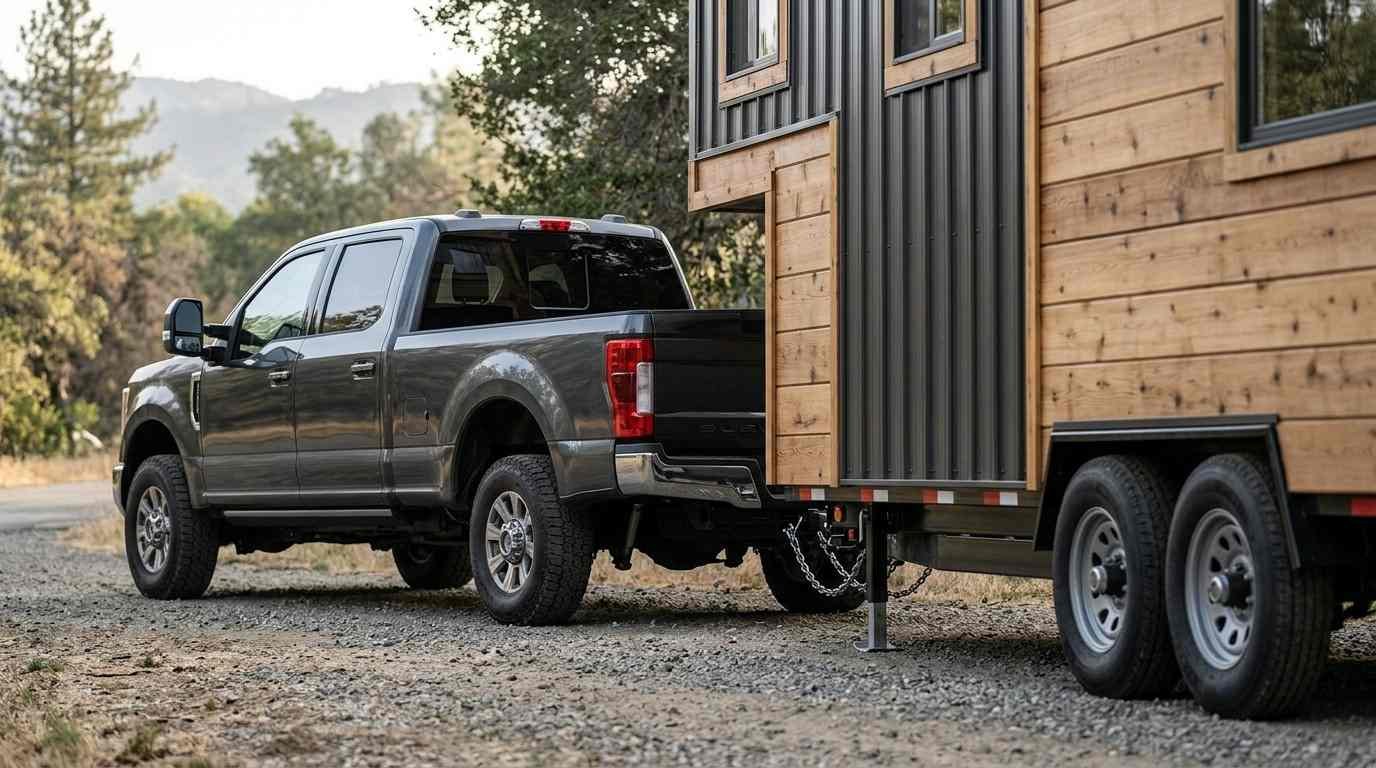
A weight distribution hitch and a properly matched brake controller are required equipment for towing any tiny house over roughly 5,000 pounds. These two systems work together to keep the trailer stable and stop safely at highway speeds.
I never tow a tiny house on a standard ball hitch alone once the trailer crosses into mid-size territory. A weight distribution hitch spreads tongue weight across all axles instead of concentrating it on the truck’s rear end.
Every state requires functioning trailer brakes above a certain weight threshold, and skipping this system is both illegal and dangerous. The exact threshold varies, but most fall between 3,000 and 5,000 pounds gross trailer weight.
Hitch Classes and Weight Distribution Systems
Hitch classes range from Class I, rated for light loads under 2,000 pounds, up to Class V and gooseneck setups rated for 12,000 pounds or more. I match the hitch class to the trailer’s GVWR with margin to spare, never right at the limit.
Weight distribution hitches use spring bars to transfer tongue weight forward onto the truck’s front axle and back onto the trailer’s axles. This keeps the truck’s steering responsive and prevents the rear end from squatting under load.
Trailer Brake Controllers and Braking Systems
Electric and electric-hydraulic brake controllers sync the trailer’s brakes with the truck’s brake pedal for coordinated stopping power. I set the controller’s gain manually so the trailer brakes engage at the right intensity for the actual loaded weight.
Sway control add-ons help correct fishtailing before it becomes dangerous, and I treat them as standard equipment rather than an upgrade. A trailer without working brakes takes dramatically longer to stop and can jackknife under hard braking.
Road Legal Requirements for Towing a Tiny House
Road legal requirements for towing a tiny house include a properly rated driver’s license, state registration for the trailer, and compliance with width and height limits. Requirements shift by state, so I always check the specific rules before a long-distance move.
Most states cap trailer width at 8.5 feet and total height at 13.5 feet, though a handful allow slightly more with a permit. I measure the tiny house against these limits before ever scheduling a move, since an oversized load changes everything about the trip.
A standard driver’s license covers most tiny house towing situations, but combined weight over roughly 26,000 pounds triggers commercial license requirements in many states.
License and Permit Rules by Vehicle Weight
Combined Gross Vehicle Weight above 26,001 pounds generally requires a Commercial Driver’s License under federal guidelines, according to the Federal Motor Carrier Safety Administration. Most tiny house tows stay under this threshold, but a heavy one-ton dually towing a large build can approach it.
I check my home state’s specific rules since some states set lower thresholds than the federal guideline. Wide-load or oversize permits become necessary once the trailer exceeds standard width or height limits.
Width, Height, and Length Restrictions on the Road
Width restrictions typically cap out at 8.5 feet without a permit, and most tiny houses on trailers are built right up against that limit. Height restrictions usually sit around 13.5 feet total, measured from the ground to the highest point of the roof.
I plan routes in advance when a build pushes close to these limits, since low bridges and narrow lanes become real hazards. A tiny house design that respects these dimensions from the start avoids permit headaches later.
Road Safety Practices for Towing Long Distances
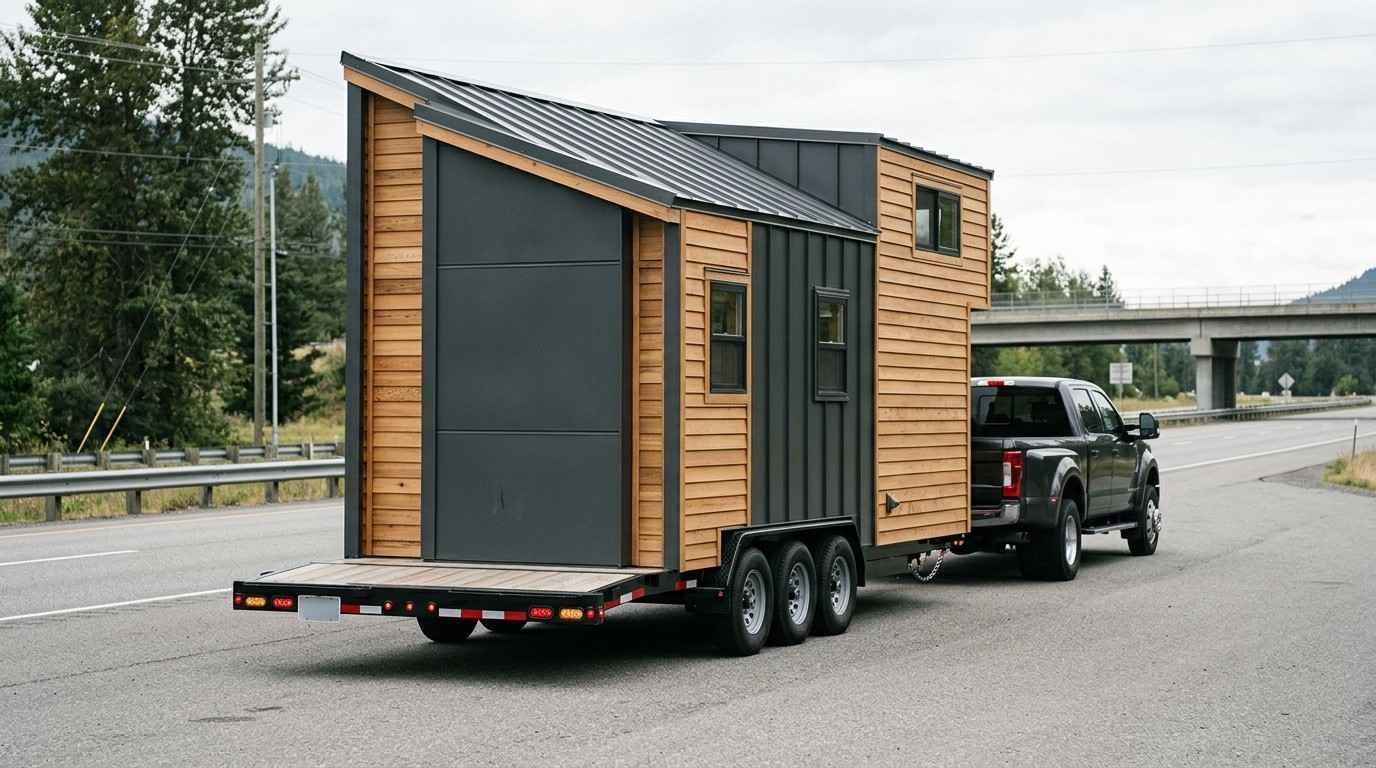
Safe long-distance towing starts with a thorough pre-trip inspection and continues with driving techniques suited to the trailer’s size and weight. Tire pressure, hitch security, and brake function all get checked before the truck ever leaves the driveway.
I inspect the entire rig every single time, even on short trips, because a loose lug nut or low tire causes the same damage at 50 miles as it does at 500. Long hauls add fatigue and weather variables that make preparation even more critical.
Wind gusts and steep grades cause more towing incidents than any mechanical failure. I slow down significantly in both conditions and keep a wider following distance than I would in a regular vehicle.
Pre-Trip Inspection Checklist
I check tire pressure and tread on both the truck and trailer, since underinflated tires are a leading cause of blowouts under load. Hitch pins, safety chains, and the brake controller connection get a physical tug test every time.
Wheel bearings, brake lights, and turn signals all get verified before pulling onto the highway. I also confirm cargo inside the tiny house is secured, since shifting weight during transit changes handling unpredictably.
Driving Techniques for Wind, Grades, and Turns
I reduce speed to around 55-60 mph on the highway when towing a tiny house, well below what feels comfortable in an unloaded truck. Wide turns account for the trailer’s extra length, and I swing wider than instinct suggests to avoid clipping curbs.
Downhill grades call for lower gears and steady braking instead of riding the brakes continuously, which overheats them. Crosswinds push a tall tiny house trailer harder than a standard camper, so I grip firmly and avoid overcorrecting when a gust hits.
Common Towing Mistakes That Put Your Tiny House at Risk
The most common tiny house towing mistakes are overloading the trailer past its GVWR, skipping the weight distribution hitch, and neglecting maintenance before a trip. Any one of these mistakes turns a routine move into a dangerous situation.
I see overloading happen most often when owners add furniture and belongings without reweighing the loaded trailer. What felt like a safe margin on paper disappears once real life gets packed inside.
Tongue weight that’s too light or too heavy both cause instability at highway speeds. I aim for that 10 to 15 percent target every time, and I verify it with a scale rather than guessing.
Overloading and Improper Weight Distribution
Overloading past GVWR stresses axles, tires, and brakes beyond their rated limits, and it’s often invisible until something fails at speed. I weigh the fully loaded trailer at a certified scale before any long trip, not just once at the point of sale.
Improper weight distribution too much weight at the front or back of the trailer — causes sway and unpredictable handling. I load heavier items low and centered over the axles, keeping the tongue weight in the safe range.
Skipping Maintenance Checks Before the Trip
Bearings that haven’t been repacked, brakes that haven’t been tested, and tires that are years old all fail more often on tiny house trailers than most owners expect. I treat trailer maintenance with the same seriousness as truck maintenance, since the trailer carries the more fragile cargo.
Rushing the pre-trip check to save ten minutes is the single most common regret I hear about after a bad towing experience. A few minutes of inspection prevents the vast majority of roadside breakdowns.
Conclusion
Towing a tiny house safely comes down to three things: knowing the real loaded weight, matching truck and hitch capacity to that number, and inspecting everything before departure.
Weight, equipment, and road law all connect directly to how confidently you can move a tiny house across any distance. Skipping one weakens the whole system.
We build tiny houses designed with towability in mind from day one. Reach out to Tiny Home Builders California to plan a build that tows as well as it lives.
Frequently Asked Questions
What size truck do I need to tow a tiny house?
Most tiny houses need at least a three-quarter-ton truck, and heavier builds over 14,000 pounds require a one-ton diesel. I always match truck capacity to the trailer’s fully loaded GVWR, not its dry weight.
Do I need a special license to tow a tiny house?
A standard driver’s license covers most tiny house tows under 26,000 pounds combined weight. Combined weight above that threshold generally requires a Commercial Driver’s License in most states.
How much does a tiny house weigh when towing?
A fully loaded tiny house typically weighs between 10,000 and 15,000 pounds, sometimes more with heavy finishes. I always calculate loaded weight with water, propane, and belongings included, not the empty dry weight.
Do tiny houses need trailer brakes?
Yes, most states require functioning trailer brakes once gross trailer weight crosses 3,000 to 5,000 pounds. I treat brake controllers as required equipment on every tiny house tow regardless of the exact state threshold.
What is a weight distribution hitch and do I need one?
A weight distribution hitch spreads the trailer’s tongue weight across all axles instead of concentrating it on the truck’s rear end. I recommend one for any tiny house over roughly 5,000 pounds to keep steering and braking stable.
How fast can I safely drive while towing a tiny house?
I keep highway speeds around 55 to 60 mph when towing a tiny house, well under normal highway speed. Wind, grade, and trailer length all reduce safe margins at higher speeds.
What’s the biggest mistake people make towing a tiny house?
Overloading the trailer past its GVWR without reweighing after adding furniture and belongings is the most common mistake. I always verify loaded weight at a certified scale before any long-distance move.


