Off-grid power, water, and waste systems are the three self-contained utility packages that let a tiny house on wheels operate without permanent municipal hookups. I build these systems into THOWs across California, and they decide more about daily comfort than any finish material ever will.
Most buyers evaluate tiny homes on cabinetry and cladding. But the systems behind the walls determine whether the home stays livable through a January cold snap or an August heat wave.
This guide covers system fundamentals, power generation and sizing, water storage and treatment, waste handling, California code, build integration, real costs, and how to judge a builder’s work.
What Off-Grid Systems Mean for a Tiny House on Wheels
Off-grid systems in a THOW replace the four utilities a conventional house takes for granted: electricity, potable water, wastewater removal, and heating fuel. In a fixed house, those arrive through buried lines. In a tiny house on wheels, I carry them with me.
That single difference reshapes every engineering choice. Every gallon of water and every amp-hour of storage has weight, volume, and a cost in trailer capacity.
I want to be direct about something. True off-grid means zero external dependency, and very few THOW owners actually live that way full time.
Off-Grid vs. Grid-Tied vs. Hybrid THOW Setups
A grid-tied THOW plugs into a 30-amp or 50-amp pedestal, connects to a hose bib, and dumps into a sewer or septic inlet. It behaves like an RV on a serviced pad.
A fully off-grid THOW generates its own power, stores its own water, and processes its own waste onsite. Nothing crosses the property line.
Hybrid setups dominate real-world builds. Most of my clients run solar and battery as the primary power source with a shore-power inlet as backup, plus tank storage they refill from a spigot when one is available.
The Three Core Systems: Power, Water, Waste
Power covers generation, storage, conversion, and distribution. Water covers storage, pressurization, heating, and treatment. Waste splits into blackwater from the toilet and greywater from sinks and the shower.
These three interlock constantly. A pressure pump draws from the battery bank, an electric water heater can consume more daily energy than the rest of the house combined, and a composting toilet needs a small continuous fan load.
Design them together or fight them forever.
Why Mobility Changes Every System Decision
Everything in a THOW rides on a trailer with a fixed gross vehicle weight rating. Water weighs 8.34 pounds per gallon, so a 100-gallon fresh tank adds over 834 pounds before you account for the tank, pump, and plumbing.
Vibration is the other mobility tax. Road travel loosens compression fittings, fatigues rigid copper, and cracks unsupported drain lines.
I use flexible PEX with reinforced supports, secure every tank against shifting, and place heavy components low and near the axles. That is not preference. That is what survives the highway.
Off-Grid Power Systems for THOWs
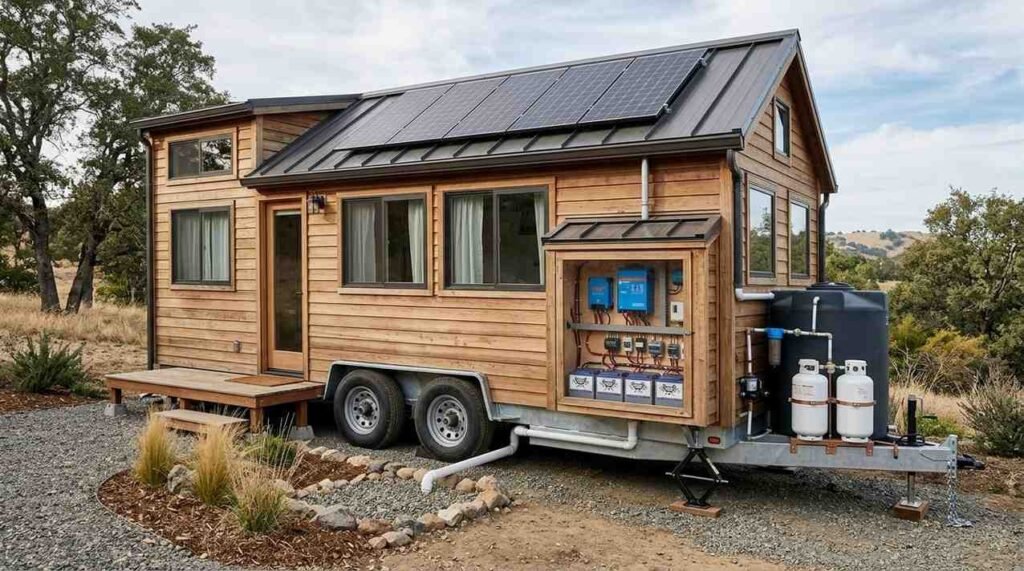
A THOW power system has four parts working in sequence: generation, storage, conversion, and protection. Solar panels generate, batteries store, an inverter converts DC to AC, and fuses plus breakers protect the whole chain.
I size these systems around real consumption, never around a panel count someone read in a forum. The approach to load-based system sizing is what separates a system that works from one that browns out every cloudy afternoon.
Solar Arrays and Roof Space Limits
A standard 8-by-24-foot THOW roof holds roughly 1,200 to 2,400 watts of modern panels once you subtract space for vents, skylights, and a mini-split condenser. Rigid monocrystalline panels deliver the best output per square foot.
Panel orientation is fixed on a mobile structure. I account for that by oversizing the array rather than assuming ideal tilt.
Battery Banks and Usable Capacity
Lithium iron phosphate has replaced lead-acid in nearly every build I do now. LFP delivers 80 to 100% usable depth of discharge against roughly 50% for lead-acid, which means a 200Ah lithium bank outperforms a 400Ah flooded bank at half the weight.
Cycle life matters just as much. Quality LFP cells hold up for thousands of cycles, which turns the higher purchase price into a lower cost per stored kilowatt-hour over a decade.
Inverters, Charge Controllers, and Wiring
The inverter determines what appliances actually run. A pure sine wave unit protects electronics and motors; modified sine wave damages them over time.
MPPT charge controllers harvest 20 to 30% more energy than older PWM controllers in variable light. I pair that with correctly gauged wire and DC breakers sized to the run, because undersized cable is the most common failure I find in other people’s builds.
Generators, Propane, and Backup Power
Solar production collapses during a week of coastal fog or winter storms. A propane generator or a shore-power inlet covers that gap without oversizing the array to an absurd degree.
Propane also carries cooking, water heating, and space heating at a fraction of the electrical draw. A 20-pound tank stores far more usable energy than any battery bank I can fit under a THOW floor.
Sizing Your Power System to Real Household Loads
Sizing starts with a watt-hour audit, not a wish list. I list every device, its draw, and its daily runtime, then total the watt-hours and add a 25 to 30% buffer for inefficiency and future additions.
That number drives everything downstream. Battery capacity, array size, inverter rating, and wire gauge all fall out of one honest load calculation.
Building a Simple Load Profile
A typical two-person THOW lands between 3 and 8 kWh per day depending on heating, cooling, and whether the water heater runs on electricity. A laptop and LED lighting cost almost nothing. An electric range and a heat pump running through a Central Valley summer cost plenty.
I separate always-on loads from intermittent ones. Refrigeration, the composting toilet fan, and network gear run constantly and set the baseline the battery must carry overnight.
Seasonal and Regional Solar Variation in California
California spans a wide solar range. According to the National Renewable Energy Laboratory’s solar resource data, interior southern California receives substantially more annual irradiance than the northern coast.
December production commonly falls to 40 to 50% of June output statewide. I size for the winter minimum in a home meant for year-round living, not the annual average.
Appliance Choices That Cut Demand
Efficiency is cheaper than capacity. A 12V DC compressor refrigerator draws a fraction of a converted household unit, and induction cooking beats resistance coils on energy per meal.
Propane for cooking and water heating removes the two largest electrical spikes from the system entirely. That single decision often shrinks the required battery bank by a third.
Off-Grid Water Systems for THOWs
An off-grid water system stores, pressurizes, heats, and treats water inside a footprint measured in cubic feet. Fresh water comes in, gets used, and leaves as greywater or blackwater.
Capacity planning follows a simple ratio. I plan on 8 to 15 gallons per person per day for conservative off-grid living, which is roughly a quarter of typical municipal household use.
Fresh Water Storage and Tank Capacity
Most THOWs carry 40 to 100 gallons of fresh water. Interior tanks stay protected from freezing and add usable weight low in the structure; exterior underbelly tanks free interior space but need insulation and heat.
I always specify NSF-certified potable-grade polyethylene tanks with baffles. Unbaffled tanks slosh, and a shifting 700-pound load changes how a trailer tracks at highway speed.
Pumps, Pressure, and Plumbing Materials
A 12V diaphragm pump with an accumulator tank delivers steady household-feel pressure at 40 to 50 PSI without cycling on every faucet crack. Pump selection is a comfort decision as much as a mechanical one.
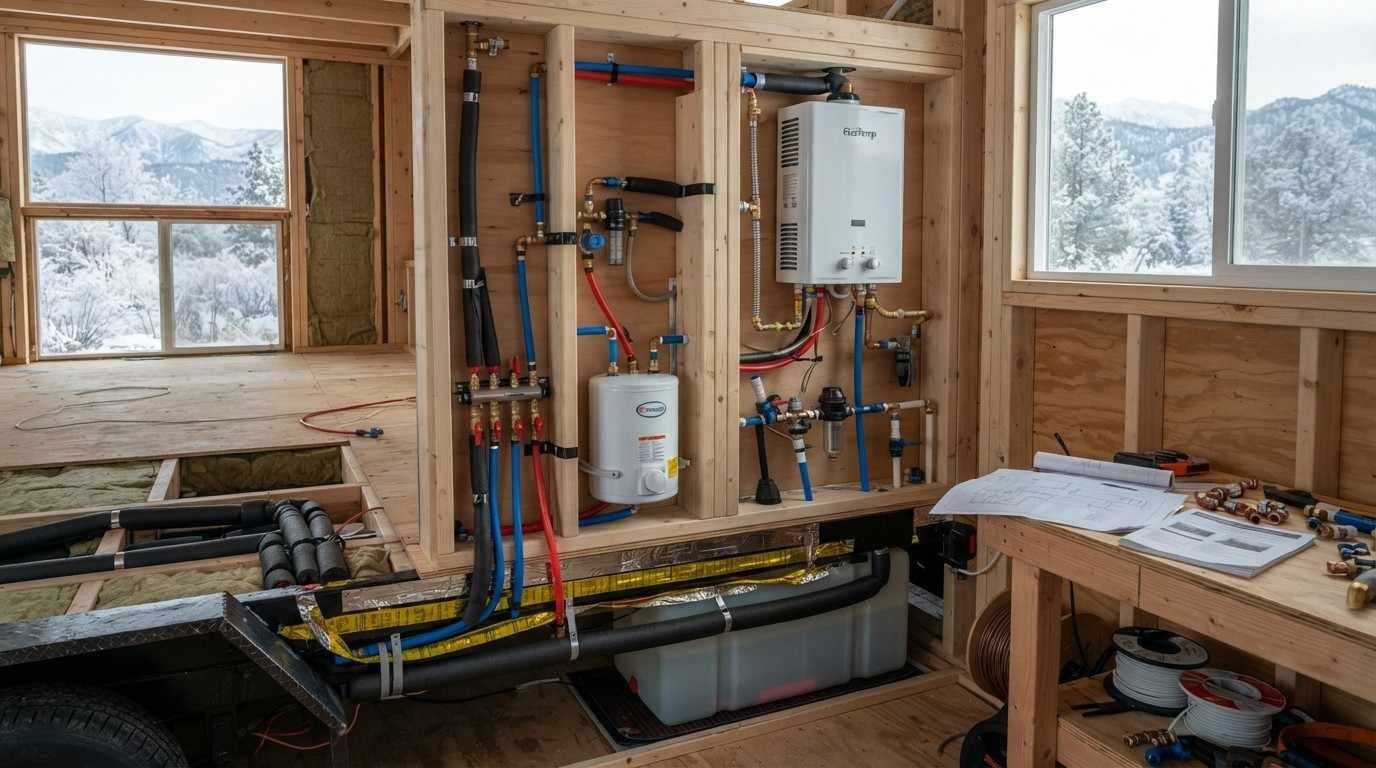
PEX-A with expansion fittings handles vibration and freeze expansion far better than rigid copper or CPVC. I run it in accessible chases with shutoffs at every fixture group.
Rainwater Catchment and Well Hookups
A metal THOW roof is an excellent collection surface. Roughly 0.6 gallons of water comes off every square foot of catchment per inch of rainfall, so a 200-square-foot roof yields about 120 gallons from a single one-inch storm.
The catch in California is timing. Most rain falls between November and March, so catchment supplements rather than replaces stored or hauled water through a dry summer.
Filtration, Purification, and Potable Water Safety
Filtration and purification are different jobs. Sediment and carbon filters remove particulates, chlorine, and taste; UV sterilization or reverse osmosis addresses pathogens and dissolved contaminants.
Water from an unverified well or catchment surface needs treatment before it touches a potable tank. The EPA’s guidance on private drinking water covers the testing baseline I recommend before anyone drinks from an onsite source.
Water Heating and Freeze Protection
Hot water is the single largest energy load in most tiny homes. It is also the system that fails first when temperatures drop, because exposed lines in a mobile structure have almost no thermal mass to protect them.
I treat heating and freeze protection as one design problem. Solving them separately produces a home that works in September and burst pipes in December.
Tankless vs. Tank Water Heaters
Propane tankless units deliver unlimited hot water with zero standby loss and consume no battery power beyond ignition. That combination fits off-grid THOWs better than anything else I install.
Small electric tanks suit grid-tied or hybrid homes with generous solar. On a pure off-grid system, a 20-gallon electric tank can eat half the daily battery budget by itself.
Insulation, Heat Tape, and Winterizing
Every water line, tank, and drain in an unconditioned cavity gets closed-cell insulation and, where exposure demands it, self-regulating heat tape. Tank heating pads keep fresh water above freezing in Sierra and high-desert placements.
I also build in a full drain-down capability. Any THOW headed to snow country needs to be emptied and blown out in under thirty minutes.
Off-Grid Waste Systems for THOWs
Waste divides into two streams with different rules and different solutions. Blackwater from the toilet carries pathogens and faces the strictest regulation; greywater from sinks, showers, and laundry is far easier to manage onsite.
Separating those streams at the fixture is the foundation of every workable off-grid waste design I build. Combine them and you have created blackwater out of everything.
Composting Toilets
Urine-diverting composting toilets are the most common off-grid choice in THOWs. They separate liquid from solid at the source, which stops odor before it starts and cuts the volume needing management by a large margin.
They use no water, need no blackwater tank, and require a small fan load plus regular emptying. That last part is real work, and I say so plainly during design.
Incinerating and Cassette Toilets
Incinerating toilets burn waste to sterile ash using propane or electricity. Output volume is minimal, but each cycle draws meaningful energy and the units carry a high purchase price.
Cassette toilets use a small removable holding tank with flush water. They are simple and inexpensive, though the frequent manual dumping suits weekend use better than full-time living.
Blackwater Tanks and Conventional Hookups
A conventional flush toilet with a blackwater tank gives the most familiar experience. It also demands 20 to 40 gallons of tank capacity, water for flushing, and access to a legal dump station or septic connection.
This path makes sense for THOWs parked long-term on serviced land. For genuine off-grid mobility, tank weight and disposal logistics work against it.
Greywater Capture, Reuse, and Disposal
Greywater is the most recoverable resource in the house. Shower and sink water can irrigate landscaping through mulch basins or subsurface distribution, which reduces both fresh water demand and disposal volume.
California treats greywater reuse as legal within defined limits, and the rules on flow volume, plumbing separation, and permitting sit in the state plumbing code. Simple systems below the flow threshold often proceed without a permit, while larger designs need review.
California Codes, Permits, and Legal Placement
Regulation is where most off-grid THOW plans stall. The home’s legal classification, the county’s zoning, and the wastewater rules operate independently and all three have to align.
I work through classification before design finalizes, because the answer changes construction standards, allowable placement, and financing options together.
ANSI 119.5, HUD, and Park Model Classifications
Most THOWs get built to ANSI A119.5, the park model recreational vehicle standard, or certified as an RV through RVIA. Others are constructed to HUD manufactured housing standards for permanent placement.
That certification decides what a jurisdiction sees. An RV-classified THOW faces occupancy limits in many counties, while a permanently sited unit triggers full residential code review.
County and Municipal Placement Rules
California has no single statewide THOW placement rule. California’s ADU legislation has pushed several jurisdictions to recognize movable tiny homes as accessory dwelling units, and a growing number of counties now permit them explicitly.
Others still restrict THOWs to RV parks or limit occupancy to a set number of days per year. I verify local ordinance before a client commits to a parcel, every single time.
Greywater and Onsite Wastewater Regulations
Greywater reuse falls under the California Plumbing Code, while onsite wastewater treatment sits with regional water boards and county environmental health departments. These are separate approvals from any building permit.
Composting toilet acceptance varies by county. Some approve them outright as a legal fixture, others require a permitted septic or sewer connection regardless of what the toilet does.
Integrating Systems During the Build
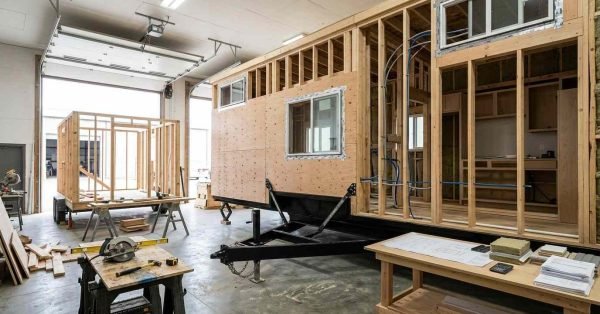
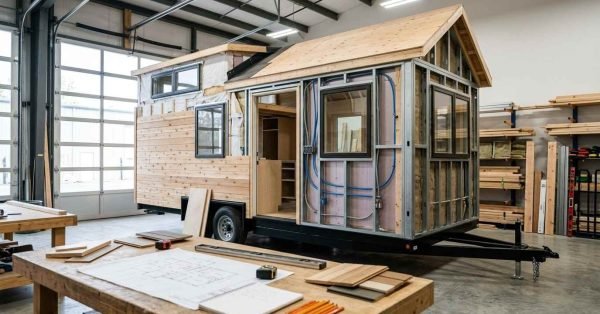
Systems integration is where craftsmanship shows. Panels, tanks, and toilets are commodities; the routing, support, sequencing, and serviceability behind them are not.
I design the mechanical layout before framing goes up. Retrofitting a chase into a finished wall costs several times what planning it costs.
Chase Runs, Access Panels, and Service Points
Every pump, filter, valve, breaker, and fitting needs to be reachable without demolition. I build dedicated chases and removable access panels at every service point.
This is the detail buyers never inspect and always regret. A water heater buried behind fixed tongue-and-groove becomes a thousand-dollar repair the first time it needs a part.
Weight Distribution and Axle Load
Batteries, water tanks, and propane are the heaviest movable items in a THOW. I place them low, centered laterally, and positioned to keep tongue weight in the correct range for the axle configuration.
Then I verify with actual scale weights. Calculated estimates drift, and an overloaded axle is a safety and insurance problem, not a paperwork one.
Sequencing Rough-In With Framing and Finishes
Plumbing and electrical rough-in happens after framing and sheathing, before insulation and interior finish. Every penetration gets sealed and flashed as it is made.
I pressure-test water lines and verify electrical continuity before a single wall closes. Finding a leak at rough-in costs an hour. Finding it after finish work costs a wall.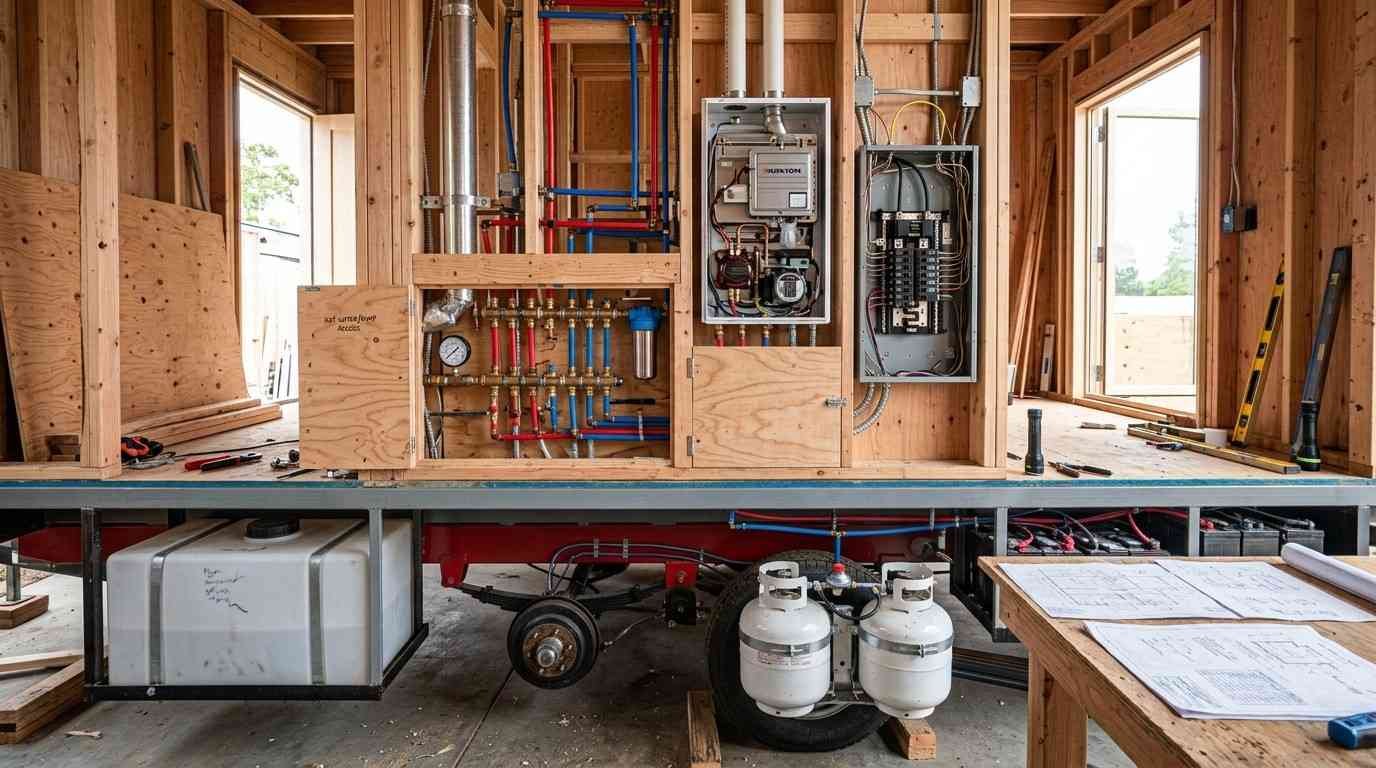
Cost, Lifespan, and Total Ownership Value
Off-grid systems typically represent 15 to 30% of a THOW’s total build cost. That share surprises buyers who budgeted around square footage and finishes.
The right frame is cost per year of reliable service, not sticker price. A cheap system replaced twice costs more than a good one maintained once.
Upfront System Costs by Tier
A basic solar and battery setup with modest capacity runs a few thousand dollars. A robust full-time off-grid electrical system with substantial lithium storage and generator backup commonly reaches $15,000 to $25,000 installed.
Water systems land in the low thousands including tank, pump, heater, and filtration. Waste ranges from under a thousand for a simple composting unit to several thousand for an incinerating toilet or a full blackwater setup.
Maintenance Intervals and Component Replacement
Filters change on a schedule measured in months. Pumps, inverters, and water heaters run 8 to 15 years. Quality LFP batteries commonly hold serviceable capacity for a decade or more under normal cycling.
I hand every client a maintenance schedule at delivery. Systems fail from neglect far more often than from defect.
Resale, Insurability, and Documentation
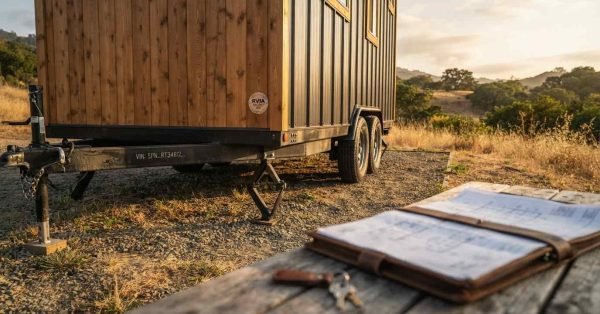
Documented systems sell better and insure more easily. Load calculations, wiring diagrams, component specs, certification paperwork, and as-built drawings prove what is inside the walls.
Insurers and lenders both want that record. A THOW with complete system documentation and RVIA or ANSI certification faces far fewer obstacles than one built without a paper trail.
So how do I know a builder actually installs these systems correctly? That question separates marketing from measurable quality, and it has concrete answers.
How to Evaluate a Builder’s Off-Grid System Work
Every builder claims quality systems. The ones who deliver can show you the math, the drawings, and the finished access panels.
I judge system work on documentation depth, component transparency, and serviceability. Those three things predict long-term performance better than any showroom walkthrough.
Documentation, Load Calcs, and As-Built Drawings
Ask for a written load calculation, a one-line electrical diagram, a plumbing schematic, and named component brands with model numbers. A builder who works from real numbers produces those documents as a matter of routine.
Vague answers signal guessing. “We put a big enough system in” is not an engineering statement.
Questions to Ask Before You Sign
Ask how the system was sized and to what daily watt-hour figure. Ask where every service point sits and how it is accessed. Ask what certification the home carries and what the freeze protection strategy is.
Then ask to see a completed build and open the access panels yourself. The full builder evaluation checklist goes deeper on contracts, warranties, and inspection points.
Common Off-Grid Mistakes in THOW Builds
The failures I get called to fix repeat with remarkable consistency. Almost all of them trace to sizing shortcuts or inaccessible installations.
Undersized battery banks top the list. Owners size for summer, then discover December production at half the rate with no reserve to cover it.
Buried components come second. Pumps and filters sealed behind finished walls turn routine maintenance into demolition.
The rest cluster around weight, water, and waste. Overloaded axles from tanks placed poorly, freeze damage from uninsulated lines in cold placements, and waste plans made after the toilet was already installed.
Conclusion
Off-grid power, water, and waste systems work as one integrated package, and their sizing, integration, and documentation decide how a THOW performs long term.
These systems anchor a much larger topic domain covering trailer construction, insulation, code compliance, and placement, each deserving its own detailed resource.
We build documented, serviceable off-grid systems into every home. Contact Tiny Home Builders California to plan a THOW engineered for real independence.
Frequently Asked Questions
Can a tiny house on wheels run fully off-grid year-round in California?
Yes, with correct sizing. Winter solar production drops sharply, so year-round systems need larger battery capacity, propane backup, and freeze protection for the climate zone.
How much solar does a THOW actually need?
Most full-time THOWs need 1,200 to 2,400 watts of panels paired with adequate lithium storage. The exact figure comes from a daily watt-hour load calculation, not a rule of thumb.
How long does fresh water last in a THOW?
At 8 to 15 gallons per person daily, a 60-gallon tank supports one person about a week. Two people conserving carefully stretch it to four or five days.
Are composting toilets legal in California?
Acceptance varies by county. Some jurisdictions approve composting toilets as legal fixtures, while others still require a permitted septic or sewer connection regardless of toilet type.
What does a complete off-grid system cost for a THOW?
Full-time off-grid power, water, and waste systems commonly total $20,000 to $35,000 installed. Cost tracks capacity, component quality, and how much redundancy the climate demands.
Can I add off-grid systems to an existing tiny home?
Yes, though retrofits cost more than original installation. Wall access, chase routing, and weight redistribution all become harder once framing and finishes are complete.
Does going off-grid affect financing or insurance?
Documentation matters more than off-grid status. RVIA or ANSI certification plus complete system records make financing and insurance approval significantly easier to obtain.