Financing a park model home works differently than financing a traditional house, because most lenders classify these homes as personal property rather than real estate. A park model home is a factory-built dwelling under 400 square feet that typically requires chattel loans, RV loans, or dealer financing instead of a conventional mortgage, and it needs specialized insurance that accounts for its unique construction and classification. Buyers who understand this distinction early avoid denied applications and coverage gaps later.
Getting this wrong costs buyers real money through rejected loan applications, higher rates, or coverage denials. Understanding your options upfront protects your investment and timeline.
This guide covers what park model homes are and why they’re classified differently, the full range of financing paths available, credit and down payment expectations, the insurance coverage types you need, and how California’s specific rules shape both processes.
What Is a Park Model Home?
A park model home is a factory-built recreational dwelling, generally under 400 square feet, designed for semi-permanent placement on a single site rather than frequent travel. Builders construct these units to meet ANSI A119.5 standards rather than the HUD code that governs manufactured homes, which is a classification difference that shapes everything downstream, from financing to insurance to where you’re legally allowed to place one.
How Park Models Differ From RVs and Manufactured Homes
Park model homes sit in a gray zone between recreational vehicles and manufactured housing. RVs are built for mobility and licensed as vehicles, while manufactured homes meet HUD code and often qualify as real property once permanently affixed to land. A park model home typically does neither cleanly, which is exactly why lenders treat it as a distinct asset class.
Why Financing and Insurance Work Differently for Park Models
Because park model homes don’t fit neatly into “house” or “vehicle” categories, conventional mortgage underwriting and standard homeowners insurance policies often don’t apply. Lenders and insurers have built separate products specifically for this classification gap, and knowing which product fits your situation is the first real decision in the buying process.
Why Park Model Homes Are Harder to Finance Than Traditional Homes
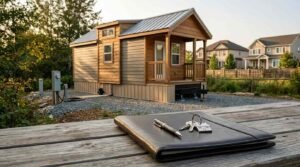
Park model homes are harder to finance because most fall under personal property classification instead of real property, which disqualifies them from conventional mortgage products. Three factors drive this difficulty in practice:
- Classification as chattel: most park models are titled like vehicles, not real estate
- Shorter loan terms: lenders treat them as depreciating assets, similar to RVs
- Limited appraisal comparables: fewer sales records make valuation harder for underwriters
- Land ownership questions: many park models sit on leased land, which complicates collateral
Classification Issues (Real Property vs. Personal Property/Chattel)
Real property classification requires the home to be permanently affixed to land the owner holds title to, while chattel classification treats the home like a vehicle with its own title document. A park model home on leased land in a community almost always falls into the chattel category, which routes the buyer toward RV-style or personal property loans instead of a mortgage.
Types of Park Model Home Financing Options
Buyers have four realistic financing paths for a park model home, and the right one depends on land ownership, credit profile, and the home’s classification. The table below summarizes how each option compares.
| Financing Type | Typical Term | Collateral | Best For |
| Chattel loan | 10–20 years | The home itself | Buyers on leased land |
| RV loan | 10–15 years | The home itself | Buyers using it recreationally or seasonally |
| Personal/unsecured loan | 3–7 years | None | Buyers with strong credit, smaller loan amounts |
| Manufacturer/dealer financing | Varies by dealer | The home itself | Buyers purchasing directly through a builder or dealer |
Chattel (Personal Property) Loans
A chattel loan is a loan secured by the home itself rather than the land beneath it, which makes it the most common financing path for park models sited on leased or rented lots. Repayment terms usually run shorter than a traditional mortgage, often landing in the 10 to 20 year range.
RV Loans for Park Model Homes
RV loans work because many park model homes qualify under ANSI standards that overlap with recreational vehicle classifications, giving buyers access to RV-specific lenders. Rates and terms resemble auto financing more than mortgage financing, with amounts tied closely to the home’s purchase price.
Personal Loans and Unsecured Financing
Personal loans skip collateral entirely, which means approval leans heavily on the borrower’s credit profile and income rather than the home’s value. This path suits smaller purchase amounts or buyers who want to avoid the home being repossessed if payments lapse.
Manufacturer or Dealer Financing Programs
Many builders and dealers offer in-house financing arrangements that bundle the loan with the purchase, often streamlining approval for buyers who qualify. Terms vary significantly by dealer, so comparing the total cost against a chattel or RV loan from an outside lender is worth the extra step.
Can You Get a Traditional Mortgage for a Park Model Home?
Getting a traditional mortgage for a park model home is possible only when the home is permanently affixed to land the buyer owns and meets the lender’s real property standards. This combination is uncommon, since most park models are designed for community or leased-lot placement rather than permanent foundation installation.
When Land-Home Financing Becomes an Option
Land-home financing becomes available when a buyer owns the land outright, installs the park model on a permanent foundation, and meets local building code requirements for permanent residential structures. Once those conditions are met, some lenders will reclassify the property and extend conventional or construction-to-permanent mortgage products.
Credit Score and Down Payment Requirements
Most park model home lenders require a credit score of at least 620 to 650, along with a down payment between 10% and 30% of the purchase price. Buyers with scores above 700 typically unlock better rates and lower down payment minimums across chattel and RV loan products.
Down payment size also affects approval odds more heavily than with conventional mortgages, since lenders use it to offset the shorter depreciation curve on these homes.
Loan Terms, Interest Rates, and Repayment Periods
Park model home loans typically carry terms of 10 to 20 years, with interest rates running one to three percentage points higher than conventional mortgage rates. Shorter terms and higher rates reflect the lender’s view of the home as a depreciating asset rather than appreciating real estate.
Rate variation between lenders can be significant, which makes comparing at least three quotes a practical step before committing to a loan product.
How to Get Pre-Approved for Park Model Financing
Pre-approval for park model financing follows a sequence that mirrors auto and RV lending more than mortgage lending.
- Check your credit score and correct any errors beforehand
- Gather proof of income and employment history
- Determine your land situation (owned, leased, or community-based)
- Request quotes from chattel, RV, and dealer-based lenders
- Submit documentation for formal pre-approval
- Compare offers based on term, rate, and total repayment cost
Completing this sequence before shopping for a home gives buyers a realistic budget and stronger negotiating position with dealers.
Financing Through a Land Lease or Park Community
Buyers placing a park model home on leased land inside a community almost always need chattel or RV financing rather than a mortgage, since the lender has no claim on land it doesn’t own. Some communities partner with specific lenders who understand the lease structure, which can simplify approval.
Lease terms matter here too, since lenders often require a minimum lease length before approving a loan, protecting themselves against the buyer losing their site mid-repayment.
California-Specific Financing Considerations
California treats park model homes under Title 25 of the California Code of Regulations, which governs manufactured housing, mobile homes, and recreational park trailers differently than standard residential construction. This classification directly determines which California lenders will even consider financing a given unit.
Title 25 Classification and Lender Impact in California
Title 25 classification requires park model homes to meet specific California Department of Housing and Community Development (HCD) standards, and HCD registration functions similarly to a vehicle title rather than a property deed. California lenders generally require proof of HCD registration before extending any financing offer, regardless of loan type.
Why Park Model Homes Need Specialized Insurance
Park model homes need specialized insurance because standard homeowners policies are built around real property, and standard RV policies are built around vehicles that travel. A park model home that sits permanently on a lot but carries a vehicle-style title falls outside both products’ standard coverage assumptions.
Insurers created park model-specific policies to close this gap, bundling structure coverage with the liability and contents protection a stationary dwelling actually needs.
Types of Park Model Home Insurance Coverage
A complete park model insurance policy typically bundles four coverage types, each protecting a different aspect of ownership risk.
| Coverage Type | What It Protects | Typical Inclusion |
| Physical damage | The structure itself | Standard |
| Liability | Injury or property damage claims | Standard |
| Personal property/contents | Belongings inside the home | Often optional add-on |
| Additional living expense | Temporary housing after a covered loss | Often optional add-on |
Physical Damage Coverage
Physical damage coverage pays to repair or replace the home’s structure after covered events like fire, windstorm, or hail damage. Insurers calculate this coverage based on the home’s replacement cost rather than its depreciated market value in most park model-specific policies.
Liability Coverage
Liability coverage protects the homeowner financially if someone is injured on the property or the owner is found responsible for damage to someone else’s property. This coverage matters particularly in community settings where neighboring units sit close together.
Personal Property/Contents Coverage
Personal property coverage reimburses the owner for belongings inside the home damaged or stolen during a covered event, functioning similarly to contents coverage on a standard homeowners policy. Buyers furnishing a park model as a full-time residence should verify this coverage matches the actual value of their belongings.
Additional Living Expense (Loss of Use) Coverage
Additional living expense coverage pays for temporary housing costs if the park model becomes uninhabitable after a covered loss. This matters most for full-time residents who would otherwise face out-of-pocket hotel or rental costs during repairs.
Factors That Affect Park Model Insurance Premiums
Several variables move park model insurance premiums up or down, and understanding them helps buyers anticipate ongoing ownership costs.
- Location and regional weather risk (wildfire, flood, wind exposure)
- Home’s age, size, and construction materials
- Whether the home is a full-time residence or seasonal/secondary dwelling
- Proximity to fire services and distance from a fire hydrant
- Security features and community safety record
- Claims history of the owner
Park Model Insurance vs. RV Insurance vs. Homeowners Insurance
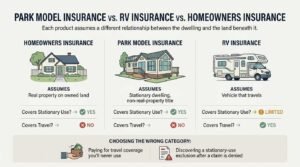
Park model insurance, RV insurance, and homeowners insurance each assume a different relationship between the dwelling and the land beneath it. The comparison below clarifies where each product fits.
| Policy Type | Assumes | Covers Stationary Use? | Covers Travel? |
| Homeowners insurance | Real property on owned land | Yes | No |
| RV insurance | Vehicle that travels | Limited | Yes |
| Park model insurance | Stationary dwelling, non-real-property title | Yes | No |
Choosing the wrong category typically means either paying for travel coverage you’ll never use or discovering a stationary-use exclusion after a claim is denied.
Insurance Requirements for Park Model Communities and Land Leases
Most park model communities and land lease agreements require proof of liability insurance before allowing a buyer to place their home on-site. Some communities set minimum coverage amounts in the lease contract itself, making insurance a prerequisite rather than an optional add-on.
Buyers should request the community’s specific insurance requirements before finalizing a lease, since gaps here can delay move-in even after financing is approved.
How to Choose the Right Insurance Provider
Selecting a park model insurance provider comes down to matching the insurer’s product specifically to this home category rather than assuming a general policy will work.
- Confirm the insurer explicitly covers park model homes, not just RVs or manufactured housing
- Compare replacement cost versus actual cash value terms
- Ask about wildfire and flood exclusions relevant to California locations
- Review bundling options for liability, contents, and additional living expense
- Check the insurer’s claims process and average response time
Common Financing and Insurance Mistakes to Avoid
Buyers repeatedly run into the same avoidable problems when financing and insuring a park model home.
- Assuming a conventional mortgage will be available before confirming classification
- Skipping HCD registration verification in California, which can stall financing
- Underinsuring contents when using the home as a full-time residence
- Not confirming a community’s minimum insurance requirements before signing a lease
- Comparing only one lender’s rate instead of shopping chattel, RV, and dealer options
How Builder Quality Affects Financing and Insurance Approval
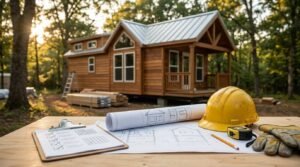
Builder quality directly influences both financing and insurance approval, because lenders and insurers assess construction standards, materials, and certifications when underwriting a park model home. A home built to recognized ANSI A119.5 standards with documented craftsmanship tends to appraise higher and insure more easily than one with unclear construction history.
Buyers working with an established, transparent builder generally move through both approval processes faster, since lenders and insurers have fewer unknowns to underwrite around.
Conclusion
Financing and insuring a park model home means navigating chattel loans, RV-style products, and specialized coverage built around a unique classification. California adds its own layer through Title 25 and HCD registration requirements.
Understanding these paths now prevents costly surprises during purchase and ownership, and connects directly to the construction quality decisions that shape long-term value.
We build park model homes with the craftsmanship and documentation that make financing and insurance approval smoother. Reach out to Tiny Home Builders California to start your project with confidence.
Frequently Asked Questions
Can you finance a park model home for 30 years?
No, park model home loans rarely extend to 30 years. Most chattel and RV-style loans cap terms between 10 and 20 years due to depreciation assumptions.
Is it hard to get a loan for a park model home?
It can be harder than a conventional mortgage because most lenders classify park models as personal property. Buyers with good credit and a clear land situation typically find approval manageable.
Do park model homes qualify for FHA or VA loans?
Generally, no, because FHA and VA loans require real property classification that most park model homes don’t meet. Some land-home arrangements on owned, permanently affixed sites may qualify in rare cases.
How much does it cost to insure a park model home?
Park model insurance typically costs several hundred to over a thousand dollars annually, depending on location, size, and coverage level. Wildfire-prone California regions often see higher premiums.
Does homeowners insurance cover park model homes?
Standard homeowners insurance usually does not cover park model homes due to their personal property classification. Specialized park model policies are built specifically to fill this gap.
What credit score do you need to finance a park model home?
Most lenders require a minimum credit score between 620 and 650 for park model financing. Scores above 700 typically unlock better rates and lower down payment requirements.
Can you finance a park model home on leased land?
Yes, chattel and RV-style loans are specifically designed for park model homes on leased land. Lenders in this case secure the loan against the home itself rather than the land.