
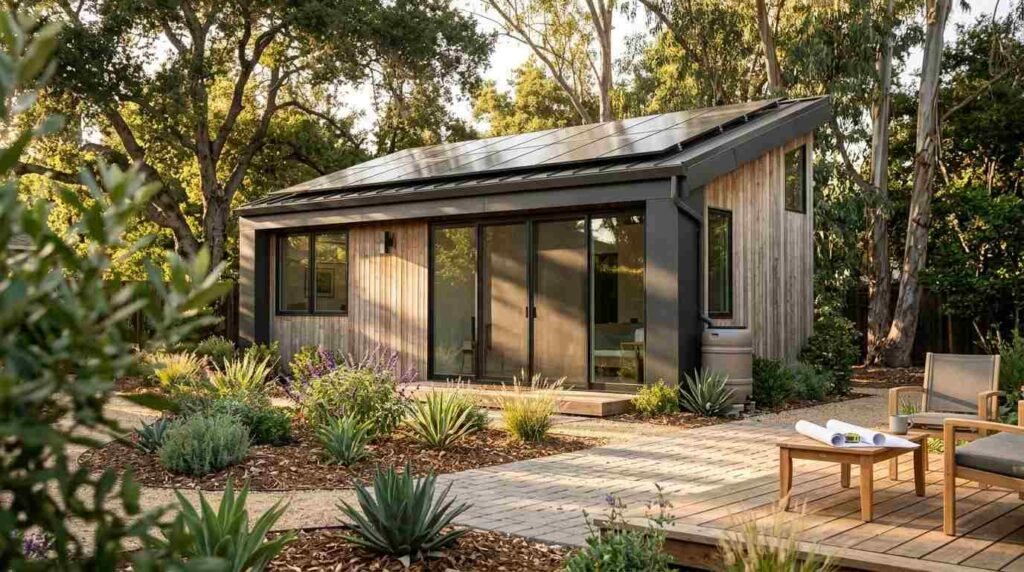
A sustainable ADU is a secondary dwelling built to minimize environmental impact through efficient materials, water conservation, and renewable energy systems. Homeowners across California are choosing eco-friendly ADU design because it cuts long-term utility costs while meeting increasingly strict state energy codes. I’ve watched this shift happen fast over the past few years, and it isn’t a trend that’s fading anytime soon.
Building an ADU without sustainability in mind creates a home that costs more to run and ages faster against California’s climate demands. Energy prices keep climbing, and buyers now expect efficient systems as a baseline, not a bonus. Getting this right from the design phase saves money and headaches later.
I walk through the foundations of sustainable ADU design and site planning first, then move into materials and energy performance, water conservation, and construction methods that reduce waste. From there, I cover the certifications and cost factors that determine long-term value, and I close with what to look for in a builder who actually understands sustainable construction.
What Makes an ADU Sustainable and Eco-Friendly
A sustainable ADU is a small residential structure designed to reduce energy use, conserve water, and minimize environmental impact across its lifespan. That definition sounds simple, but the execution touches nearly every decision in the build.
I think about sustainability as three connected layers: how the home is sited, what it’s built from, and how it performs once someone moves in. Miss one layer and the other two can’t fully compensate.
Core Sustainability Principles in ADU Design
Every sustainable ADU rests on a few non-negotiable principles. Energy efficiency, water conservation, material responsibility, and indoor air quality all work together rather than as separate checkboxes.
I always tell clients to think about the building envelope first. A tight, well-insulated envelope makes every other efficiency measure work harder and cost less to maintain.
How Sustainable ADUs Differ from Standard ADUs
A standard ADU meets minimum code requirements. A sustainable one exceeds them on purpose, often targeting performance 20% to 30% beyond Title 24 baseline requirements.
The difference shows up in the details. Better windows, tighter air sealing, smarter orientation, and higher-efficiency mechanical systems all separate a sustainable build from a purely code-compliant one.
Sustainable Site Planning and Orientation for ADUs
Site planning happens before a single wall goes up, and it’s one of the cheapest ways to boost long-term performance. Get the orientation wrong, and you’re fighting the sun for the life of the building.
I’ve seen ADUs on the same lot perform completely differently based purely on which direction the main glazing faces. This step costs nothing extra to plan correctly.
Solar Orientation and Passive Design Strategy
Orienting the ADU’s longest wall to face south captures winter sun for passive heating while allowing for shading strategies that block excess summer heat. This single decision affects heating and cooling loads more than most equipment upgrades.
I look at the sun path across the actual lot, not just a generic compass direction. Shade from existing trees or neighboring structures changes the calculation completely.
Lot Placement and Natural Ventilation Planning
Good lot placement takes advantage of prevailing breezes to support natural cross-ventilation, reducing dependence on mechanical cooling. This matters even more in California’s inland valleys, where summer temperatures push cooling systems hard.
I plan window placement to create airflow paths through the unit. It’s a small design choice that changes how the home feels in August.
Eco-Friendly Building Materials for ADUs
Material selection determines the embodied carbon of an ADU before it ever consumes a kilowatt of energy. This part of the process gets overlooked because it’s less visible than solar panels or smart thermostats.
I choose materials based on durability, sourcing, and how they perform over decades, not just what looks good on day one.
Sustainably Sourced Framing and Structural Materials
FSC-certified lumber and engineered wood products reduce deforestation impact while maintaining the structural performance builders need. The World Green Building Council reports that buildings and construction account for 37% of global energy-related carbon emissions, which makes material sourcing decisions carry real weight.
I specify engineered framing where it makes sense because it uses wood fiber more efficiently than traditional dimensional lumber. It also tends to be straighter and more dimensionally stable.
Low-Impact Insulation and Finishing Materials
Insulation made from recycled denim, cellulose, or mineral wool performs as well as traditional fiberglass while carrying a lower environmental footprint. Finishes matter here too, since low-VOC paints and sealants protect indoor air quality.
I pay close attention to what goes into the walls, not just what’s visible. What you can’t see ends up mattering the most for long-term health and performance.
Energy-Efficient Systems for Sustainable ADUs
The mechanical systems inside an ADU determine most of its ongoing energy consumption. This is where the biggest long-term savings actually live.
I treat HVAC and energy system selection as a core design decision, not an afterthought bolted on after the layout is finalized.
High-Performance HVAC and Heat Pump Systems
Heat pump systems move heat rather than generate it, which makes them two to four times more efficient than traditional gas furnaces, according to the U.S. Department of Energy. California’s climate suits heat pumps particularly well since they handle both heating and cooling from a single system.
I recommend ductless mini-split heat pumps for most ADUs because they eliminate duct losses entirely. Smaller footprints mean less equipment and less energy waste.
Solar Panels and Renewable Energy Integration
Rooftop solar paired with battery storage lets an ADU generate and store its own power, cutting grid dependence significantly. California’s building code increasingly expects new construction to plan for solar readiness even when panels aren’t installed immediately.
I design roof structures with solar loading in mind from the start. Retrofitting solar onto a roof that wasn’t planned for it costs more and looks like an afterthought.
Water Conservation Strategies in ADU Design
Water use matters just as much as energy use in California’s drought-prone climate. A sustainable ADU treats water as a resource to manage carefully, not something that flows in and out unnoticed.
I build water efficiency into the plumbing plan from day one rather than adding fixtures as a last-minute upgrade.
Low-Flow Fixtures and Greywater Systems
WaterSense-labeled fixtures reduce water use by roughly 20% compared to standard fixtures without sacrificing performance. Greywater systems take it further by recycling water from sinks and showers for irrigation.
I install greywater-ready plumbing even when the system itself gets added later. It’s far cheaper to rough in during construction than to retrofit afterward.
Rainwater Harvesting and Drought-Tolerant Landscaping
Rainwater collection systems capture roof runoff for irrigation use, reducing reliance on municipal water during dry months. Pairing this with drought-tolerant landscaping cuts outdoor water use dramatically.
I design gutters and downspouts with harvesting in mind from the start. It’s a simple addition that pays off every summer.
Passive Design Principles for Eco-Friendly ADUs
Passive design uses the building’s own form and materials to manage temperature and light before mechanical systems ever kick in. This reduces energy demand at the source rather than compensating for a poorly designed structure.
I think of passive strategies as the foundation everything else builds on top of.
Natural Lighting and Thermal Mass Strategy
Strategic window placement brings in daylight while thermal mass materials like concrete or tile absorb heat during the day and release it slowly at night. This reduces both lighting and heating loads simultaneously.
I balance window size against solar gain carefully. Too much south-facing glass without shading turns a sunny room into an oven by afternoon.
Insulation Envelope and Air Sealing Performance
A continuous, well-sealed insulation envelope is the single most cost-effective sustainability measure in ADU construction. Air leaks waste more energy than most homeowners realize, since conditioned air simply escapes through gaps.
I test envelope performance with a blower door test whenever possible. It’s the only way to actually confirm the sealing worked as designed.
Sustainable ADU Construction Methods and Waste Reduction
How an ADU gets built matters almost as much as what it’s built from. Construction methods that reduce waste and improve precision cut both environmental impact and cost overruns.
I favor methods that minimize on-site waste and maximize material efficiency wherever the project allows for it.
Prefab and Modular Construction Benefits
Prefabricated and modular ADU construction happens in a controlled factory environment, which reduces material waste and weather-related delays. Precision manufacturing also tightens tolerances that are harder to achieve with fully on-site builds.
I see modular methods work especially well for standardized ADU floor plans. The repeatable process keeps quality consistent from unit to unit.
Construction Waste Diversion Practices
Waste diversion programs redirect construction debris away from landfills toward recycling and reuse. Many California jurisdictions now require diversion rates of 65% or higher on new construction projects.
I work with builders who track and report diversion rates transparently. It’s a simple metric that reveals a lot about how seriously a builder takes sustainability.
Green Building Certifications and Standards for ADUs
Certifications give homeowners a measurable way to verify sustainability claims instead of relying on marketing language alone. They also often unlock rebates and incentives that offset upfront costs.
I encourage clients to understand these standards even if they don’t pursue formal certification, because the underlying requirements shape smart design decisions either way.
Title 24 Compliance and California Energy Code
Title 24 sets California’s mandatory energy efficiency standards for all new residential construction, including ADUs. The California Energy Commission updates these standards periodically to push efficiency requirements higher over time.
I make sure every plan I review meets current Title 24 requirements as a baseline, not a stretch goal. It’s the legal floor, and sustainable design should sit well above it.
LEED, GreenPoint Rated, and Other Certifications
GreenPoint Rated is a California-specific green building certification that evaluates energy, water, materials, and indoor air quality performance. LEED certification offers a nationally recognized alternative with similar evaluation categories.
I recommend GreenPoint Rated for most California ADU projects since it’s calibrated specifically to the state’s climate and building codes. It also tends to be more cost-accessible than full LEED certification for smaller structures.
Cost, ROI, and Long-Term Value of Sustainable ADU Design
Sustainable features carry an upfront cost premium, and I never pretend otherwise. The real conversation is about how quickly that premium pays for itself.
I walk clients through both the immediate budget and the multi-year return before they finalize a design.
Upfront Cost vs Long-Term Utility Savings
Sustainable ADU features typically add 5% to 15% to upfront construction costs but can reduce ongoing utility bills by 30% to 50% annually. Over a decade, those savings often exceed the initial premium entirely.
I run the numbers with clients using real utility rate data, not generic estimates. Seeing actual projected savings makes the upfront investment easier to justify.
Property Value and Rental Appeal of Green ADUs
Energy-efficient ADUs command stronger rental rates and resale value because tenants and buyers increasingly prioritize lower utility costs. A well-built sustainable ADU also tends to need fewer repairs over time, which protects long-term value.
I see this play out consistently with rental-focused ADU owners. Efficient units simply attract more serious, longer-term tenants.
Choosing a Builder for a Sustainable ADU Project
The builder you choose determines whether sustainable design intentions actually translate into a well-performing building. Plans on paper mean nothing without a construction team that executes them precisely.
I always push clients to vet builders specifically on sustainable construction experience, not just general ADU experience.
Questions to Ask About Sustainable Building Experience
Ask a builder directly how many sustainable or high-performance ADUs they’ve completed and request references from those specific projects. A builder who can’t answer clearly probably hasn’t done much of this work.
I also ask about their blower door test results on past projects. Numbers don’t lie the way marketing brochures sometimes do.
Evaluating Builder Transparency and Green Credentials
A transparent builder shares material specifications, energy modeling results, and certification documentation without being asked twice. Vague answers about “eco-friendly practices” without specifics are a warning sign.
We built our process around this kind of transparency because homeowners deserve to see exactly what they’re paying for. Every material choice and system spec gets documented clearly from the start.
Conclusion
Sustainable ADU design connects site planning, materials, energy systems, and construction methods into one coherent, high-performing home. Each layer reinforces the others, and skipping one weakens the entire structure’s long-term value.
California’s climate and energy codes make sustainable design a practical necessity, not an optional upgrade. The right choices now pay off for decades.
We build sustainable ADUs with transparency and long-term performance in mind. Reach out to Tiny Home Builders California to start planning a home that delivers lasting value.
Frequently Asked Questions
What makes an ADU sustainable?
A sustainable ADU minimizes environmental impact through efficient materials, water conservation, and renewable energy systems. It exceeds minimum code requirements rather than just meeting them.
Do sustainable ADUs cost more to build?
Sustainable features typically add 5% to 15% to upfront construction costs. Those costs are usually offset within a decade through reduced utility bills.
What certification should a California ADU pursue?
GreenPoint Rated works well for most California ADU projects since it’s calibrated to the state’s specific climate and codes. LEED offers a nationally recognized alternative for those wanting broader recognition.
How much energy can a sustainable ADU save?
Sustainable design features can reduce ongoing utility bills by 30% to 50% annually compared to standard construction. Savings depend heavily on climate zone and system choices.
Is solar required on new ADUs in California?
California code increasingly requires new residential construction to plan for solar readiness, though exact requirements vary by jurisdiction. I recommend designing roof structures for solar loading regardless of current mandates.
What is Title 24 and why does it matter for ADUs?
Title 24 sets California’s mandatory energy efficiency standards for all new residential construction, including ADUs. Every sustainable design should meet this as a baseline, not a stretch goal.
How do I know if a builder has real sustainable construction experience?
Ask directly how many sustainable ADUs they’ve completed and request references from those specific projects. A transparent builder shares energy modeling results and material specifications without hesitation.
Do greywater systems work well in an ADU?
Greywater systems recycle water from sinks and showers for irrigation, reducing overall water consumption. I recommend roughing in greywater-ready plumbing during construction even if the full system gets added later.
What’s the biggest factor in ADU energy efficiency?
A continuous, well-sealed insulation envelope is the single most cost-effective sustainability measure. It affects heating, cooling, and overall comfort more than any single mechanical upgrade.


