
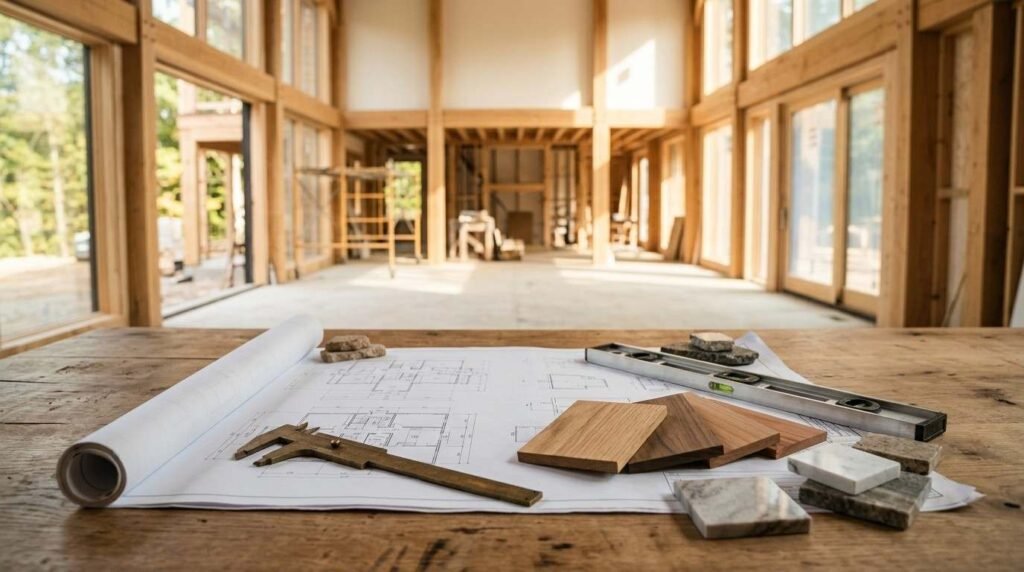
Picking the wrong builder costs more than money. The right custom home builder gets vetted on licensing, craftsmanship standards, material specifications, and warranty terms before a single contract gets signed. I’ve watched families skip this vetting and pay for it years later in cracked foundations and voided warranties.
A custom home is likely the largest investment you’ll ever make, and the builder you hire determines whether that investment holds up. Poor construction choices surface slowly in energy bills, in maintenance costs, in resale value. The gap between an average builder and a great one shows up ten years down the road, not on move-in day.
I break this down into five areas that matter most: the builder’s legal and professional standing, how they handle construction quality and materials, how transparent they are with process and pricing, what happens after the check clears through warranty support, and how to spot red flags before you commit. Each section gives you specific questions to ask.
Why the Builder You Choose Determines Your Home’s Long-Term Value
I’ve seen two homes built on the same street, with nearly identical floor plans, age five years apart in completely different ways. One still looks new. The other has settling cracks, a warped deck, and an HVAC system that never quite kept up.
The difference wasn’t the architect. It was the builder, the person who decided how deep the footings went, which framing lumber grade to use, and whether the crew doubled-checked flashing details around every window.
Construction quality is not something you can fully see at a walkthrough. A lot of what makes a house perform well for thirty years is buried behind drywall, poured into a foundation, or wrapped around a water heater. That’s exactly why the vetting process matters more than the finished model home tour.
Home construction quality is the measurable standard of materials, workmanship, and building practices used to construct a residence that determines its durability, safety, and performance over time. It’s not a feeling. It’s inspections, material grades, and code compliance.
I structured this guide around 15 specific questions, grouped into five practical areas. Ask them in order, and you’ll have a clear comparison between builders by the time you’re done not a gut feeling, but an actual scorecard.
Question 1-3 – Licensing, Insurance, and Legal Standing
Before I look at a single portfolio photo, I check paperwork. It’s unglamorous, and it’s the fastest way to eliminate a builder who shouldn’t be on your list at all.
Question 1: Are you licensed to build in this specific jurisdiction, and can I verify that license?
Every state runs its own contractor licensing board, and California’s Contractors State License Board lets anyone search a license number in under a minute. A legitimate builder gives you that number without hesitation. Someone who deflects or gets vague about “working with a licensed partner” is telling you they aren’t the one holding the license.
Question 2: What insurance coverage do you carry, and can I get certificates naming me as an additional insured?
General liability and workers’ compensation insurance protect you from lawsuits if a worker gets injured on your property or if the builder damages a neighbor’s fence during construction. I ask for the actual certificate, not a verbal confirmation. A builder without current coverage is a liability you’re personally exposed to.
Question 3: How long have you held this license, and has it ever been suspended or disciplined?
License history reveals patterns. A suspension for unpermitted work or unresolved consumer complaints tells you something a glossy brochure never will. This information is public record and worth the ten minutes it takes to pull it.
Question 4-5 – Experience, Portfolio, and Local Track Record
Licensing tells you a builder can legally operate. It doesn’t tell you if they’re good. That’s where portfolio and track record come in.
Question 4: Can I see three completed homes similar in scope to mine, and can I talk to those homeowners directly?
Photos get staged. A five-year-old home that’s still holding up tells you more than a freshly finished one. I always ask to see something that’s weathered a few winters, and I always ask for the homeowner’s contact information, not just a written testimonial the builder selected.
Question 5: How many homes like mine have you built in this specific region, and what regional challenges have you handled?
Soil composition, seismic requirements, and climate demands shift dramatically across California. A builder experienced in coastal fog-belt construction may not know how to handle inland heat expansion or foothill grading requirements. Regional experience isn’t a nice-to-have. It’s the difference between a foundation engineered for local conditions and one that wasn’t.
Question 6-7 – Craftsmanship Standards and Quality Control Process
This is where I separate builders who talk about quality from builders who actually enforce it on-site.
Question 6: What is your quality control process during each construction phase, and who performs those inspections?
A builder with a real quality system has documented checkpoints framing inspection before drywall, waterproofing verification before siding, electrical rough-in review before insulation. Ask who signs off at each stage. If the answer is vague, the process is probably informal at best.
Question 7: What craftsmanship standards do your subcontractors follow, and how do you vet them?
Most builders don’t swing hammers themselves. They manage subcontractors, and the quality of those subs determines the quality of your home. I want to know how long the builder has worked with their electrician, their framer, their finish carpenter. Long-standing relationships with skilled subs usually produce more consistent results than a rotating cast of the cheapest available crew.
Question 8 – Building Materials and Construction Specifications
Materials are where corners get cut invisibly. A buyer walking through a model home can’t tell the difference between code-minimum lumber and a higher grade, but the house tells the difference over the next twenty years.
Question 8: What specific material grades and brands do you use for framing, insulation, roofing, and windows, and will you put that in writing?
I want line-item specifics, not “quality materials,” but actual product names and grades. The National Association of Home Builders has documented that material selection accounts for a significant share of long-term maintenance costs, and vague material commitments in a contract are one of the most common sources of disputes after the fact.
Get it in writing. A written materials list protects you if a builder tries to substitute a cheaper product mid-project to protect their margin.
Question 9 – Energy Efficiency and Long-Term Home Performance

Energy performance isn’t a bonus feature anymore. It’s a measurable construction outcome that affects your monthly costs for decades.
Question 9: What energy efficiency standards does this home meet, and how do you verify performance after construction?
California’s Title 24 energy code sets a mandatory baseline, but “meeting code” and “built for genuine efficiency” are different things. The U.S. Department of Energy notes that building envelope quality, insulation continuity, air sealing, and window performance have as much impact on energy use as the mechanical systems themselves.
A builder who talks about blower door testing, duct sealing verification, or third-party energy modeling is thinking about performance, not just compliance. That’s the builder whose homes cost less to run in year one and year twenty.
Question 10-11 – Project Management, Timelines, and Communication
Even a technically skilled builder can make a project miserable if the process is disorganized. I’ve talked to homeowners who loved their finished house and still wouldn’t hire the same builder again because of how chaotic the build felt.
Question 10: What does your typical project timeline look like, and what has caused delays on past projects?
Every builder has faced delays: weather, permit backlogs, material shortages. I’m not looking for a builder who claims a perfect record. I’m looking for one who’s honest about what’s gone wrong and what they changed because of it.
Question 11: How often will I receive updates, and who is my single point of contact throughout construction?
A defined communication cadence, whether it’s weekly check-ins or a shared project dashboard, tells me the builder runs an organized operation. “We’ll call you when something comes up” is not a communication plan.
Question 12-13 – Pricing Transparency, Contracts, and Change Orders
Money conversations reveal more about a builder’s integrity than almost any other question on this list.
Question 12: Is your bid a fixed price, cost-plus, or a hybrid, and what exactly is included versus excluded?
Fixed-price contracts protect you from surprise overages, but they only work if the scope is detailed. Cost-plus contracts offer more flexibility but shift more risk onto you. Either structure can work well. What matters is whether every line item is spelled out instead of buried under “allowances” that get revealed later.
Question 13: How do you handle change orders, and what’s your markup on changes made mid-project?
Change orders are where budgets balloon. I want a builder who documents every change in writing, with cost and timeline impact stated before work proceeds, not after.
Question 14-15 – Warranty Coverage and Post-Construction Support
A great build should hold up. A great builder stands behind it in writing.
Question 14: What warranty do you provide, and what specifically is and isn’t covered?
Structural warranties, workmanship warranties, and manufacturer warranties on appliances and systems all operate differently. I ask for the actual warranty document, not a verbal summary, because coverage gaps hide in the fine print.
Question 15: What happens if I find a problem six months or two years after move-in?
A builder’s answer here tells you everything about their post-construction philosophy. The good ones have a defined process: a walkthrough at 30 days, another at 11 months before the warranty year closes, and a clear phone number that still gets answered after final payment.
Red Flags That Signal a Builder Will Compromise on Quality
Some warning signs show up before you ever sign a contract. I’ve learned to treat these as disqualifiers, not minor concerns.
A builder who pressures you to sign quickly, who can’t produce a license number without delay, or who refuses to put material specifications in writing is telling you how the rest of the project will go. Vague answers during vetting turn into vague answers during construction.
Watch for bids that come in dramatically lower than every other quote. That gap usually gets made up somewhere: thinner materials, rushed subcontractors, or corners cut in places you won’t see until years later.
How to Compare Builder Answers and Make Your Final Decision

Once you’ve asked all 15 questions to two or three builders, put the answers side by side. Patterns emerge fast when you compare them directly instead of relying on memory.
I weigh craftsmanship and material transparency heaviest, because those decisions get locked into the walls before you ever move in. Pricing matters, but the lowest bid rarely wins once you account for what it’s missing.
Choose the builder whose answers were specific, documented, and consistent across every question, not the one who sounded the most confident in the sales meeting.
Conclusion
Fifteen questions separate an informed decision from an expensive guess. Licensing, materials, and warranty terms reveal what a sales pitch never will.
Construction quality shows up years later, in energy bills and structural integrity, long after the contract’s signed. The builder you choose today writes that outcome.
We build homes at Tiny Home Builders California with the transparency this guide asks you to demand. Contact us to see how our process holds up to these same 15 questions.
Frequently Asked Questions
What is the most important question to ask a custom home builder?
Licensing verification matters most because it’s the fastest disqualifier. An unlicensed or disciplined builder shouldn’t advance to material or pricing discussions at all.
How many builders should I interview before choosing one?
I recommend interviewing at least three builders using the same 15 questions. This gives you enough comparison data to spot inconsistencies and confirm which answers are industry-standard versus genuinely exceptional.
What’s the difference between a fixed-price and cost-plus contract?
A fixed-price contract locks in one total cost regardless of changes to labor or material pricing. A cost-plus contract bills actual costs plus a builder fee, offering flexibility but less budget certainty upfront.
How do I verify a contractor’s license in California?
Search the contractor’s license number directly through the California Contractors State License Board website. The lookup tool shows license status, classification, bond information, and any disciplinary history in seconds.
What warranty should a custom home builder provide?
A reputable builder provides a structural warranty, a workmanship warranty covering finishes and systems, and passes through manufacturer warranties on appliances. Ask for these documents in writing before signing.
How can I tell if a builder is cutting corners on materials?
Request a written, itemized materials list naming specific brands and grades for framing, insulation, roofing, and windows. Vague terms like “quality materials” without specifics often signal flexibility to substitute cheaper products later.
Why does regional building experience matter for custom homes?
Soil conditions, seismic codes, and climate demands vary significantly across regions. A builder unfamiliar with local conditions may design or construct in ways that don’t account for site-specific engineering requirements.
What should I do if I find a construction issue after moving in?
Contact your builder immediately and reference your warranty documentation. Reputable builders schedule follow-up walkthroughs at 30 days and near the one-year mark specifically to catch and address these issues.


